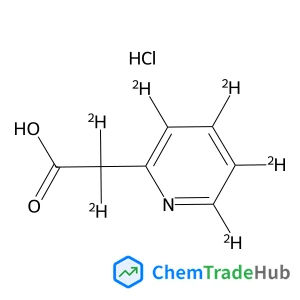
2,2-dideuterio-2-(3,4,5,6-tetradeuterio-2-pyridyl)acetic acid;hydrochloride
CAS Number:
1329799-67-8
Molecular Formula:
C7H2ClD6NO2
Ning Zhu, Xin Hu, Yajun Zhang, Kai Zhang, Zhenjiang Li, Kai Guo
A green, highly effective and energy-saving route to the grafting modification of polymers was developed via continuous flow single electron transfer living radical polymerization (SET-LRP) in a copper tubular reactor. Polymerizations of methyl methacrylate and acrylonitrile in the presence of poly(vinylidene fluoride-co-chlorotrifluoroethylene) as the macroinitiator were used as model investigation systems. Significant benefits were achieved in the continuous flow mode compared to a batch reactor including diminished inconsistent induction times and suppressed “hot spot” effects. Furthermore, accelerated reaction rates, lower reaction temperatures and decreased ligand feed concentrations were observed by utilizing the copper tubular reactor. The structures of the modified P(VDF-co-CTFE) graft copolymers were characterized using 1H NMR, 19F NMR, FT-IR, and SEC.
Prajal Chettri, Kalathur Mohan Ganesh, Sahashransu Satyajeet Mahapatra, A. S. Vishwanathan, Shailesh Srivastava
DOI: 10.1039/D3AY01612A
Ali Nematollahzadeh
DOI: 10.1039/D3AY01160G
Arina S. Ivkina, Mikhail V. Zyuzin, Sergei A. Shipilovskikh
DOI: 10.1039/D3BM01651J
Rhona M. Cowan, Eleanor Birch, Grace Nisbet, Chimaeze Onyeiwu, Clare Campbell, Ian Archer, Dominic J. Campopiano
DOI: 10.1039/D3AY01433A
Siyi Li, Qinglin Wang, Yingying Ren, Pengtao Bao, Shanyue Guan, Xiaochen Qiu
DOI: 10.1039/D3BM01514A
Wenyao Liang, Zemin Xia, Jianhua Tan
DOI: 10.1039/D3AY01553J
Jose Lucena Barbosa, Jr, Mohammed Kamruzzaman, Douglas Fernandes Barbin
DOI: 10.1039/D3AY01192E
Jiahao Shen, Junli Liu, Xiuyi Fan, Hui Liu, Yan Bao, AiPing Hui, Hafiz Akif Munir
DOI: 10.1039/D3BM01030A
Emmanuvel Arputharaj, Shivangi Singh, Raghavendra Rao Pasupuleti, Chun-An Kuo, Wei-Jyun Ya, Yu-Hui Huang, You-Rong Wu
DOI: 10.1039/D3AY01312J
Minli Qiu, Jun Cheng, Huajun Zhou, Feihu Che, Yan Hu, Yinghui He, Yuzhu Dai, Yingjie Zhang
DOI: 10.1039/D3AY01246H
4-Nitrophenyl phosphate disodium salt hexahydrate is primarily used as a substra...
2-(Trifluoromethyl)-1,3-oxazole-4-carboxylic Acid (CAS: 1060816-01-4) is widely ...
2-Fluoro-4-biphenylcarboxylic acid should be stored in a cool, dry place at room...
Prednisolone-21-Carboxylic Acid is primarily used in the pharmaceutical industry...
4-(Hydrazinomethyl)-1,2,3-benzenetriol (CAS: 3614-72-0) should be stored in a co...
4-Amino-1-methyl-1H-pyrazole-5-carboxylic acid hydrochloride (CAS: 92534-70-8) i...
Dehydropachymic acid (CAS: 77012-31-8) is regulated by various agencies. It fall...
The market and research trends for 6-[(2,2-Dimethylpropanoyl)amino]nicotinic aci...
1,10-Phenanthroline-2,9-dicarbaldehyde should be stored in a cool, dry place awa...
5-Carbamoyl-11-oxo-10,11-dihydro-5H-dibenzo[b,f]azepin-10-yl acetate can be synt...

Polymer Chemistry welcomes submissions in all areas of polymer science that have a strong focus on macromolecular chemistry. Manuscripts may cover a broad range of fields, yet no direct application focus is required.