












Enhancement of the crosslink density, glass transition temperature, and strength of epoxy resin by using functionalized graphene oxide co-curing agents
Literature Information
Publication Date
2015-11-03
DOI
10.1039/C5PY01483B
Impact Factor
5.582
Authors
Jin Jung, Yong-Mun Choi, Jae Hun Choi, Jaesang Yu, Jae Kwan Lee, Nam-Ho You, Munju Goh
View Original
Abstract
We synthesized diamine-functionalized graphene oxide, DDS–GO and HMDA–GO, by introducing 4,4′-diaminodiphenyl sulfone (DDS) or hexamethylenediamine (HMDA) into the carboxylic acid groups on graphene oxide (GO) via amide bonds. The introduction of diamines was confirmed by analytical methods such as FT-IR, TG-DTA, XPS, AFM, and optical microscopy. Then, we applied DDS–GO and HMDA–GO as co-curing agents for epoxy (EP) nanocomposites that were prepared by mixing bisphenol-A type EP and DDS curing agent (ca. 21 wt%). Interestingly, when 1.0 wt% of DDS–GO was added to the EP/DDS mixture, the crosslink density (CD) increased from 0.028 to 0.069 mol cm−3. Due to the higher CD, both the glass transition temperature and tensile strength of the EP/DDS/DDS–GO nanocomposite effectively improved from 160.7 °C to 183.4 °C and from 87.4 MPa to 110.3 MPa, respectively.
Related Literature
Electrochemical tuning of capacitive response of graphene oxide
Sanjin J. Gutić, Dževad K. Kozlica, Fehim Korać, Danica Bajuk-Bogdanović, Miodrag Mitrić, Vladimir M. Mirsky, Igor A. Pašti
2018-08-07
Paper
DOI: 10.1039/C8CP03631D
Counteraction of denaturant-induced protein unfolding is a general property of stabilizing agents
Serena Cozzolino, Rosario Oliva, Giuseppe Graziano, Pompea Del Vecchio
2018-11-07
Paper
DOI: 10.1039/C8CP04421J
Impact of pore size, interconnections, and dynamic conductivity on the electrochemistry of vanadium pentoxide in well defined porous structures
Nam Kim, Emily Sahadeo, Chanyuan Liu, Olivia Rose
2018-11-21
Paper
DOI: 10.1039/C8CP04706E
van der Waals interaction-induced photoluminescence weakening and multilayer growth in epitaxially aligned WS2
Hyun Goo Ji, Mina Maruyama, Adha Sukma Aji, Susumu Okada, Kazunari Matsuda
2018-11-07
Paper
DOI: 10.1039/C8CP04418J
Self-adaptive multiscaling algorithm for efficient simulations of many-protein systems in crowded conditions
2018-10-29
Paper
DOI: 10.1039/C8CP05517C
A synergetic stabilization and strengthening strategy for two-dimensional ordered hybrid transition metal carbides
Dominik Legut, Timothy C. Germann, Shiyu Du, Joseph S. Francisco
2018-11-16
Paper
DOI: 10.1039/C8CP06458J
Solvation of 2-(hydroxymethyl)-2,5,7,8-tetramethyl-chroman-6-ol revealed by circular dichroism: a case of chromane helicity rule breaking
Joanna E. Rode, Marcin Górecki, Stanisław Witkowski, Jadwiga Frelek
2018-08-15
Paper
DOI: 10.1039/C8CP02491J
Rate constants for collision-induced emission of O2(a1Δg) with He, Ne, Ar, Kr, N2, CO2 and SF6 as collisional partners
2018-11-15
Paper
DOI: 10.1039/C8CP06231E
Protonation-induced molecular permeation at the oil/water interface in an electric field
2018-09-15
Paper
DOI: 10.1039/C8CP04028A
You might also like
Compound Q&A
What are the main uses of 4-Nitrophenyl phosphate disodium salt hexahydrate (CAS: 333338-18-4)?
4-Nitrophenyl phosphate disodium salt hexahydrate is primarily used as a substra...
333338-18-44-Nitrophenyl phosph...
Compound Q&A
What are the main uses of 2-(Trifluoromethyl)-1,3-oxazole-4-carboxylic Acid (CAS: 1060816-01-4)?
2-(Trifluoromethyl)-1,3-oxazole-4-carboxylic Acid (CAS: 1060816-01-4) is widely ...
1060816-01-42-(Trifluoromethyl)-...
Compound Q&A
How should 2-Fluoro-4-biphenylcarboxylic acid (CAS: 137045-30-8) be stored?
2-Fluoro-4-biphenylcarboxylic acid should be stored in a cool, dry place at room...
137045-30-82-Fluoro-4-biphenylc...
Compound Q&A
What industries use Prednisolone-21-Carboxylic Acid (CAS: 61549-70-0)?
Prednisolone-21-Carboxylic Acid is primarily used in the pharmaceutical industry...
61549-70-0Prednisolone-21-Carb...
Compound Q&A
How should 4-(Hydrazinomethyl)-1,2,3-benzenetriol (CAS: 3614-72-0) be stored?
4-(Hydrazinomethyl)-1,2,3-benzenetriol (CAS: 3614-72-0) should be stored in a co...
3614-72-04-(Hydrazinomethyl)-...
Compound Q&A
What industries use 4-Amino-1-methyl-1H-pyrazole-5-carboxylic acid hydrochloride (CAS: 92534-70-8)?
4-Amino-1-methyl-1H-pyrazole-5-carboxylic acid hydrochloride (CAS: 92534-70-8) i...
92534-70-84-Amino-1-methyl-1H-...
Compound Q&A
What regulatory guidelines apply to dehydropachymic acid (CAS: 77012-31-8)?
Dehydropachymic acid (CAS: 77012-31-8) is regulated by various agencies. It fall...
77012-31-8Dehydropachymic acid
Compound Q&A
What is the market or research trend for 6-[(2,2-Dimethylpropanoyl)amino]nicotinic acid (CAS: 898561-66-5)?
The market and research trends for 6-[(2,2-Dimethylpropanoyl)amino]nicotinic aci...
898561-66-56-[(2,2-Dimethylprop...
Compound Q&A
How should 1,10-Phenanthroline-2,9-dicarbaldehyde (CAS: 57709-62-3) be stored?
1,10-Phenanthroline-2,9-dicarbaldehyde should be stored in a cool, dry place awa...
57709-62-31,10-Phenanthroline-...
Compound Q&A
How is 5-Carbamoyl-11-oxo-10,11-dihydro-5H-dibenzo[b,f]azepin-10-yl acetate (CAS: 113952-21-9) typically synthesized?
5-Carbamoyl-11-oxo-10,11-dihydro-5H-dibenzo[b,f]azepin-10-yl acetate can be synt...
113952-21-95-Carbamoyl-11-oxo-1...
Source Journal
Polymer Chemistry

CiteScore:
8.6
Self-citation Rate:
7.3%
Articles per Year:
457
Polymer Chemistry welcomes submissions in all areas of polymer science that have a strong focus on macromolecular chemistry. Manuscripts may cover a broad range of fields, yet no direct application focus is required.
Recommended Compounds
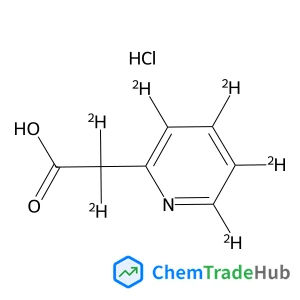
2,2-dideuterio-2-(3,4,5,6-tetradeuterio-2-pyridyl)acetic acid;hydrochloride
CAS Number:
1329799-67-8
Molecular Formula:
C7H2ClD6NO2

Recommended Suppliers




Disclaimer
This page provides academic journal information for reference and research purposes only. We are not affiliated with any journal publishers and do not handle publication submissions. For publication-related inquiries, please contact the respective journal publishers directly.
If you notice any inaccuracies in the information displayed, please contact us at support@chemtradehub.com. We will promptly review and address your concerns.