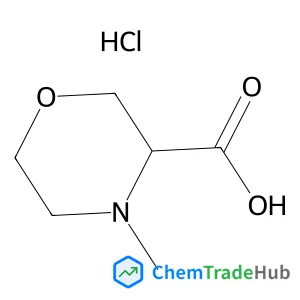
4-Methyl-3-morpholinecarboxylic acid hydrochloride (1:1)
CAS Number:
1240518-90-4
Molecular Formula:
C6H12ClNO3
S. Ponyrko, L. Matějka
High performance shape memory (SM) epoxy–silica nanocomposites have been synthesized. The structure of the corresponding SM polymer was designed on the basis of the determined relationships between structure, mechanical properties and SM performance. The recovery stress, as a crucial SM property of high performance systems, is governed by the material toughness while the efficiency of the SM performance is controlled by morphological homogeneity and viscoelastic behaviour of the polymer as well as by experimental conditions of the SM procedure. The nanocomposites were prepared by in situ generation of nanosilica in the epoxy matrix. A non-aqueous sol–gel procedure was applied and the ionic liquid (IL) was used in the synthesis as a multifunctional agent controlling morphology and mechanical properties. The effect of nanosilica, IL, crosslinking density of the epoxy network, physical crosslinking as well as the application of the concept of bimodal networks on SM performance was evaluated and discussed. Based on the knowledge of the corresponding relationships and structural effects the SM nanocomposite was synthesized showing the high recovery stress σr = 3.9 MPa or high deformability εb = 103%. The study contributed to the better understanding of the SM behaviour of polymers.
Yingying Li, Shan Gao, Yu Zhang, Zhijing He, Jianbo Ji, Xiaoye Yang, Lei Ye, Lixia Zhao
DOI: 10.1039/D3BM01349A
Zuolong Liu, Xianchi Zhou, Yongcheng Chen, Yanwen Ni, Zihao Zhu, Wenzhong Cao, Kexin Chen, Yu Yan
DOI: 10.1039/D3BM01783D
Greicy Kelly Cerqueira Caldas, Guilherme de Abreu Souza, Alan Silva de Menezes, Silma Regina Ferreira Pereira, Rita de Cássia Silva Luz, Flavio Santos Damos
DOI: 10.1039/D3AY01309J
Guoyun Wan, Xuheng Chen, Ruiling Gou, Chenguang Guan, Jiayu Chen, Qian Wang, Qiqing Zhang, Haijiao Wang
DOI: 10.1039/D3BM01627G
Chunyu Xie, Xiao Yang, Fan Zheng, Jiahao Shi, Caixia Huo, Zuyuan Wang, Bo Xiao, Lian Duan
DOI: 10.1039/D3BM01488F
Joanna Kowalska, Alicja Drwal, Klaudia Tutaj, Lidiia Kovshun, Beata Krasnodębska-Ostręga
DOI: 10.1039/D3AY01292A
Martina Banchelli, Sara Tombelli, Marella de Angelis, Cristiano D'Andrea, Cosimo Trono, Francesco Baldini, Ambra Giannetti, Paolo Matteini
DOI: 10.1039/D3AY01661G
4-Nitrophenyl phosphate disodium salt hexahydrate is primarily used as a substra...
2-(Trifluoromethyl)-1,3-oxazole-4-carboxylic Acid (CAS: 1060816-01-4) is widely ...
2-Fluoro-4-biphenylcarboxylic acid should be stored in a cool, dry place at room...
Prednisolone-21-Carboxylic Acid is primarily used in the pharmaceutical industry...
4-(Hydrazinomethyl)-1,2,3-benzenetriol (CAS: 3614-72-0) should be stored in a co...
4-Amino-1-methyl-1H-pyrazole-5-carboxylic acid hydrochloride (CAS: 92534-70-8) i...
Dehydropachymic acid (CAS: 77012-31-8) is regulated by various agencies. It fall...
The market and research trends for 6-[(2,2-Dimethylpropanoyl)amino]nicotinic aci...
1,10-Phenanthroline-2,9-dicarbaldehyde should be stored in a cool, dry place awa...
5-Carbamoyl-11-oxo-10,11-dihydro-5H-dibenzo[b,f]azepin-10-yl acetate can be synt...

Polymer Chemistry welcomes submissions in all areas of polymer science that have a strong focus on macromolecular chemistry. Manuscripts may cover a broad range of fields, yet no direct application focus is required.