












Controlled radical polymerization and in-depth mass-spectrometric characterization of poly(ionic liquid)s and their photopatterning on surfaces
Literature Information
Publication Date
2015-10-26
DOI
10.1039/C5PY01320H
Impact Factor
5.582
Authors
Birgit Huber, Vanessa Trouillet, Steffen M. Weidner, Leonie Barner, Peter W. Roesky, Jiayin Yuan
View Original
Abstract
The preparation and characterization of poly(ionic liquid)s (PILs) bearing a polystyrene backbone via reversible addition fragmentation chain transfer (RAFT) polymerization and their photolithographic patterning on silicon wafers is reported. The controlled radical polymerization of the styrenic ionic liquid (IL) monomers ([BVBIM]X, X = Cl− or Tf2N−) by RAFT polymerization is investigated in detail. We provide a general synthetic tool to access this class of PILs with controlled molecular weight and relatively narrow molecular weight distribution (2000 g mol−1 ≤ Mn ≤ 10 000 g mol−1 with dispersities between 1.4 and 1.3 for p([BVBIM]Cl); 2100 g mol−1 ≤ MP ≤ 14 000 g mol−1 for p([BVBIM]Tf2N)). More importantly, we provide an in-depth characterization of the PILs and demonstrate a detailed mass spectrometric analysis via matrix-assisted laser desorption ionization (MALDI) as well as – for the first time for PILs – electrospray ionization mass spectrometry (ESI-MS). Importantly, p([BVBIM]Cl) and p([DMVBIM]Tf2N) were photochemically patterned on silicon wafers. Therefore, a RAFT agent carrying a photoactive group based on ortho-quinodimethane chemistry – more precisely photoenol chemistry – was photochemically linked for subsequent controlled radical polymerization of [BVBIM]Cl and [DMVBIM]Tf2N. The successful spatially-resolved photografting is evidenced by surface-sensitive characterization methods such as X-ray photoelectron spectroscopy (XPS) and time-of-flight secondary ion mass spectrometry (ToF-SIMS). The presented method allows for the functionalization of diverse surfaces with poly(ionic liquid)s.
Related Literature
On site separation of inorganic forms of thallium and arsenic in sea water systems followed by ICP-MS determination
Joanna Kowalska, Alicja Drwal, Klaudia Tutaj, Lidiia Kovshun, Beata Krasnodębska-Ostręga
2023-11-06
Paper
DOI: 10.1039/D3AY01292A
Molecular beacon decorated silver nanowires for quantitative miRNA detection by a SERS approach
Martina Banchelli, Sara Tombelli, Marella de Angelis, Cristiano D'Andrea, Cosimo Trono, Francesco Baldini, Ambra Giannetti, Paolo Matteini
2023-10-27
Paper
DOI: 10.1039/D3AY01661G
Milk exosomes anchored with hydrophilic and zwitterionic motifs enhance mucus permeability for applications in oral gene delivery
Chenzhen Zhang, Hengli Zhang, Héctor A. Millán Cotto, Timothy L. Boyer, Matthew R. Warren, Chia-Ming Wang, Joshua Luchan, Pradeep K. Dhal, Rebecca L. Carrier, Ambika G. Bajpayee
2023-11-23
Paper
DOI: 10.1039/D3BM01089A
Facilely printed silk fibroin hydrogel microparticles as injectable long-lasting fillers
Chunyu Xie, Xiao Yang, Fan Zheng, Jiahao Shi, Caixia Huo, Zuyuan Wang, Bo Xiao, Lian Duan
2023-11-14
Paper
DOI: 10.1039/D3BM01488F
Simultaneous determination of 27 pesticides in corn and cow matrices by ultra-performance liquid chromatography-tandem mass spectrometry
Fengjiao Hao, Yuanyuan Luo, Fengshou Dong, Xinglu Pan, Xiaohu Wu, Yongquan Zheng, Jun Xu
2023-11-08
Paper
DOI: 10.1039/D3AY01473H
Cartilage regeneration using transforming growth factor-beta 3-loaded injectable crosslinked hyaluronic acid hydrogel
Ju Hwa Lee, Yun Chang Pyun, Jonggyu Park, Tae Woong Kang, Jin Sol Seo, Dae Hoon Lee
2023-12-13
Paper
DOI: 10.1039/D3BM01008B
Expression of concern: High cytotoxic activity of ZnO@leucovorin nanocomposite based materials against an MCF-7 cell model
Shereen Magdy Bazid, Shimaa Nabih, Md Ariful Ahsan
2023-11-21
Expression of Concern
DOI: 10.1039/D3AY90141F
You might also like
Compound Q&A
What are the main uses of 4-Nitrophenyl phosphate disodium salt hexahydrate (CAS: 333338-18-4)?
4-Nitrophenyl phosphate disodium salt hexahydrate is primarily used as a substra...
333338-18-44-Nitrophenyl phosph...
Compound Q&A
What are the main uses of 2-(Trifluoromethyl)-1,3-oxazole-4-carboxylic Acid (CAS: 1060816-01-4)?
2-(Trifluoromethyl)-1,3-oxazole-4-carboxylic Acid (CAS: 1060816-01-4) is widely ...
1060816-01-42-(Trifluoromethyl)-...
Compound Q&A
How should 2-Fluoro-4-biphenylcarboxylic acid (CAS: 137045-30-8) be stored?
2-Fluoro-4-biphenylcarboxylic acid should be stored in a cool, dry place at room...
137045-30-82-Fluoro-4-biphenylc...
Compound Q&A
What industries use Prednisolone-21-Carboxylic Acid (CAS: 61549-70-0)?
Prednisolone-21-Carboxylic Acid is primarily used in the pharmaceutical industry...
61549-70-0Prednisolone-21-Carb...
Compound Q&A
How should 4-(Hydrazinomethyl)-1,2,3-benzenetriol (CAS: 3614-72-0) be stored?
4-(Hydrazinomethyl)-1,2,3-benzenetriol (CAS: 3614-72-0) should be stored in a co...
3614-72-04-(Hydrazinomethyl)-...
Compound Q&A
What industries use 4-Amino-1-methyl-1H-pyrazole-5-carboxylic acid hydrochloride (CAS: 92534-70-8)?
4-Amino-1-methyl-1H-pyrazole-5-carboxylic acid hydrochloride (CAS: 92534-70-8) i...
92534-70-84-Amino-1-methyl-1H-...
Compound Q&A
What regulatory guidelines apply to dehydropachymic acid (CAS: 77012-31-8)?
Dehydropachymic acid (CAS: 77012-31-8) is regulated by various agencies. It fall...
77012-31-8Dehydropachymic acid
Compound Q&A
What is the market or research trend for 6-[(2,2-Dimethylpropanoyl)amino]nicotinic acid (CAS: 898561-66-5)?
The market and research trends for 6-[(2,2-Dimethylpropanoyl)amino]nicotinic aci...
898561-66-56-[(2,2-Dimethylprop...
Compound Q&A
How should 1,10-Phenanthroline-2,9-dicarbaldehyde (CAS: 57709-62-3) be stored?
1,10-Phenanthroline-2,9-dicarbaldehyde should be stored in a cool, dry place awa...
57709-62-31,10-Phenanthroline-...
Compound Q&A
How is 5-Carbamoyl-11-oxo-10,11-dihydro-5H-dibenzo[b,f]azepin-10-yl acetate (CAS: 113952-21-9) typically synthesized?
5-Carbamoyl-11-oxo-10,11-dihydro-5H-dibenzo[b,f]azepin-10-yl acetate can be synt...
113952-21-95-Carbamoyl-11-oxo-1...
Source Journal
Polymer Chemistry

CiteScore:
8.6
Self-citation Rate:
7.3%
Articles per Year:
457
Polymer Chemistry welcomes submissions in all areas of polymer science that have a strong focus on macromolecular chemistry. Manuscripts may cover a broad range of fields, yet no direct application focus is required.
Recommended Compounds
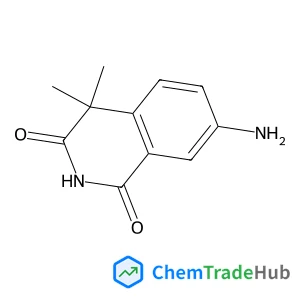
1,3(2H,4H)-Isoquinolinedione, 7-amino-4,4-dimethyl-
CAS Number:
14576-22-8
Molecular Formula:
C11H12N2O2

Recommended Suppliers






Disclaimer
This page provides academic journal information for reference and research purposes only. We are not affiliated with any journal publishers and do not handle publication submissions. For publication-related inquiries, please contact the respective journal publishers directly.
If you notice any inaccuracies in the information displayed, please contact us at support@chemtradehub.com. We will promptly review and address your concerns.