












Reductant-triggered rapid self-gelation and biological functionalization of hydrogels
Literature Information
Publication Date
2015-10-05
DOI
10.1039/C5PY01299F
Impact Factor
5.582
Authors
Dawei Chen, Dongxia Wu, Guochen Cheng, Hanying Zhao
View Original
Abstract
Hydrogels have found wide applications in many fields. Although plenty of mature preparation methodologies are available now, there is certainly a continuous impetus in developing new methods toward simplicity, adjustability and satisfying diverse emerging needs. In this paper, a novel and efficient approach for hydrogel preparation is proposed. Polyacrylamide (PAM) chains with pyridyl disulfide (PDS) side groups were synthesized by free-radical polymerization. Upon addition of a tiny amount of reductants to the aqueous solution of the synthesized copolymer, part of the PDS groups are reduced to free thiols, and the subsequent exchange reaction between thiol groups and PDS results in disulfide-crosslinked hydrogels. The rapid self-gelation process was monitored by in situ rheological measurements, and the network structures of the hydrogels were observed using a scanning electron microscope. It has been found that the mechanical properties and pore sizes of the hydrogels could be tuned by changing the polymer concentration and the amounts of the reductants added into the solution. The residual PDS groups in the hydrogels provide reaction sites for immobilization of biological functional molecules. Reduced glutathione and bovine serum albumin were successfully immobilized in the hydrogels, and the bioactivities of the hydrogels were measured in this research. The disulfide crosslinks are cleavable and the hydrogels are dissociated under reducing conditions, which indicates that the hydrogels may find potential applications in biological and medical fields.
Related Literature
A comparison of size exclusion chromatography-based tandem strategies for plasma exosome enrichment and proteomic analysis
H. H. Bai, X. F. Wang, B. Y. Zhang, W. Liu
2023-11-02
Paper
DOI: 10.1039/D3AY01704D
Milk exosomes anchored with hydrophilic and zwitterionic motifs enhance mucus permeability for applications in oral gene delivery
Chenzhen Zhang, Hengli Zhang, Héctor A. Millán Cotto, Timothy L. Boyer, Matthew R. Warren, Chia-Ming Wang, Joshua Luchan, Pradeep K. Dhal, Rebecca L. Carrier, Ambika G. Bajpayee
2023-11-23
Paper
DOI: 10.1039/D3BM01089A
3D bioprinting of GelMA with enhanced extrusion printability through coupling sacrificial carrageenan
Yudong Yao
2023-12-07
Paper
DOI: 10.1039/D3BM01489D
Molecular beacon decorated silver nanowires for quantitative miRNA detection by a SERS approach
Martina Banchelli, Sara Tombelli, Marella de Angelis, Cristiano D'Andrea, Cosimo Trono, Francesco Baldini, Ambra Giannetti, Paolo Matteini
2023-10-27
Paper
DOI: 10.1039/D3AY01661G
Detection of coca alkaloids in oral fluid from coca leaf (tea) consumers: using solid phase extraction to improve validation parameters and widen the detection window
I. Álvarez-Freire, P. Cabarcos-Fernández, N. C. Rubio, A. Moreda-Piñeiro, M. J. Tabernero-Duque, I. Sánchez-Sellero, P. Bermejo-Barrera, A. M. Bermejo-Barrera
2023-10-18
Paper
DOI: 10.1039/D3AY01298K
Covalent drugs based on small molecules and peptides for disease theranostics
Yin-Sheng Xu, Yingying Cui, Zeng-Ying Qiao
2023-11-08
Review Article
DOI: 10.1039/D3BM01138K
Preparation and characterization of iron(iii) nitrilotriacetate complex in aqueous solutions for quantitative protein binding experiments
Valentina Borko, Tomislav Friganović, Tin Weitner
2023-11-09
Technical Note
DOI: 10.1039/D3AY01261A
A stable ratiometric fluorescent probe for hypochlorous acid detection and rheumatoid arthritis evaluation
Liuwei Gu, Yinghao Li, Xiaojie Kong, Ke Zhang, Yuling Qin, Xiaobo Zhou, Haiwei Ji, Guo Li, Li Wu
2023-12-21
Communication
DOI: 10.1039/D3BM01576A
You might also like
Compound Q&A
What are the main uses of 4-Nitrophenyl phosphate disodium salt hexahydrate (CAS: 333338-18-4)?
4-Nitrophenyl phosphate disodium salt hexahydrate is primarily used as a substra...
333338-18-44-Nitrophenyl phosph...
Compound Q&A
What are the main uses of 2-(Trifluoromethyl)-1,3-oxazole-4-carboxylic Acid (CAS: 1060816-01-4)?
2-(Trifluoromethyl)-1,3-oxazole-4-carboxylic Acid (CAS: 1060816-01-4) is widely ...
1060816-01-42-(Trifluoromethyl)-...
Compound Q&A
How should 2-Fluoro-4-biphenylcarboxylic acid (CAS: 137045-30-8) be stored?
2-Fluoro-4-biphenylcarboxylic acid should be stored in a cool, dry place at room...
137045-30-82-Fluoro-4-biphenylc...
Compound Q&A
What industries use Prednisolone-21-Carboxylic Acid (CAS: 61549-70-0)?
Prednisolone-21-Carboxylic Acid is primarily used in the pharmaceutical industry...
61549-70-0Prednisolone-21-Carb...
Compound Q&A
How should 4-(Hydrazinomethyl)-1,2,3-benzenetriol (CAS: 3614-72-0) be stored?
4-(Hydrazinomethyl)-1,2,3-benzenetriol (CAS: 3614-72-0) should be stored in a co...
3614-72-04-(Hydrazinomethyl)-...
Compound Q&A
What industries use 4-Amino-1-methyl-1H-pyrazole-5-carboxylic acid hydrochloride (CAS: 92534-70-8)?
4-Amino-1-methyl-1H-pyrazole-5-carboxylic acid hydrochloride (CAS: 92534-70-8) i...
92534-70-84-Amino-1-methyl-1H-...
Compound Q&A
What regulatory guidelines apply to dehydropachymic acid (CAS: 77012-31-8)?
Dehydropachymic acid (CAS: 77012-31-8) is regulated by various agencies. It fall...
77012-31-8Dehydropachymic acid
Compound Q&A
What is the market or research trend for 6-[(2,2-Dimethylpropanoyl)amino]nicotinic acid (CAS: 898561-66-5)?
The market and research trends for 6-[(2,2-Dimethylpropanoyl)amino]nicotinic aci...
898561-66-56-[(2,2-Dimethylprop...
Compound Q&A
How should 1,10-Phenanthroline-2,9-dicarbaldehyde (CAS: 57709-62-3) be stored?
1,10-Phenanthroline-2,9-dicarbaldehyde should be stored in a cool, dry place awa...
57709-62-31,10-Phenanthroline-...
Compound Q&A
How is 5-Carbamoyl-11-oxo-10,11-dihydro-5H-dibenzo[b,f]azepin-10-yl acetate (CAS: 113952-21-9) typically synthesized?
5-Carbamoyl-11-oxo-10,11-dihydro-5H-dibenzo[b,f]azepin-10-yl acetate can be synt...
113952-21-95-Carbamoyl-11-oxo-1...
Source Journal
Polymer Chemistry

CiteScore:
8.6
Self-citation Rate:
7.3%
Articles per Year:
457
Polymer Chemistry welcomes submissions in all areas of polymer science that have a strong focus on macromolecular chemistry. Manuscripts may cover a broad range of fields, yet no direct application focus is required.
Recommended Compounds
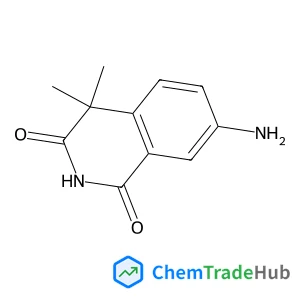
1,3(2H,4H)-Isoquinolinedione, 7-amino-4,4-dimethyl-
CAS Number:
14576-22-8
Molecular Formula:
C11H12N2O2
![(3R,5R)-1-[(Benzyloxy)carbonyl]-5-methyl-3-piperidinecarboxylic acid structure](https://static.chemtradehub.com/structs/126/1269757-29-0-c552.webp "(3R,5R)-1-[(Benzyloxy)carbonyl]-5-methyl-3-piperidinecarboxylic acid structure")
(3R,5R)-1-[(Benzyloxy)carbonyl]-5-methyl-3-piperidinecarboxylic acid
CAS Number:
1269757-29-0
Molecular Formula:
C15H19NO4
Recommended Suppliers




Disclaimer
This page provides academic journal information for reference and research purposes only. We are not affiliated with any journal publishers and do not handle publication submissions. For publication-related inquiries, please contact the respective journal publishers directly.
If you notice any inaccuracies in the information displayed, please contact us at support@chemtradehub.com. We will promptly review and address your concerns.