












Ru(bpy)32+ derivatized polystyrenes constructed by nitroxide-mediated radical polymerization. Relationship between polymer chain length, structure and photophysical properties
Literature Information
Publication Date
2015-10-01
DOI
10.1039/C5PY01289A
Impact Factor
5.582
Authors
Gyu Leem, Shahar Keinan, Junlin Jiang, Zhuo Chen, Toan Pho, Zachary A. Morseth, Zhenya Hu, Egle Puodziukynaite, Zhen Fang, John M. Papanikolas, John R. Reynolds, Kirk S. Schanze
View Original
Abstract
A series of polystyrene-based light harvesting polymers featuring pendant polypyridyl ruthenium complexes has been synthesized. The polymer backbones were prepared by nitroxide-mediated radical polymerization with a variable average molecular weight (Mn) ranging from ∼5500 to ∼24 000 g mol−1. Pendant Ru(II) polypyridyl complexes were grafted to the polymer backbone by azide–alkyne click chemistry to afford chromophore loaded polymers. The resulting polystyrene-based polychromophores with pendant Ru(II) polypyridyl complexes (PS-Ru) were characterized by nuclear magnetic resonance and infrared spectroscopy, confirming the high efficiency of the click grafting. The photophysical and electrochemical properties of the series of PS-Ru polymers were characterized in solution and investigated as a function of polymer chain length and solvent. The electrochemical properties of PS-Ru maintained the characteristics of the individual Ru(II) polypyridyl units. Emission quantum yield and lifetime studies reveal that the metal-to-ligand charge transfer (MLCT) excited states are quenched to a variable extent depending on the molecular weight of the polymers, consistent with intramolecular energy transfer and self-quenching in polymers with longer chain lengths. To support the synthetic effort, molecular dynamics simulations of the polypyridyl ruthenium derivatized polystyrenes in different solvents were conducted.
Recommended Journals
Related Literature
Multifunctional MXene-doped photothermal microneedles for drug-resistant bacteria-infected wound healing
Yongjin Zhong, Yancheng Lai, Zeru Feng, Si Huang, Yu Fu, Lirong Huang, Keng-fu Lan, Anchun Mo
2023-12-08
Paper
DOI: 10.1039/D3BM01676E
A simple, quick and non-destructive approach for sampling drugs of abuse in tablets and blotter for qualitative analysis by paper spray mass spectrometry
Mariana C. C. Diniz, Yuri Machado, Evandro Piccin
2023-10-20
Paper
DOI: 10.1039/D3AY01393F
Simultaneous derivatization and extraction of amphetamine and methamphetamine using dispersive liquid–liquid microextraction prior to their analysis using GC-FID in creatine supplements
Mahdi Golsanamlou
2023-10-18
Paper
DOI: 10.1039/D3AY00828B
Ionophore-modified polyaniline-based optode for the determination of hydrogen sulfite levels in beverages, wastewater, and soil
Faisal K. Algethami, Basant H. Koraim, Ehab A. Abdelrahman, Yasmeen G. Abou El-Reash, Mahmoud S. Rizk
2023-11-13
Paper
DOI: 10.1039/D3AY01320K
Antiepileptic drug concentration detection based on Raman spectroscopy and an improved snake optimization-convolutional neural network algorithm
Xinghu Fu, Xiqing Cao, Zizhen Fu, Zhexu Huang, Wa Jin, Guangwei Fu, Weihong Bi
2023-11-07
Paper
DOI: 10.1039/D3AY01631E
Genetically engineered probiotics for an optical imaging-guided tumor photothermal therapy/immunotherapy
Xue Chen, Puze Li, Shiqiang Xie
2023-11-15
Paper
DOI: 10.1039/D3BM01227A
Biosynthesized tumor acidity and MMP dual-responsive plant toxin gelonin for robust cancer therapy
Huiyan Cao, Chenchen Zhu, Fangyuan Chen, Jiaqi Ye, Bin-Chun Li, Peng Yang, Mingqiang Qiao, Zhuoyu Li
2023-12-05
Paper
DOI: 10.1039/D3BM01779F
Rapamycin-based inhaled therapy for potential treatment of COPD-related inflammation: production and characterization of aerosolizable nano into micro (NiM) particles
Emanuela Fabiola Craparo, Marta Cabibbo, Cinzia Scialabba, Luca Casula, Francesco Lai
2023-11-24
Paper
DOI: 10.1039/D3BM01210G
Constructing a 3D interconnected network of Ag nanostructures for high-performance SERS detection of food coloring agents
Pei Zeng, Huan Zhang, Qi Guan, Qianqian Zhang, Xianzai Yan, Lili Yu, Luying Duan, Chunrong Wang
2023-11-07
Paper
DOI: 10.1039/D3AY01515G
You might also like
Compound Q&A
What are the main uses of 4-Nitrophenyl phosphate disodium salt hexahydrate (CAS: 333338-18-4)?
4-Nitrophenyl phosphate disodium salt hexahydrate is primarily used as a substra...
333338-18-44-Nitrophenyl phosph...
Compound Q&A
What are the main uses of 2-(Trifluoromethyl)-1,3-oxazole-4-carboxylic Acid (CAS: 1060816-01-4)?
2-(Trifluoromethyl)-1,3-oxazole-4-carboxylic Acid (CAS: 1060816-01-4) is widely ...
1060816-01-42-(Trifluoromethyl)-...
Compound Q&A
How should 2-Fluoro-4-biphenylcarboxylic acid (CAS: 137045-30-8) be stored?
2-Fluoro-4-biphenylcarboxylic acid should be stored in a cool, dry place at room...
137045-30-82-Fluoro-4-biphenylc...
Compound Q&A
What industries use Prednisolone-21-Carboxylic Acid (CAS: 61549-70-0)?
Prednisolone-21-Carboxylic Acid is primarily used in the pharmaceutical industry...
61549-70-0Prednisolone-21-Carb...
Compound Q&A
How should 4-(Hydrazinomethyl)-1,2,3-benzenetriol (CAS: 3614-72-0) be stored?
4-(Hydrazinomethyl)-1,2,3-benzenetriol (CAS: 3614-72-0) should be stored in a co...
3614-72-04-(Hydrazinomethyl)-...
Compound Q&A
What industries use 4-Amino-1-methyl-1H-pyrazole-5-carboxylic acid hydrochloride (CAS: 92534-70-8)?
4-Amino-1-methyl-1H-pyrazole-5-carboxylic acid hydrochloride (CAS: 92534-70-8) i...
92534-70-84-Amino-1-methyl-1H-...
Compound Q&A
What regulatory guidelines apply to dehydropachymic acid (CAS: 77012-31-8)?
Dehydropachymic acid (CAS: 77012-31-8) is regulated by various agencies. It fall...
77012-31-8Dehydropachymic acid
Compound Q&A
What is the market or research trend for 6-[(2,2-Dimethylpropanoyl)amino]nicotinic acid (CAS: 898561-66-5)?
The market and research trends for 6-[(2,2-Dimethylpropanoyl)amino]nicotinic aci...
898561-66-56-[(2,2-Dimethylprop...
Compound Q&A
How should 1,10-Phenanthroline-2,9-dicarbaldehyde (CAS: 57709-62-3) be stored?
1,10-Phenanthroline-2,9-dicarbaldehyde should be stored in a cool, dry place awa...
57709-62-31,10-Phenanthroline-...
Compound Q&A
How is 5-Carbamoyl-11-oxo-10,11-dihydro-5H-dibenzo[b,f]azepin-10-yl acetate (CAS: 113952-21-9) typically synthesized?
5-Carbamoyl-11-oxo-10,11-dihydro-5H-dibenzo[b,f]azepin-10-yl acetate can be synt...
113952-21-95-Carbamoyl-11-oxo-1...
Source Journal
Polymer Chemistry

CiteScore:
8.6
Self-citation Rate:
7.3%
Articles per Year:
457
Polymer Chemistry welcomes submissions in all areas of polymer science that have a strong focus on macromolecular chemistry. Manuscripts may cover a broad range of fields, yet no direct application focus is required.
Recommended Compounds
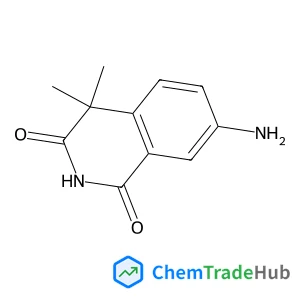
1,3(2H,4H)-Isoquinolinedione, 7-amino-4,4-dimethyl-
CAS Number:
14576-22-8
Molecular Formula:
C11H12N2O2
Recommended Suppliers




Disclaimer
This page provides academic journal information for reference and research purposes only. We are not affiliated with any journal publishers and do not handle publication submissions. For publication-related inquiries, please contact the respective journal publishers directly.
If you notice any inaccuracies in the information displayed, please contact us at support@chemtradehub.com. We will promptly review and address your concerns.