












Rheological behavior and molecular relaxation of polycations with macrocounterions in aqueous solutions
Literature Information
Publication Date
2015-10-12
DOI
10.1039/C5PY01022E
Impact Factor
5.582
Authors
Shangguan Yonggang, Qiang Zheng
View Original
Abstract
Counterions play significant roles in the characteristics of polyelectrolytes, whereas many problems still remain unsolved. Among most previous research studies, counterions were too small to be “seen” by light scattering. In this article, we prepare macrocounterions which are single/double carboxylate ion-terminated polyethylene glycols (Mn ≈ 5000 g mol−1). The solution properties of polycations with macrocounterions are investigated through rheological, conductivity and dynamic light scattering measurement. On the basis of the scaling theory, the static and dynamic parameters of polyelectrolytes are analyzed over wide concentration ranges. In rheological measurement, a critical concentration () has been observed. When the concentration is below , the role of macrocounterions can be ignored; while above , macrocounterions determine the longest relaxation and prevent entanglement of polycations. Moreover, the same turning point exists in the dependence of conductivity and viscosity on the molar fraction of macrocounterions, which indicates that macrocounterions can't serve as brushes condensed on the polycation until their molar fraction is above the effective charge density of polyelectrolytes. In dynamic light scattering, we investigate the relaxation of polycations with macrocounterions on the length scale of electrostatic blobs, where the size of macrocounterions becomes significant. In comparison with ordinary polyelectrolytes, it is observed that both fast and slow diffusive relaxations of polycations with macrocounterions are significantly slowed down, and the fast mode relaxation becomes dominant. Since no independent relaxation of macrocounterions has been observed, it is supposed that the fast mode relaxation is the coupled relaxation of polycations and macrocounterions.
Recommended Journals
Related Literature
UPLC-MS/MS method for quantitative determination of the advanced glycation endproducts Nε-(carboxymethyl)lysine and Nε-(carboxyethyl)lysine
2023-12-01
Paper
DOI: 10.1039/D3AY01817B
Milk exosomes anchored with hydrophilic and zwitterionic motifs enhance mucus permeability for applications in oral gene delivery
Chenzhen Zhang, Hengli Zhang, Héctor A. Millán Cotto, Timothy L. Boyer, Matthew R. Warren, Chia-Ming Wang, Joshua Luchan, Pradeep K. Dhal, Rebecca L. Carrier, Ambika G. Bajpayee
2023-11-23
Paper
DOI: 10.1039/D3BM01089A
A homogeneous label-free electrochemical aptasensor based on an omega-like DNA nanostructure for progesterone detection
Zaofen Wang, Weiping Shi, Yunzhu Tan, Bingqian Liu
2023-11-13
Paper
DOI: 10.1039/D3AY01255G
Construction of Mn–N–C nanoparticles with multienzyme-like properties and photothermal performance for the effective treatment of bacterial infections
Yong Ding, Xiao-Chan Yang, Ya-Ya Yu, Sheng-Nan Song, Bo Li, Xue-Yao Pang, Jian-Jian Cai, Chun-Huan Zhang, Ya-Mu Xia, Wei-Wei Gao
2023-11-22
Paper
DOI: 10.1039/D3BM01228J
N-doped molybdenum oxide quantum dots as fluorescent probes for the quantitative detection of copper ions in environmental samples
Mingzhu Liu, Jingran Sun, Jin Wu, Zunquan Zhao, Jialei Bai, Yanjun Fang, Xiaoyong Jin
2023-10-30
Paper
DOI: 10.1039/D3AY01423A
Advances in biomedical systems based on microneedles: design, fabrication, and application
Xinghao Wang, Zifeng Wang, Min Xiao, Zhanhong Li, Zhigang Zhu
2023-11-07
Review Article
DOI: 10.1039/D3BM01551C
The application of generalized S-transform in the denoising of surface plasmon resonance (SPR) spectrum
Dai Junfeng, Fu Li-hui
2023-10-27
Paper
DOI: 10.1039/D3AY01462B
You might also like
Compound Q&A
What are the main uses of 4-Nitrophenyl phosphate disodium salt hexahydrate (CAS: 333338-18-4)?
4-Nitrophenyl phosphate disodium salt hexahydrate is primarily used as a substra...
333338-18-44-Nitrophenyl phosph...
Compound Q&A
What are the main uses of 2-(Trifluoromethyl)-1,3-oxazole-4-carboxylic Acid (CAS: 1060816-01-4)?
2-(Trifluoromethyl)-1,3-oxazole-4-carboxylic Acid (CAS: 1060816-01-4) is widely ...
1060816-01-42-(Trifluoromethyl)-...
Compound Q&A
How should 2-Fluoro-4-biphenylcarboxylic acid (CAS: 137045-30-8) be stored?
2-Fluoro-4-biphenylcarboxylic acid should be stored in a cool, dry place at room...
137045-30-82-Fluoro-4-biphenylc...
Compound Q&A
What industries use Prednisolone-21-Carboxylic Acid (CAS: 61549-70-0)?
Prednisolone-21-Carboxylic Acid is primarily used in the pharmaceutical industry...
61549-70-0Prednisolone-21-Carb...
Compound Q&A
How should 4-(Hydrazinomethyl)-1,2,3-benzenetriol (CAS: 3614-72-0) be stored?
4-(Hydrazinomethyl)-1,2,3-benzenetriol (CAS: 3614-72-0) should be stored in a co...
3614-72-04-(Hydrazinomethyl)-...
Compound Q&A
What industries use 4-Amino-1-methyl-1H-pyrazole-5-carboxylic acid hydrochloride (CAS: 92534-70-8)?
4-Amino-1-methyl-1H-pyrazole-5-carboxylic acid hydrochloride (CAS: 92534-70-8) i...
92534-70-84-Amino-1-methyl-1H-...
Compound Q&A
What regulatory guidelines apply to dehydropachymic acid (CAS: 77012-31-8)?
Dehydropachymic acid (CAS: 77012-31-8) is regulated by various agencies. It fall...
77012-31-8Dehydropachymic acid
Compound Q&A
What is the market or research trend for 6-[(2,2-Dimethylpropanoyl)amino]nicotinic acid (CAS: 898561-66-5)?
The market and research trends for 6-[(2,2-Dimethylpropanoyl)amino]nicotinic aci...
898561-66-56-[(2,2-Dimethylprop...
Compound Q&A
How should 1,10-Phenanthroline-2,9-dicarbaldehyde (CAS: 57709-62-3) be stored?
1,10-Phenanthroline-2,9-dicarbaldehyde should be stored in a cool, dry place awa...
57709-62-31,10-Phenanthroline-...
Compound Q&A
How is 5-Carbamoyl-11-oxo-10,11-dihydro-5H-dibenzo[b,f]azepin-10-yl acetate (CAS: 113952-21-9) typically synthesized?
5-Carbamoyl-11-oxo-10,11-dihydro-5H-dibenzo[b,f]azepin-10-yl acetate can be synt...
113952-21-95-Carbamoyl-11-oxo-1...
Source Journal
Polymer Chemistry

CiteScore:
8.6
Self-citation Rate:
7.3%
Articles per Year:
457
Polymer Chemistry welcomes submissions in all areas of polymer science that have a strong focus on macromolecular chemistry. Manuscripts may cover a broad range of fields, yet no direct application focus is required.
Recommended Compounds
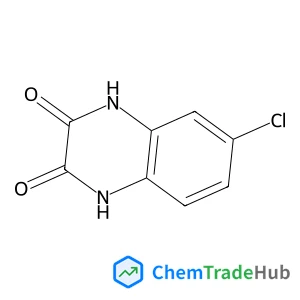
6-CHLORO-2,3-DIOXO-1,2,3,4-TETRAHYDROQUINOXALINE, 97
CAS Number:
169-14-2
Molecular Formula:
C8H5ClN2O2
![N-[2-(4-Hydroxyphenoxy)-4-nitrophenyl]methanesulfonamide structure](https://static.chemtradehub.com/structs/109/109032-22-6-7c88.webp "N-[2-(4-Hydroxyphenoxy)-4-nitrophenyl]methanesulfonamide structure")
N-[2-(4-Hydroxyphenoxy)-4-nitrophenyl]methanesulfonamide
CAS Number:
109032-22-6
Molecular Formula:
C13H12N2O6S
phosphoryl}methyl 4-methylbenzenesulfonate structure](https://static.chemtradehub.com/structs/864/864068-45-1-ba7c.webp "{[3-(Hexadecyloxy)propoxy](hydroxy)phosphoryl}methyl 4-methylbenzenesulfonate structure")
{[3-(Hexadecyloxy)propoxy](hydroxy)phosphoryl}methyl 4-methylbenzenesulfonate
CAS Number:
864068-45-1
Molecular Formula:
C27H49O7PS
![1-[(4-Methylphenyl)sulfonyl]-3-(4,4,5,5-tetramethyl-1,3,2-dioxaborolan-2-yl)-1H-pyrrolo[2,3-b]pyridine-5-carbonitrile structure](https://static.chemtradehub.com/structs/143/1434747-57-5-fc0d.webp "1-[(4-Methylphenyl)sulfonyl]-3-(4,4,5,5-tetramethyl-1,3,2-dioxaborolan-2-yl)-1H-pyrrolo[2,3-b]pyridine-5-carbonitrile structure")
1-[(4-Methylphenyl)sulfonyl]-3-(4,4,5,5-tetramethyl-1,3,2-dioxaborolan-2-yl)-1H-pyrrolo[2,3-b]pyridine-5-carbonitrile
CAS Number:
1434747-57-5
Molecular Formula:
C21H22BN3O4S
Recommended Suppliers







Disclaimer
This page provides academic journal information for reference and research purposes only. We are not affiliated with any journal publishers and do not handle publication submissions. For publication-related inquiries, please contact the respective journal publishers directly.
If you notice any inaccuracies in the information displayed, please contact us at support@chemtradehub.com. We will promptly review and address your concerns.