













The effect of the metal fragment on the aromaticity and synchronicity of the gold(i)-catalysed divinylcyclopropane–cycloheptadiene rearrangement
Literature Information
Publication Date
2015-11-19
DOI
10.1039/C5CP06523B
Impact Factor
3.676
Authors
Israel Fernández
View Original
Abstract
The gold(I)-catalysed divinylcyclopropane–cycloheptadiene rearrangement has been studied computationally within the Density Functional Theory framework. Regardless of the ligand directly attached to the transition metal (L = phosphine, phosphite and N-heterocyclic carbene), the process is found to occur concertedly via endo-boatlike transition structures. The influence of the transition metal fragment on the transformation is analysed and compared to the corresponding uncatalysed process in terms of the computed activation barriers, synchronicity and aromaticity of the associated transition states.
Related Literature
Strong selective oxidization on two-dimensional GaN: a first principles study
2019-02-25
Paper
DOI: 10.1039/C9CP00049F
Deuterium isotope effect in fluorescence of gaseous oxazine dyes
Matthew Kusinski, Rebecca A. Jockusch
2019-02-21
Paper
DOI: 10.1039/C8CP05731A
Tritium trapping and migration mechanisms in Li2O: a first-principles study
Xin Xiang, Guikai Zhang, Feilong Yang, Tao Tang
2019-02-13
Paper
DOI: 10.1039/C8CP07187J
Membrane pore formation and ion selectivity of the Ebola virus delta peptide
Rudramani Pokhrel, Elumalai Pavadai
2019-02-11
Paper
DOI: 10.1039/C8CP07323F
Fast Nosé–Hoover thermostat: molecular dynamics in quasi-thermodynamic equilibrium
Dominik Sidler, Sereina Riniker
2019-02-18
Paper
DOI: 10.1039/C8CP06800C
Position-, disorder-, and salt-dependent diffusion in binding-coupled-folding of intrinsically disordered proteins
Xiakun Chu
2019-02-12
Paper
DOI: 10.1039/C8CP06803H
Insights into the influence of the molecular structures of fluorinated ionic liquids on their thermophysical properties. A soft-SAFT based approach
João M. M. Araújo, Ana B. Pereiro, Lourdes F. Vega
2019-02-25
Paper
DOI: 10.1039/C8CP07522K
Direct conversion of carbon nanofibers into diamond nanofibers using nanosecond pulsed laser annealing
Anagh Bhaumik, Jagdish Narayan
2019-03-04
Paper
DOI: 10.1039/C9CP00063A
Air-stable formamidinium/methylammonium mixed lead iodide perovskite integral microcrystals with low trap density and high photo-responsivity
Guangbao Wu, Jiyu Zhou, Rui Meng, Baoda Xue, Huiqiong Zhou, Zhiyong Tang, Yuan Zhang
2019-01-12
Paper
DOI: 10.1039/C8CP07271J
Micromechanical exfoliation of graphene on the atomistic scale‡
Robert C. Sinclair, James L. Suter, Peter V. Coveney
2019-02-25
Paper
DOI: 10.1039/C8CP07796G
You might also like
Compound Q&A
What are the main uses of 4-Nitrophenyl phosphate disodium salt hexahydrate (CAS: 333338-18-4)?
4-Nitrophenyl phosphate disodium salt hexahydrate is primarily used as a substra...
333338-18-44-Nitrophenyl phosph...
Compound Q&A
What are the main uses of 2-(Trifluoromethyl)-1,3-oxazole-4-carboxylic Acid (CAS: 1060816-01-4)?
2-(Trifluoromethyl)-1,3-oxazole-4-carboxylic Acid (CAS: 1060816-01-4) is widely ...
1060816-01-42-(Trifluoromethyl)-...
Compound Q&A
How should 2-Fluoro-4-biphenylcarboxylic acid (CAS: 137045-30-8) be stored?
2-Fluoro-4-biphenylcarboxylic acid should be stored in a cool, dry place at room...
137045-30-82-Fluoro-4-biphenylc...
Compound Q&A
What industries use Prednisolone-21-Carboxylic Acid (CAS: 61549-70-0)?
Prednisolone-21-Carboxylic Acid is primarily used in the pharmaceutical industry...
61549-70-0Prednisolone-21-Carb...
Compound Q&A
How should 4-(Hydrazinomethyl)-1,2,3-benzenetriol (CAS: 3614-72-0) be stored?
4-(Hydrazinomethyl)-1,2,3-benzenetriol (CAS: 3614-72-0) should be stored in a co...
3614-72-04-(Hydrazinomethyl)-...
Compound Q&A
What industries use 4-Amino-1-methyl-1H-pyrazole-5-carboxylic acid hydrochloride (CAS: 92534-70-8)?
4-Amino-1-methyl-1H-pyrazole-5-carboxylic acid hydrochloride (CAS: 92534-70-8) i...
92534-70-84-Amino-1-methyl-1H-...
Compound Q&A
What regulatory guidelines apply to dehydropachymic acid (CAS: 77012-31-8)?
Dehydropachymic acid (CAS: 77012-31-8) is regulated by various agencies. It fall...
77012-31-8Dehydropachymic acid
Compound Q&A
What is the market or research trend for 6-[(2,2-Dimethylpropanoyl)amino]nicotinic acid (CAS: 898561-66-5)?
The market and research trends for 6-[(2,2-Dimethylpropanoyl)amino]nicotinic aci...
898561-66-56-[(2,2-Dimethylprop...
Compound Q&A
How should 1,10-Phenanthroline-2,9-dicarbaldehyde (CAS: 57709-62-3) be stored?
1,10-Phenanthroline-2,9-dicarbaldehyde should be stored in a cool, dry place awa...
57709-62-31,10-Phenanthroline-...
Compound Q&A
How is 5-Carbamoyl-11-oxo-10,11-dihydro-5H-dibenzo[b,f]azepin-10-yl acetate (CAS: 113952-21-9) typically synthesized?
5-Carbamoyl-11-oxo-10,11-dihydro-5H-dibenzo[b,f]azepin-10-yl acetate can be synt...
113952-21-95-Carbamoyl-11-oxo-1...
Source Journal
Physical Chemistry Chemical Physics

CiteScore:
5.5
Self-citation Rate:
10.3%
Articles per Year:
3036
Physical Chemistry Chemical Physics (PCCP) is an international journal co-owned by 19 physical chemistry and physics societies from around the world. This journal publishes original, cutting-edge research in physical chemistry, chemical physics and biophysical chemistry. To be suitable for publication in PCCP, articles must include significant innovation and/or insight into physical chemistry; this is the most important criterion that reviewers and Editors will judge against when evaluating submissions. The journal has a broad scope and welcomes contributions spanning experiment, theory, computation and data science. Topical coverage includes spectroscopy, dynamics, kinetics, statistical mechanics, thermodynamics, electrochemistry, catalysis, surface science, quantum mechanics, quantum computing and machine learning. Interdisciplinary research areas such as polymers and soft matter, materials, nanoscience, energy, surfaces/interfaces, and biophysical chemistry are welcomed if they demonstrate significant innovation and/or insight into physical chemistry. Joined experimental/theoretical studies are particularly appreciated when complementary and based on up-to-date approaches.
Recommended Compounds
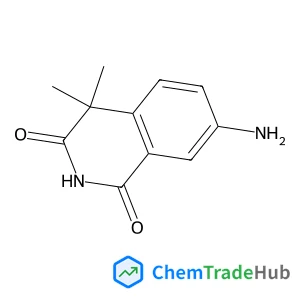
1,3(2H,4H)-Isoquinolinedione, 7-amino-4,4-dimethyl-
CAS Number:
14576-22-8
Molecular Formula:
C11H12N2O2
Recommended Suppliers




Disclaimer
This page provides academic journal information for reference and research purposes only. We are not affiliated with any journal publishers and do not handle publication submissions. For publication-related inquiries, please contact the respective journal publishers directly.
If you notice any inaccuracies in the information displayed, please contact us at support@chemtradehub.com. We will promptly review and address your concerns.