


Optimization of the surface properties of nanostructured Ni–W alloys on steel by a mixed silane layer
Literature Information
Publication Date
2015-04-30
DOI
10.1039/C5CP01895A
Impact Factor
3.676
Authors
M. P. Quiroga Argañaraz, J. M. Ramallo-López, G. Benítez, A. Rubert, E. D. Prieto, L. M. Gassa, R. C. Salvarezza, M. E. Vela
View Original
Abstract
Ni–W nanostructured coatings electrodeposited on steel by galvanostatic pulses were functionalized by tetraethoxysilane (TEOS) and octadecyltrichlorosilane (OTS) in a two-step procedure. A silica-rich layer is formed by the reaction of TEOS with the metal coating surface oxides, which allows a further reaction with OTS forming a hydrocarbon–silica outer network. This mixed silane layer provides hydrophobicity and improves the corrosion behavior of the Ni–W surface coatings without modifying their excellent mechanical properties.
Recommended Journals

Main Group Chemistry

Herald of the Russian Academy of Sciences

Journal of Asian Natural Products Research

Electroanalysis

Journal of the Indian Institute of Science

Acta Metallurgica Sinica-English Letters

Topics in Catalysis

Bioorganic & Medicinal Chemistry

Critical Reviews in Solid State and Materials Sciences

Chinese Journal of Chemistry
Related Literature
Formation of various crystalline structures in a polypropylene/polycarbonate in situ microfibrillar blend during the melt second flow
Xiao-Chao Xia, Wei Yang, Shan He, Dan-Dan Xie, Rui-Yan Zhang, Feng Tian, Ming-Bo Yang
2016-04-25
Paper
DOI: 10.1039/C6CP01426G
The methyl- and aza-substituent effects on nonradiative decay mechanisms of uracil in water: a transient absorption study in the UV region
LinQiang Hua, XiaoJun Liu
2016-04-22
Paper
DOI: 10.1039/C6CP00732E
Prevention of thermal- and moisture-induced degradation of the photoluminescence properties of the Sr2Si5N8:Eu2+ red phosphor by thermal post-treatment in N2–H2
Chenning Zhang, Tetsuo Uchikoshi, Rong-Jun Xie, Lihong Liu, Yoshio Sakka, Naoto Hirosaki
2016-03-29
Paper
DOI: 10.1039/C6CP01102K
The remarkable ability of anions to bind dihydrogen
Therese Davis Della, Cherumuttathu H. Suresh
2016-05-04
Paper
DOI: 10.1039/C6CP00412A
Conformational distortion of α-phenylethyl amine in cryogenic matrices – a matrix isolation VCD study
Corina H. Pollok, Christian Merten
2016-04-14
Paper
DOI: 10.1039/C6CP01946C
Evaluating the solid electrolyte interphase formed on silicon electrodes: a comparison of ex situ X-ray photoelectron spectroscopy and in situ neutron reflectometry
T. M. Fears, M. Doucet, J. F. Browning, J. K. S. Baldwin, J. G. Winiarz, H. Kaiser, H. Taub, R. L. Sacci, G. M. Veith
2016-04-15
Paper
DOI: 10.1039/C6CP00978F
High-field dissolution dynamic nuclear polarization of [1-13C]pyruvic acid
Hikari A. I. Yoshihara, Emine Can, Juerg Schwitter, Arnaud Comment
2016-04-12
Communication
DOI: 10.1039/C6CP00589F
Stacking of purines in water: the role of dipolar interactions in caffeine
S. Di Fonzo, F. D’Amico, C. Masciovecchio, J. W. Brady
2016-04-18
Paper
DOI: 10.1039/C5CP07326J
A new strategy to prepare giant vesicles from surface active ionic liquids (SAILs): a study of protein dynamics in a crowded environment using a fluorescence correlation spectroscopic technique
Chiranjib Banerjee, Arpita Roy, Niloy Kundu, Debasis Banik, Nilmoni Sarkar
2016-04-12
Paper
DOI: 10.1039/C5CP07225E
You might also like
Compound Q&A
What are the main uses of 4-Nitrophenyl phosphate disodium salt hexahydrate (CAS: 333338-18-4)?
4-Nitrophenyl phosphate disodium salt hexahydrate is primarily used as a substra...
333338-18-44-Nitrophenyl phosph...
Compound Q&A
What are the main uses of 2-(Trifluoromethyl)-1,3-oxazole-4-carboxylic Acid (CAS: 1060816-01-4)?
2-(Trifluoromethyl)-1,3-oxazole-4-carboxylic Acid (CAS: 1060816-01-4) is widely ...
1060816-01-42-(Trifluoromethyl)-...
Compound Q&A
How should 2-Fluoro-4-biphenylcarboxylic acid (CAS: 137045-30-8) be stored?
2-Fluoro-4-biphenylcarboxylic acid should be stored in a cool, dry place at room...
137045-30-82-Fluoro-4-biphenylc...
Compound Q&A
What industries use Prednisolone-21-Carboxylic Acid (CAS: 61549-70-0)?
Prednisolone-21-Carboxylic Acid is primarily used in the pharmaceutical industry...
61549-70-0Prednisolone-21-Carb...
Compound Q&A
How should 4-(Hydrazinomethyl)-1,2,3-benzenetriol (CAS: 3614-72-0) be stored?
4-(Hydrazinomethyl)-1,2,3-benzenetriol (CAS: 3614-72-0) should be stored in a co...
3614-72-04-(Hydrazinomethyl)-...
Compound Q&A
What industries use 4-Amino-1-methyl-1H-pyrazole-5-carboxylic acid hydrochloride (CAS: 92534-70-8)?
4-Amino-1-methyl-1H-pyrazole-5-carboxylic acid hydrochloride (CAS: 92534-70-8) i...
92534-70-84-Amino-1-methyl-1H-...
Compound Q&A
What regulatory guidelines apply to dehydropachymic acid (CAS: 77012-31-8)?
Dehydropachymic acid (CAS: 77012-31-8) is regulated by various agencies. It fall...
77012-31-8Dehydropachymic acid
Compound Q&A
What is the market or research trend for 6-[(2,2-Dimethylpropanoyl)amino]nicotinic acid (CAS: 898561-66-5)?
The market and research trends for 6-[(2,2-Dimethylpropanoyl)amino]nicotinic aci...
898561-66-56-[(2,2-Dimethylprop...
Compound Q&A
How should 1,10-Phenanthroline-2,9-dicarbaldehyde (CAS: 57709-62-3) be stored?
1,10-Phenanthroline-2,9-dicarbaldehyde should be stored in a cool, dry place awa...
57709-62-31,10-Phenanthroline-...
Compound Q&A
How is 5-Carbamoyl-11-oxo-10,11-dihydro-5H-dibenzo[b,f]azepin-10-yl acetate (CAS: 113952-21-9) typically synthesized?
5-Carbamoyl-11-oxo-10,11-dihydro-5H-dibenzo[b,f]azepin-10-yl acetate can be synt...
113952-21-95-Carbamoyl-11-oxo-1...
Source Journal
Physical Chemistry Chemical Physics

CiteScore:
5.5
Self-citation Rate:
10.3%
Articles per Year:
3036
Physical Chemistry Chemical Physics (PCCP) is an international journal co-owned by 19 physical chemistry and physics societies from around the world. This journal publishes original, cutting-edge research in physical chemistry, chemical physics and biophysical chemistry. To be suitable for publication in PCCP, articles must include significant innovation and/or insight into physical chemistry; this is the most important criterion that reviewers and Editors will judge against when evaluating submissions. The journal has a broad scope and welcomes contributions spanning experiment, theory, computation and data science. Topical coverage includes spectroscopy, dynamics, kinetics, statistical mechanics, thermodynamics, electrochemistry, catalysis, surface science, quantum mechanics, quantum computing and machine learning. Interdisciplinary research areas such as polymers and soft matter, materials, nanoscience, energy, surfaces/interfaces, and biophysical chemistry are welcomed if they demonstrate significant innovation and/or insight into physical chemistry. Joined experimental/theoretical studies are particularly appreciated when complementary and based on up-to-date approaches.
Recommended Compounds
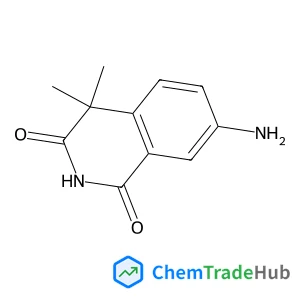
1,3(2H,4H)-Isoquinolinedione, 7-amino-4,4-dimethyl-
CAS Number:
14576-22-8
Molecular Formula:
C11H12N2O2
Recommended Suppliers



Disclaimer
This page provides academic journal information for reference and research purposes only. We are not affiliated with any journal publishers and do not handle publication submissions. For publication-related inquiries, please contact the respective journal publishers directly.
If you notice any inaccuracies in the information displayed, please contact us at support@chemtradehub.com. We will promptly review and address your concerns.