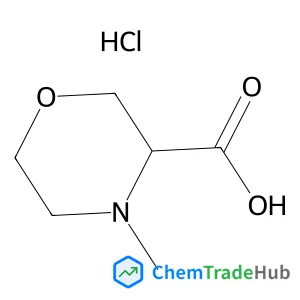
4-Methyl-3-morpholinecarboxylic acid hydrochloride (1:1)
CAS Number:
1240518-90-4
Molecular Formula:
C6H12ClNO3
Luis Rodríguez-Santiago, Jorge Alí-Torres, Mariona Sodupe
Several lines of evidence supporting the role of metal ions in amyloid aggregation, one of the hallmarks of Alzheimer's disease (AD), have turned metal ion chelation into a promising therapeutic treatment. The design of efficient chelating ligands requires proper knowledge of the electronic and molecular structure of the complexes formed, including their hydration properties. Among various potential chelators, clioquinol (5-chloro-7-iodo-8-hydroxyquinoline, CQH) has been evaluated with relative success in in vitro experiments and even in phase 2 clinical trials. Clioquinol interacts with Zn(II) to lead to a binary metal/ligand 1 : 2 stoichiometric complex in which the phenolic group of CQH is deprotonated, resulting in Zn(CQ)2 neutral complexes, to which additional water molecules may coordinate. In the present work, the coordinative properties of clioquinol in aqueous solution have been analyzed by means of static, minimal cluster based DFT calculations and explicit solvent ab initio molecular dynamics simulations. Results from static calculations accounting for solvent effects by means of polarized continuum models suggest that the preferred metal coordination environment is tetrahedral Zn(CQ)2, whereas ab initio molecular dynamics simulations point to quasi degenerate penta Zn(CQ)2(H2O) and hexa Zn(CQ)2(H2O)2 coordinated complexes. The possible reasons for these discrepant results are discussed.
DOI: 10.1039/C5CP90078F
Polina Tereshchuk, Rafael L. H. Freire, Crina G. Ungureanu, Yohanna Seminovski, Adam Kiejna, Juarez L. F. Da Silva
DOI: 10.1039/C4CP06016D
Dan Mu, Jian-Quan Li, Sheng-Yu Feng
DOI: 10.1039/C5CP00561B
Gregorio García, Mert Atilhan, Santiago Aparicio
DOI: 10.1039/C5CP00076A
Yingwen Cheng, Ryan M. Stolley, Kee Sung Han, Yuyan Shao, Bruce W. Arey, Nancy M. Washton, Monte L. Helm, Vincent L. Sprenkle, Jun Liu, Guosheng Li
DOI: 10.1039/C5CP00859J
Peng-Cheng Chen, Xiao-Jun Huang, Zhi-Kang Xu
DOI: 10.1039/C5CP00802F
DOI: 10.1039/C5CP00628G
Zhiguo Li, Champika N. Weeraman, Md. Shafiul Azam, Eiman Osman, Julianne M. Gibbs-Davis
DOI: 10.1039/C5CP00781J
4-Nitrophenyl phosphate disodium salt hexahydrate is primarily used as a substra...
2-(Trifluoromethyl)-1,3-oxazole-4-carboxylic Acid (CAS: 1060816-01-4) is widely ...
2-Fluoro-4-biphenylcarboxylic acid should be stored in a cool, dry place at room...
Prednisolone-21-Carboxylic Acid is primarily used in the pharmaceutical industry...
4-(Hydrazinomethyl)-1,2,3-benzenetriol (CAS: 3614-72-0) should be stored in a co...
4-Amino-1-methyl-1H-pyrazole-5-carboxylic acid hydrochloride (CAS: 92534-70-8) i...
Dehydropachymic acid (CAS: 77012-31-8) is regulated by various agencies. It fall...
The market and research trends for 6-[(2,2-Dimethylpropanoyl)amino]nicotinic aci...
1,10-Phenanthroline-2,9-dicarbaldehyde should be stored in a cool, dry place awa...
5-Carbamoyl-11-oxo-10,11-dihydro-5H-dibenzo[b,f]azepin-10-yl acetate can be synt...

Physical Chemistry Chemical Physics (PCCP) is an international journal co-owned by 19 physical chemistry and physics societies from around the world. This journal publishes original, cutting-edge research in physical chemistry, chemical physics and biophysical chemistry. To be suitable for publication in PCCP, articles must include significant innovation and/or insight into physical chemistry; this is the most important criterion that reviewers and Editors will judge against when evaluating submissions. The journal has a broad scope and welcomes contributions spanning experiment, theory, computation and data science. Topical coverage includes spectroscopy, dynamics, kinetics, statistical mechanics, thermodynamics, electrochemistry, catalysis, surface science, quantum mechanics, quantum computing and machine learning. Interdisciplinary research areas such as polymers and soft matter, materials, nanoscience, energy, surfaces/interfaces, and biophysical chemistry are welcomed if they demonstrate significant innovation and/or insight into physical chemistry. Joined experimental/theoretical studies are particularly appreciated when complementary and based on up-to-date approaches.
![[(1S,2S,3R,4S,7R,9S,10S,12R,15S)-4,12-Diacetyloxy-15-[(2R,3S)-3-benzamido-3-phenyl-2-(2,2,2-trichloroethoxycarbonyloxy)propanoyl]oxy-1,9-dihydroxy-10,14,17,17-tetramethyl-11-oxo-6-oxatetracyclo[11.3.1.03,10.04,7]heptadec-13-en-2-yl] benzoate structure](https://static.chemtradehub.com/structs/100/100431-55-8-7104.webp "[(1S,2S,3R,4S,7R,9S,10S,12R,15S)-4,12-Diacetyloxy-15-[(2R,3S)-3-benzamido-3-phenyl-2-(2,2,2-trichloroethoxycarbonyloxy)propanoyl]oxy-1,9-dihydroxy-10,14,17,17-tetramethyl-11-oxo-6-oxatetracyclo[11.3.1.03,10.04,7]heptadec-13-en-2-yl] benzoate structure")