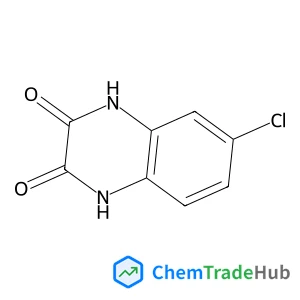
6-CHLORO-2,3-DIOXO-1,2,3,4-TETRAHYDROQUINOXALINE, 97
CAS Number:
169-14-2
Molecular Formula:
C8H5ClN2O2
Heike Fliegl, Dage Sundholm
Magnetically induced current densities have been calculated for dioxaporphyrin, dithiaporphyrin, true carbaporphyrins, and N-confused porphyrins using the gauge-including magnetically induced current (GIMIC) method. The current-strength susceptibilities (current strengths) have been obtained by numerically integrating the current flow passing selected chemical bonds. The current strength calculations yield very detailed information about the electron delocalization pathways of the molecules. The strength of the ring-current that circles around the porphyrinoid macroring is used to estimate the degree of molecular aromaticity. The studied porphyrinoid structures have been obtained by replacing the NH and N groups of porphin with formally isoelectronic moieties such as O, S, CH and CH2. Replacing an NH moiety of trans-porphin with isoelectronic O and S does not significantly change the current strengths and pathways, whereas substitution of N with an isoelectronic CH group leads to significant changes in the current pathway and current strengths. CH2 groups cut the flow of diatropic currents, whereas in strongly antiaromatic molecules a significant fraction of the paratropic ring-current is able to pass the sp3 hybridized inner carbons. N-confused porphyrinoids sustain a ring current whose strength is about half the ring-current strength of porphin with the dominating current flow along the outer pathway via the NH moiety. When no hydrogen is attached to the inner carbon of the inverted pyrrolic ring, the current prefers the inner route at that ring.
Julian Schulze, Johannes Möller, Jonathan Weine, Karin Julius, Nico König, Julia Nase, Michael Paulus, Metin Tolan, Roland Winter
DOI: 10.1039/C6CP01791F
Yujin An, Dang Xuan Long, Yiho Kim, Yong-Young Noh, Changduk Yang
DOI: 10.1039/C6CP01314G
Mamilla Rathaiah, Pamuluri Haritha, Antonio Diego Lozano-Gorrín, Palamandala Babu, Chalicheemalapalli Kulala Jayasankar, Ulises Ruyman Rodríguez-Mendoza, Victor Lavín, Vemula Venkatramu
DOI: 10.1039/C6CP01639A
T. M. Fears, M. Doucet, J. F. Browning, J. K. S. Baldwin, J. G. Winiarz, H. Kaiser, H. Taub, R. L. Sacci, G. M. Veith
DOI: 10.1039/C6CP00978F
V. Sáez-Rábanos, J. E. Verdasco, F. J. Aoiz, V. J. Herrero
DOI: 10.1039/C6CP01305H
Steve J. Spencer, Dario Imbraguglio, Andrea M. Rossi, Andrew J. Wain, Bert M. Weckhuysen, Debdulal Roy
DOI: 10.1039/C6CP01641C
D. Karpinsky, P. B. Tavares, Soma Das, J. V. Leitão, E. H. Brück, J. Agostinho Moreira, V. S. Amaral
DOI: 10.1039/C6CP01562J
4-Nitrophenyl phosphate disodium salt hexahydrate is primarily used as a substra...
2-(Trifluoromethyl)-1,3-oxazole-4-carboxylic Acid (CAS: 1060816-01-4) is widely ...
2-Fluoro-4-biphenylcarboxylic acid should be stored in a cool, dry place at room...
Prednisolone-21-Carboxylic Acid is primarily used in the pharmaceutical industry...
4-(Hydrazinomethyl)-1,2,3-benzenetriol (CAS: 3614-72-0) should be stored in a co...
4-Amino-1-methyl-1H-pyrazole-5-carboxylic acid hydrochloride (CAS: 92534-70-8) i...
Dehydropachymic acid (CAS: 77012-31-8) is regulated by various agencies. It fall...
The market and research trends for 6-[(2,2-Dimethylpropanoyl)amino]nicotinic aci...
1,10-Phenanthroline-2,9-dicarbaldehyde should be stored in a cool, dry place awa...
5-Carbamoyl-11-oxo-10,11-dihydro-5H-dibenzo[b,f]azepin-10-yl acetate can be synt...

Physical Chemistry Chemical Physics (PCCP) is an international journal co-owned by 19 physical chemistry and physics societies from around the world. This journal publishes original, cutting-edge research in physical chemistry, chemical physics and biophysical chemistry. To be suitable for publication in PCCP, articles must include significant innovation and/or insight into physical chemistry; this is the most important criterion that reviewers and Editors will judge against when evaluating submissions. The journal has a broad scope and welcomes contributions spanning experiment, theory, computation and data science. Topical coverage includes spectroscopy, dynamics, kinetics, statistical mechanics, thermodynamics, electrochemistry, catalysis, surface science, quantum mechanics, quantum computing and machine learning. Interdisciplinary research areas such as polymers and soft matter, materials, nanoscience, energy, surfaces/interfaces, and biophysical chemistry are welcomed if they demonstrate significant innovation and/or insight into physical chemistry. Joined experimental/theoretical studies are particularly appreciated when complementary and based on up-to-date approaches.
![1-[(4-Methylphenyl)sulfonyl]-3-(4,4,5,5-tetramethyl-1,3,2-dioxaborolan-2-yl)-1H-pyrrolo[2,3-b]pyridine-5-carbonitrile structure](https://static.chemtradehub.com/structs/143/1434747-57-5-fc0d.webp "1-[(4-Methylphenyl)sulfonyl]-3-(4,4,5,5-tetramethyl-1,3,2-dioxaborolan-2-yl)-1H-pyrrolo[2,3-b]pyridine-5-carbonitrile structure")