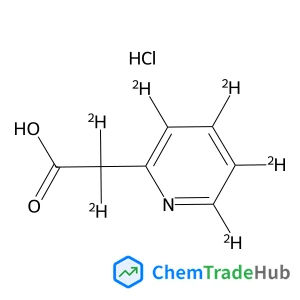
2,2-dideuterio-2-(3,4,5,6-tetradeuterio-2-pyridyl)acetic acid;hydrochloride
CAS Number:
1329799-67-8
Molecular Formula:
C7H2ClD6NO2
In recent years, the nuclear receptors (NR) dynamics have been studied extensively by various approaches. However, the transition path of helix 12 (H12) to an agonist or an antagonist conformation and the exchange pathway between these states is not clear yet. A number of accelerated molecular dynamics (aMD) runs were performed on both an ERα monomer and a homodimer with a total length of 2.2 μs. We have been able to sample reasonably well the H12 conformational landscape to reproduce precisely both the agonist and the antagonist conformations, starting from an unfolded position, and to describe the transition path between them, even in the presence of an agonist ligand. These conformations were the most prevalent, suggesting that the extended H12 state is not likely to exist and that the natural ERα H12 position might exist in both the agonist and antagonist states. Remarkably, the H12 transition occurs and is regulated only in a dimer form and the proper agonist or antagonist H12 conformation can be achieved solely in one of the dimer subunits. These results clearly demonstrate that clusters of the two well-known H12 states exist by themselves in the protein free energy landscape, i.e. they are not constituted directly by the ligands, and dimerization favors the switch between them. Conversely, in a monomer, no transitions have been observed. Thus, the dimer formation helps the constitution of populations of discrete H12 conformational states and reshapes the conformational landscape. Further analyses have shown that these observations can be explained by specific interface and long range protein–protein interactions, resulting in conformational fluctuations in helices 5 and 11. Based on these results, a new ERα activation/deactivation mechanism and a sequence of binding events during receptor activity modulation have been suggested according to which ligands control the H12 conformation via alterations of the inter-dimer interactions. These findings agree with the HDX and fluorescence experiments and provide an explanation on a structural basis of these data, demonstrating that the dynamics of H12 are not altered greatly upon ligand binding and large fluctuations at the end of H11 are present.
Alena Kremleva, Sven Krüger
DOI: 10.1039/C5CP01074H
Zhi Qin, Fang-Li Fan, Hiromitsu Haba, Yukiko Komori, Xiao-Lei Wu
DOI: 10.1039/C5CP00979K
Gongbiao Xin, Huiping Yuan, Lijun Jiang, Shumao Wang, Xiaopeng Liu, Xingguo Li
DOI: 10.1039/C5CP01897H
Jiameng Qiu, Feilong Wu, Xin Jin, Xinyuan Gu, Wenbin Cai, Dalin Sun, Fang Fang
DOI: 10.1039/C5CP00800J
Tae-Sik Oh, Sossina M. Haile
DOI: 10.1039/C4CP05990E
Zhonglong Zhao, Kuo Bao, Defang Duan, Fubo Tian, Yanping Huang, Hongyu Yu, Yunxian Liu, Bingbing Liu, Tian Cui
DOI: 10.1039/C5CP00147A
Sergii Domanskyi, Katie L. Poetz
DOI: 10.1039/C5CP00473J
Xia Wang, Zhentao Cui, Bing Liu, Minhua Cao
DOI: 10.1039/C5CP01199J
Zhiguo Li, Champika N. Weeraman, Md. Shafiul Azam, Eiman Osman, Julianne M. Gibbs-Davis
DOI: 10.1039/C5CP00781J
Bin Liu, Lichao Ning, Hua Zhao, Congjie Zhang, Heqing Yang, Shengzhong (Frank) Liu
DOI: 10.1039/C5CP00450K
4-Nitrophenyl phosphate disodium salt hexahydrate is primarily used as a substra...
2-(Trifluoromethyl)-1,3-oxazole-4-carboxylic Acid (CAS: 1060816-01-4) is widely ...
2-Fluoro-4-biphenylcarboxylic acid should be stored in a cool, dry place at room...
Prednisolone-21-Carboxylic Acid is primarily used in the pharmaceutical industry...
4-(Hydrazinomethyl)-1,2,3-benzenetriol (CAS: 3614-72-0) should be stored in a co...
4-Amino-1-methyl-1H-pyrazole-5-carboxylic acid hydrochloride (CAS: 92534-70-8) i...
Dehydropachymic acid (CAS: 77012-31-8) is regulated by various agencies. It fall...
The market and research trends for 6-[(2,2-Dimethylpropanoyl)amino]nicotinic aci...
1,10-Phenanthroline-2,9-dicarbaldehyde should be stored in a cool, dry place awa...
5-Carbamoyl-11-oxo-10,11-dihydro-5H-dibenzo[b,f]azepin-10-yl acetate can be synt...

Physical Chemistry Chemical Physics (PCCP) is an international journal co-owned by 19 physical chemistry and physics societies from around the world. This journal publishes original, cutting-edge research in physical chemistry, chemical physics and biophysical chemistry. To be suitable for publication in PCCP, articles must include significant innovation and/or insight into physical chemistry; this is the most important criterion that reviewers and Editors will judge against when evaluating submissions. The journal has a broad scope and welcomes contributions spanning experiment, theory, computation and data science. Topical coverage includes spectroscopy, dynamics, kinetics, statistical mechanics, thermodynamics, electrochemistry, catalysis, surface science, quantum mechanics, quantum computing and machine learning. Interdisciplinary research areas such as polymers and soft matter, materials, nanoscience, energy, surfaces/interfaces, and biophysical chemistry are welcomed if they demonstrate significant innovation and/or insight into physical chemistry. Joined experimental/theoretical studies are particularly appreciated when complementary and based on up-to-date approaches.

![N-[2-(4-Hydroxyphenoxy)-4-nitrophenyl]methanesulfonamide structure](https://static.chemtradehub.com/structs/109/109032-22-6-7c88.webp "N-[2-(4-Hydroxyphenoxy)-4-nitrophenyl]methanesulfonamide structure")