












DNA damage induced by bare and loaded microporous coordination polymers from their ground and electronic excited states
Literature Information
Publication Date
2015-04-16
DOI
10.1039/C5CP00308C
Impact Factor
3.676
Authors
Juan G. Yañuk, María L. Alomar, M. Micaela Gonzalez, Francisco Simon, Rosa Erra-Balsells, Matías Rafti, Franco M. Cabrerizo
View Original
Abstract
We report on interactions of cell free double-stranded DNA (dsDNA) with a selected subgroup of Microporous Coordination Polymers (MCPs). In particular, we have studied the influence of different metal ion constituents and chemically modified linkers using a set of five benzene carboxylate-based MCPs. Our results suggest that the DNA moiety can be structurally modified in two different ways: by direct MCPs–dsDNA interaction and/or through photosensitized processes. The extent of the observed damage was found to be strongly dependent on the charge density of the material. The potential use of the MCPs tested as inert carriers of photosensitizers was demonstrated by analyzing the interaction between dsDNA and harmine-loaded Cr-based materials, both in the absence of light and upon UVA irradiation.
Related Literature
Ultrafast internal conversion dynamics of bilirubin bound to UnaG and its N57A mutant
Xiaodan Cao, Changcheng Zhang, Ziheng Gao, Yangyi Liu, Yuzheng Zhao, Yi Yang
2019-01-16
Paper
DOI: 10.1039/C8CP07553K
Equilibrium structures of the tetramezine diastereomers and their ratio: joint analysis of gas phase electron diffraction, quantum chemistry, and spectroscopic data
Leonid S. Khaikin, Igor V. Kochikov, Anatoliy N. Rykov, Olga E. Grikina, Georgiy G. Ageev, Igor F. Shishkov, Vladimir V. Kuznetsov, Nina N. Makhova
2019-02-08
Paper
DOI: 10.1039/C8CP07607C
Membrane pore formation and ion selectivity of the Ebola virus delta peptide
Rudramani Pokhrel, Elumalai Pavadai
2019-02-11
Paper
DOI: 10.1039/C8CP07323F
Dynamics of proteins confined in non-ionic bicontinuous microemulsions: a FCS study
Oliver Wrede, Sören Großkopf, Thorsten Seidel, Thomas Hellweg
2019-03-04
Paper
DOI: 10.1039/C8CP06419A
Theoretical predication of the high hydrogen evolution catalytic activity for the cubic and tetragonal SnP systems
Jingwei Liu, Guangtao Yu, Ran Zhang, Xuri Huang, Wei Chen
2019-02-08
Paper
DOI: 10.1039/C9CP00618D
Micromechanical exfoliation of graphene on the atomistic scale‡
Robert C. Sinclair, James L. Suter, Peter V. Coveney
2019-02-25
Paper
DOI: 10.1039/C8CP07796G
Low linear energy transfer radiolysis of supercritical water at 400 °C: in situ generation of ultrafast, transient, density-dependent “acid spikes”
Md Mohsin Patwary, Vanaja Kanike, Sunuchakan Sanguanmith, Jintana Meesungnoen, Muhammad Mainul Islam, Jean-Paul Jay-Gerin
2019-03-11
Paper
DOI: 10.1039/C9CP00790C
Far-IR and UV spectral signatures of controlled complexation and microhydration of the polycyclic aromatic hydrocarbon acenaphthene
Jens Antony, Stefan Grimme, Anouk M. Rijs
2018-10-11
Paper
DOI: 10.1039/C8CP04480E
Evaluation of spin-flip scattering in chirality-induced spin selectivity using the Riccati equation
Daniel Nürenberg, Helmut Zacharias
2019-01-22
Paper
DOI: 10.1039/C8CP07257D
You might also like
Compound Q&A
What are the main uses of 4-Nitrophenyl phosphate disodium salt hexahydrate (CAS: 333338-18-4)?
4-Nitrophenyl phosphate disodium salt hexahydrate is primarily used as a substra...
333338-18-44-Nitrophenyl phosph...
Compound Q&A
What are the main uses of 2-(Trifluoromethyl)-1,3-oxazole-4-carboxylic Acid (CAS: 1060816-01-4)?
2-(Trifluoromethyl)-1,3-oxazole-4-carboxylic Acid (CAS: 1060816-01-4) is widely ...
1060816-01-42-(Trifluoromethyl)-...
Compound Q&A
How should 2-Fluoro-4-biphenylcarboxylic acid (CAS: 137045-30-8) be stored?
2-Fluoro-4-biphenylcarboxylic acid should be stored in a cool, dry place at room...
137045-30-82-Fluoro-4-biphenylc...
Compound Q&A
What industries use Prednisolone-21-Carboxylic Acid (CAS: 61549-70-0)?
Prednisolone-21-Carboxylic Acid is primarily used in the pharmaceutical industry...
61549-70-0Prednisolone-21-Carb...
Compound Q&A
How should 4-(Hydrazinomethyl)-1,2,3-benzenetriol (CAS: 3614-72-0) be stored?
4-(Hydrazinomethyl)-1,2,3-benzenetriol (CAS: 3614-72-0) should be stored in a co...
3614-72-04-(Hydrazinomethyl)-...
Compound Q&A
What industries use 4-Amino-1-methyl-1H-pyrazole-5-carboxylic acid hydrochloride (CAS: 92534-70-8)?
4-Amino-1-methyl-1H-pyrazole-5-carboxylic acid hydrochloride (CAS: 92534-70-8) i...
92534-70-84-Amino-1-methyl-1H-...
Compound Q&A
What regulatory guidelines apply to dehydropachymic acid (CAS: 77012-31-8)?
Dehydropachymic acid (CAS: 77012-31-8) is regulated by various agencies. It fall...
77012-31-8Dehydropachymic acid
Compound Q&A
What is the market or research trend for 6-[(2,2-Dimethylpropanoyl)amino]nicotinic acid (CAS: 898561-66-5)?
The market and research trends for 6-[(2,2-Dimethylpropanoyl)amino]nicotinic aci...
898561-66-56-[(2,2-Dimethylprop...
Compound Q&A
How should 1,10-Phenanthroline-2,9-dicarbaldehyde (CAS: 57709-62-3) be stored?
1,10-Phenanthroline-2,9-dicarbaldehyde should be stored in a cool, dry place awa...
57709-62-31,10-Phenanthroline-...
Compound Q&A
How is 5-Carbamoyl-11-oxo-10,11-dihydro-5H-dibenzo[b,f]azepin-10-yl acetate (CAS: 113952-21-9) typically synthesized?
5-Carbamoyl-11-oxo-10,11-dihydro-5H-dibenzo[b,f]azepin-10-yl acetate can be synt...
113952-21-95-Carbamoyl-11-oxo-1...
Source Journal
Physical Chemistry Chemical Physics

CiteScore:
5.5
Self-citation Rate:
10.3%
Articles per Year:
3036
Physical Chemistry Chemical Physics (PCCP) is an international journal co-owned by 19 physical chemistry and physics societies from around the world. This journal publishes original, cutting-edge research in physical chemistry, chemical physics and biophysical chemistry. To be suitable for publication in PCCP, articles must include significant innovation and/or insight into physical chemistry; this is the most important criterion that reviewers and Editors will judge against when evaluating submissions. The journal has a broad scope and welcomes contributions spanning experiment, theory, computation and data science. Topical coverage includes spectroscopy, dynamics, kinetics, statistical mechanics, thermodynamics, electrochemistry, catalysis, surface science, quantum mechanics, quantum computing and machine learning. Interdisciplinary research areas such as polymers and soft matter, materials, nanoscience, energy, surfaces/interfaces, and biophysical chemistry are welcomed if they demonstrate significant innovation and/or insight into physical chemistry. Joined experimental/theoretical studies are particularly appreciated when complementary and based on up-to-date approaches.
Recommended Compounds
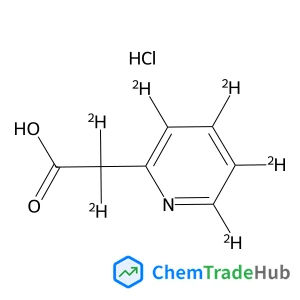
2,2-dideuterio-2-(3,4,5,6-tetradeuterio-2-pyridyl)acetic acid;hydrochloride
CAS Number:
1329799-67-8
Molecular Formula:
C7H2ClD6NO2
Recommended Suppliers





Disclaimer
This page provides academic journal information for reference and research purposes only. We are not affiliated with any journal publishers and do not handle publication submissions. For publication-related inquiries, please contact the respective journal publishers directly.
If you notice any inaccuracies in the information displayed, please contact us at support@chemtradehub.com. We will promptly review and address your concerns.