


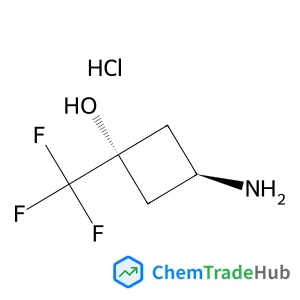
cis-3-Amino-1-(trifluoromethyl)cyclobutanol hydrochloride (1:1)
CAS Number:
1408075-16-0
Molecular Formula:
C5H9ClF3NO
Zhonglong Zhao, Kuo Bao, Defang Duan, Fubo Tian, Yanping Huang, Hongyu Yu, Yunxian Liu, Bingbing Liu, Tian Cui
Tungsten–nitrogen (W–N) compounds are studied via a combination of first-principles calculations and variable-composition evolutionary structure searches. New candidate ground states and high-pressure phases at 3 : 2, 1 : 1, and 5 : 6 compositions are uncovered and established for possible synthesis. We found that the structures in 4/5-fold N coordination (i.e., NbO–WN and W5N6) are more favoured for the W–N system at low-pressures compared with the conventional 6-fold phases (rs-WN and δ-WN). We attribute the low N coordination feature of W–N ground states to the enhanced W 5d–N 2p orbital hybridization and strong covalent W–N bonding, which involves the full-filling of W–N bonding and antibonding states and can remarkably improve the mechanical strength and hardness. These findings not only clarify the phase diagram of the W–N system, but also shed light on the correlations of hardness with microscopic crystal and electronic structures.

Main Group Chemistry

Chinese Journal of Chemistry

Biocatalysis and Biotransformation

Bioorganic & Medicinal Chemistry

Journal of Chemical Sciences

Medicinal Chemistry Research

Critical Reviews in Solid State and Materials Sciences

Herald of the Russian Academy of Sciences

Journal of Asian Natural Products Research

Bioorganic & Medicinal Chemistry Letters
Laurent Nahon, Lipsa Nag, Gustavo A. Garcia, Uwe Meierhenrich, Samuel Beaulieu, Vincent Wanie, Valérie Blanchet, Romain Géneaux, Ivan Powis
DOI: 10.1039/C6CP01293K
J. Hernández-Rojas, F. Calvo, D. J. Wales
DOI: 10.1039/C6CP00592F
Yuxu Wang, Kun Zhou, Ziliang Shi
DOI: 10.1039/C6CP01836J
Paramita Banerjee, Prasanta K. Nandi
DOI: 10.1039/C5CP07661G
Apratim Sanyal, Saptarshi Basu, Swetaprovo Chaudhuri
DOI: 10.1039/C6CP01272H
Stefano Carli, Elisabetta Benazzi, Laura Casarin, Tatiana Bernardi, Valerio Bertolasi, Roberto Argazzi, Stefano Caramori, Carlo Alberto Bignozzi
DOI: 10.1039/C6CP90114J
D. Karpinsky, P. B. Tavares, Soma Das, J. V. Leitão, E. H. Brück, J. Agostinho Moreira, V. S. Amaral
DOI: 10.1039/C6CP01562J
LinQiang Hua, XiaoJun Liu
DOI: 10.1039/C6CP00732E
Israel Fernández
DOI: 10.1039/C5CP06523B
Shohei Kanno, Yutaka Imamura, Masahiko Hada
DOI: 10.1039/C6CP01461E
4-Nitrophenyl phosphate disodium salt hexahydrate is primarily used as a substra...
2-(Trifluoromethyl)-1,3-oxazole-4-carboxylic Acid (CAS: 1060816-01-4) is widely ...
2-Fluoro-4-biphenylcarboxylic acid should be stored in a cool, dry place at room...
Prednisolone-21-Carboxylic Acid is primarily used in the pharmaceutical industry...
4-(Hydrazinomethyl)-1,2,3-benzenetriol (CAS: 3614-72-0) should be stored in a co...
4-Amino-1-methyl-1H-pyrazole-5-carboxylic acid hydrochloride (CAS: 92534-70-8) i...
Dehydropachymic acid (CAS: 77012-31-8) is regulated by various agencies. It fall...
The market and research trends for 6-[(2,2-Dimethylpropanoyl)amino]nicotinic aci...
1,10-Phenanthroline-2,9-dicarbaldehyde should be stored in a cool, dry place awa...
5-Carbamoyl-11-oxo-10,11-dihydro-5H-dibenzo[b,f]azepin-10-yl acetate can be synt...

Physical Chemistry Chemical Physics (PCCP) is an international journal co-owned by 19 physical chemistry and physics societies from around the world. This journal publishes original, cutting-edge research in physical chemistry, chemical physics and biophysical chemistry. To be suitable for publication in PCCP, articles must include significant innovation and/or insight into physical chemistry; this is the most important criterion that reviewers and Editors will judge against when evaluating submissions. The journal has a broad scope and welcomes contributions spanning experiment, theory, computation and data science. Topical coverage includes spectroscopy, dynamics, kinetics, statistical mechanics, thermodynamics, electrochemistry, catalysis, surface science, quantum mechanics, quantum computing and machine learning. Interdisciplinary research areas such as polymers and soft matter, materials, nanoscience, energy, surfaces/interfaces, and biophysical chemistry are welcomed if they demonstrate significant innovation and/or insight into physical chemistry. Joined experimental/theoretical studies are particularly appreciated when complementary and based on up-to-date approaches.
phosphoryl}methyl 4-methylbenzenesulfonate structure](https://static.chemtradehub.com/structs/864/864068-45-1-ba7c.webp "{[3-(Hexadecyloxy)propoxy](hydroxy)phosphoryl}methyl 4-methylbenzenesulfonate structure")







