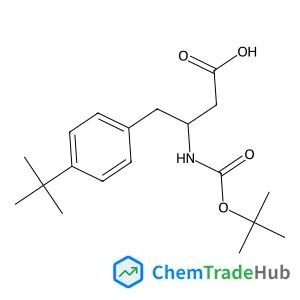
(S)-3-((tert-Butoxycarbonyl)amino)-4-(4-(tert-butyl)phenyl)butanoic acid
CAS Number:
403661-85-8
Molecular Formula:
C19H29NO4
Xu Wang, Jutta Pauli, Reinhard Niessner, Ute Resch-Genger, Dietmar Knopp
A multifunctional fluorescence platform has been constructed based on gold nanoparticle (AuNP)-catalyzed uranine reduction. The catalytic reduction of uranine was conducted in aqueous solution using AuNPs as nanocatalyst and sodium borohydride as reducing reagent, which was monitored by fluorescence and UV-vis spectroscopy. The reaction rate was highly dependent on the concentration, size and dispersion state of AuNPs. When AuNPs aggregated, their catalytic ability decreased, and thereby a label-free fluorescent assay was developed for the detection of melamine, which can be used for melamine determination in milk. In addition, a fluorescent immunoassay for aflatoxin B1 (AFB1) was established using the catalytic reaction for signal amplification based on target-induced concentration change of AuNPs, where AFB1-BSA-coated magnetic beads and anti-AFB1 antibody-conjugated AuNPs were employed as capture and signal probe, respectively. The detection can be accomplished in 1 h and acceptable recoveries in spiked maize samples were achieved. The developed fluorescence system is simple, sensitive and specific, which could be used for the detection of a wide range of analytes.

Current Opinion in Colloid & Interface Science

New Journal of Chemistry

Journal of Saudi Chemical Society

Journal of Natural Medicines

Russian Journal of Applied Chemistry

Journal of Peptide Science

Russian Journal of Bioorganic Chemistry

Saudi Pharmaceutical Journal

Russian Journal of Coordination Chemistry

Crystallography Reports
DOI: 10.1039/B111483M
Christian Blattner, Jürgen Bittner, Georg Schmeer, Werner Kunz
DOI: 10.1039/B109085B
F. X. Llabrés i Xamena, A. Zecchina
DOI: 10.1039/B110483G
V. V. Roddatis, V. L. Kuznetsov, Yu. V. Butenko, D. S. Su, R. Schlögl
DOI: 10.1039/B110487J
Meike Wiedemann, Vera M. Fernandes de Lima, Wolfgang Hanke
DOI: 10.1039/B109166M
Martin C. R. Cockett, David A. Beattie, Neil A. Macleod, Kenneth P. Lawley, Trevor Ridley, Robert J. Donovan
DOI: 10.1039/B109560A
P. Larregaray, L. Bonnet, J. C. Rayez
DOI: 10.1039/B110235B
Vera Maura Fernandes de Lima, Marc Weimer, Wolfgang Hanke
DOI: 10.1039/B109914K
Giuseppe D'Amico, Marcel Snels, Hans Hollenstein, Martin Quack
DOI: 10.1039/B110919G
L. Ventolà, T. Calvet, M. A. Cuevas-Diarte, D. Mondieig, H. A. J. Oonk
DOI: 10.1039/B111635E
When handling 4-Methyl-6-(trifluoromethyl)quinoline (CAS: 40716-16-3), safety go...
4-(3,5-Difluorophenyl)aniline is an aromatic organic compound with the CAS numbe...
5-{[4-(Trifluoromethyl)phenyl]sulfanyl}-1,2,3-thiadiazole-4-carboxylic acid can ...
The market for 4-Benzylaniline hydrochloride (CAS: 6317-57-3) is steadily growin...
[3-(Diethylsulfamoyl)phenyl]boronic acid is generally considered safe when handl...
3-Bromo-2,5-dimethoxyaniline is mainly used in the pharmaceutical and chemical i...
N-Methyl-1-(5-methyl-1H-indol-3-yl)methanamine (CAS: 915922-67-7) is subject to ...
This compound is primarily used in the pharmaceutical industry for the synthesis...
2-Methyl-2-propanyl [(1S,3R)-3-aminocyclohexyl]carbamate (CAS: 1298101-47-9) sho...
Ethyl 2-bromo-4,4,4-trifluorobutanoate (CAS: 367-33-9) is utilized in the pharma...

Analyst publishes analytical and bioanalytical research that reports premier fundamental discoveries and inventions, and the applications of those discoveries, unconfined by traditional discipline barriers.