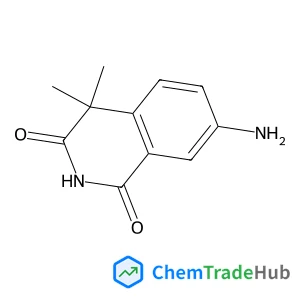
1,3(2H,4H)-Isoquinolinedione, 7-amino-4,4-dimethyl-
CAS Number:
14576-22-8
Molecular Formula:
C11H12N2O2
Massimiliano Porrini, Ryan Morris, Tom Smith, Stefan Weidt, C. Logan Mackay, Cait E. MacPhee, Perdita E. Barran
A prevalent type of protein misfolding causes the formation of β-sheet-rich structures known as amyloid fibrils. Research into the mechanisms of fibril formation has implications for both disease prevention and nanoscale templating technologies. This investigation into the aggregation of insulin utilises ion mobility mass spectrometry coupled with molecular modelling to identify and characterise oligomers formed during the ‘lag’ phase that precedes fibril growth. High resolution mass spectrometry and collision induced dissociation is used to unequivocally assign species as m/z coincident multimers or confomers, providing a robust analytical approach that supports the use of molecular dynamics to atomistically resolve the observed oligomers. We show that insulin oligomerises to form species In where 2 ≤ n ≤ 12 and within this set of oligomers we delineate over 60 distinct conformations, the most dominant of which are compact species. Modelling trained with experimental data suggests that the dominant compact dimers are enriched in β-sheet secondary structure and dominated by hydrophobic interactions, and provides a linear relationship between Rg and collision cross section. This approach provides detailed insight to the early stages of assembly of this much studied amyloidogenic protein, and can be used to inform models of nucleation and growth.
N. Zink-Lorre, E. Font-Sanchis, Á. Sastre-Santos, F. Fernández-Lázaro
DOI: 10.1039/C7QO00337D
Pengbo Zhang, Jianxi Ying, Guo Tang
DOI: 10.1039/C7QO00466D
Zhi-Xiang Zhang, Wei Wei, Fu-Quan Bai, Shamsa Bibi, Hong-Xing Zhang
DOI: 10.1039/C7QO00476A
Zhe Huang, Ming Zhan, Shaoguang Zhang, Qian Luo, Wen-Xiong Zhang
DOI: 10.1039/C7QO00287D
Jiuhan Gong, Ling Huang, Qidu Deng, Kun Jie, Yufeng Wang, Shengmei Guo, Hu Cai
DOI: 10.1039/C7QO00318H
Ibrahim Ata, Sadok Ben Dkhil, Martin Pfannmöller, Sara Bals, David Duché, Jean-Jacques Simon, Tomoyuki Koganezawa, Noriyuki Yoshimoto, Christine Videlot-Ackermann, Olivier Margeat, Jörg Ackermann, Peter Bäuerle
DOI: 10.1039/C7QO00222J
Huimin Dai, Chun-Xiao Li, Chao Yu, Zihao Wang, Hong Yan, Changsheng Lu
DOI: 10.1039/C7QO00333A
Xiaozhong Cheng, Tao Zhu, Haofei Hong, Zhifang Zhou, Zhimeng Wu
DOI: 10.1039/C7QO00481H
Yuhan Zhou, Huan Wang, Yang Liu, Yilong Zhao, Chunxia Zhang, Jingping Qu
DOI: 10.1039/C7QO00228A
DOI: 10.1039/C7QO00446J
When handling 4-Methyl-6-(trifluoromethyl)quinoline (CAS: 40716-16-3), safety go...
4-(3,5-Difluorophenyl)aniline is an aromatic organic compound with the CAS numbe...
5-{[4-(Trifluoromethyl)phenyl]sulfanyl}-1,2,3-thiadiazole-4-carboxylic acid can ...
The market for 4-Benzylaniline hydrochloride (CAS: 6317-57-3) is steadily growin...
[3-(Diethylsulfamoyl)phenyl]boronic acid is generally considered safe when handl...
3-Bromo-2,5-dimethoxyaniline is mainly used in the pharmaceutical and chemical i...
N-Methyl-1-(5-methyl-1H-indol-3-yl)methanamine (CAS: 915922-67-7) is subject to ...
This compound is primarily used in the pharmaceutical industry for the synthesis...
2-Methyl-2-propanyl [(1S,3R)-3-aminocyclohexyl]carbamate (CAS: 1298101-47-9) sho...
Ethyl 2-bromo-4,4,4-trifluorobutanoate (CAS: 367-33-9) is utilized in the pharma...

Analyst publishes analytical and bioanalytical research that reports premier fundamental discoveries and inventions, and the applications of those discoveries, unconfined by traditional discipline barriers.
![S-[2,3-Bis(palmitoyloxy)propyl]-N-[(9H-fluoren-9-ylmethoxy)(hydroxy)methylene]cysteine structure](https://static.chemtradehub.com/structs/210/210532-98-2-f6a7.webp "S-[2,3-Bis(palmitoyloxy)propyl]-N-[(9H-fluoren-9-ylmethoxy)(hydroxy)methylene]cysteine structure")