












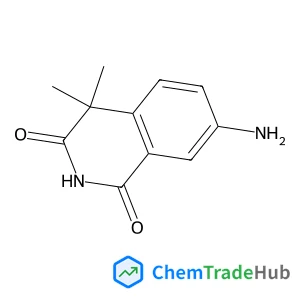
1,3(2H,4H)-Isoquinolinedione, 7-amino-4,4-dimethyl-
CAS Number:
14576-22-8
Molecular Formula:
C11H12N2O2
Gerdi Christine Kemmer, Sidsel Ammitzbøll Bogh, Michael Urban, Michael G. Palmgren, Tom Vosch, Jürgen Schiller, Thomas Günther Pomorski
Accurate real-time measurements of the dynamics of proton concentration gradients are crucial for detailed molecular studies of proton translocation by membrane-bound enzymes. To reduce complexity, these measurements are often carried out with purified, reconstituted enzyme systems. Yet the most paramount problem to detect pH changes in reconstituted systems is that soluble pH reporters leak out of the vesicle system during the reconstitution procedure. This requires loading of substantial amounts of pH-sensors into the lumen of unilamellar liposomes during reconstitution. Here, we report the synthesis and detailed characterisation of two lipid-linked pH sensors employing amine-reactive forms of seminaphthorhodafluors (SNARF®-1 dye) and rhodamine probes (pHrodo™ Red dye). Lipid-conjugation of both dyes allowed for efficient detergent-based reconstitution of these pH indicators into liposomes. Vesicle-embedded pHrodo™ displayed excellent photostability and an optimal pH-response between 4 and 7. The suitability of the lipid-linked pHrodo™ probe as a pH reporter was demonstrated by assaying the activity of a plant plasma membrane H+-ATPase (proton pump) reconstituted in proteoliposomes.
Ibrahim Ata, Sadok Ben Dkhil, Martin Pfannmöller, Sara Bals, David Duché, Jean-Jacques Simon, Tomoyuki Koganezawa, Noriyuki Yoshimoto, Christine Videlot-Ackermann, Olivier Margeat, Jörg Ackermann, Peter Bäuerle
DOI: 10.1039/C7QO00222J
Ze-lin Li, Li-kun Jin, Chun Cai
DOI: 10.1039/C7QO00396J
Shupeng Dong, Guibing Wu, Xiaoqian Yuan, Chuncheng Zou, Jinxing Ye
DOI: 10.1039/C7QO00453B
Changchun Yuan, Bo Liu
DOI: 10.1039/C8QO90004C
Zi Yang, Xing Lin, Lianhui Wang, Xiuling Cui
DOI: 10.1039/C7QO00541E
Yubo Pang, Mingyu Guan, Runsheng Zeng, Yingsheng Zhao
DOI: 10.1039/C7QO00710H
Peng Chen, Ying Sun, Yile Wu, Liu Leo Liu, Jun Zhu
DOI: 10.1039/C7QO00240H
Yujuan Zhou, Kecheng Jie, Feihe Huang
DOI: 10.1039/C7QO00736A
Wei-Wei Zhao
DOI: 10.1039/C7QO00621G
Yasuhiro Kubota, Masahiro Tsukamoto, Katsuhiro Ohnishi, Jiye Jin, Kazumasa Funabiki, Masaki Matsui
DOI: 10.1039/C7QO00225D
When handling 4-Methyl-6-(trifluoromethyl)quinoline (CAS: 40716-16-3), safety go...
4-(3,5-Difluorophenyl)aniline is an aromatic organic compound with the CAS numbe...
5-{[4-(Trifluoromethyl)phenyl]sulfanyl}-1,2,3-thiadiazole-4-carboxylic acid can ...
The market for 4-Benzylaniline hydrochloride (CAS: 6317-57-3) is steadily growin...
[3-(Diethylsulfamoyl)phenyl]boronic acid is generally considered safe when handl...
3-Bromo-2,5-dimethoxyaniline is mainly used in the pharmaceutical and chemical i...
N-Methyl-1-(5-methyl-1H-indol-3-yl)methanamine (CAS: 915922-67-7) is subject to ...
This compound is primarily used in the pharmaceutical industry for the synthesis...
2-Methyl-2-propanyl [(1S,3R)-3-aminocyclohexyl]carbamate (CAS: 1298101-47-9) sho...
Ethyl 2-bromo-4,4,4-trifluorobutanoate (CAS: 367-33-9) is utilized in the pharma...

Analyst publishes analytical and bioanalytical research that reports premier fundamental discoveries and inventions, and the applications of those discoveries, unconfined by traditional discipline barriers.
![(3R,5R)-1-[(Benzyloxy)carbonyl]-5-methyl-3-piperidinecarboxylic acid structure](https://static.chemtradehub.com/structs/126/1269757-29-0-c552.webp "(3R,5R)-1-[(Benzyloxy)carbonyl]-5-methyl-3-piperidinecarboxylic acid structure")

![[(1S,2S,3R,4S,7R,9S,10S,12R,15S)-4,12-Diacetyloxy-15-[(2R,3S)-3-benzamido-3-phenyl-2-(2,2,2-trichloroethoxycarbonyloxy)propanoyl]oxy-1,9-dihydroxy-10,14,17,17-tetramethyl-11-oxo-6-oxatetracyclo[11.3.1.03,10.04,7]heptadec-13-en-2-yl] benzoate structure](https://static.chemtradehub.com/structs/100/100431-55-8-7104.webp "[(1S,2S,3R,4S,7R,9S,10S,12R,15S)-4,12-Diacetyloxy-15-[(2R,3S)-3-benzamido-3-phenyl-2-(2,2,2-trichloroethoxycarbonyloxy)propanoyl]oxy-1,9-dihydroxy-10,14,17,17-tetramethyl-11-oxo-6-oxatetracyclo[11.3.1.03,10.04,7]heptadec-13-en-2-yl] benzoate structure")




