












How useful is molecular modelling in combination with ion mobility mass spectrometry for ‘small molecule’ ion mobility collision cross-sections?
Literature Information
Publication Date
2015-06-23
DOI
10.1039/C5AN00411J
Impact Factor
4.616
Authors
Cris Lapthorn, Frank S. Pullen, Babur Z. Chowdhry, Patricia Wright, George L. Perkins, Yanira Heredia
View Original
Abstract
Ion mobility mass spectrometry is used to measure the drift-time of an ion. The drift-time of an ion can be used to calculate the collision cross-section (CCS) in travelling wave ion mobility (e.g. Waters Synapt and Vion instruments) or directly determine the experimental CCS (e.g. Agilent 6560 instrument and many drift-tube instruments). A comparison of the experimental CCS and theoretical CCS values obtained from trajectory method He(g) parameterised MOBCAL and N2(g) parameterised MOBCAL software, for a range of 20 ‘small molecules’ is presented. This study utilises density functional theory B3LYP methods and the 6-31G+(d,p) basis set to calculate theoretical CCS values. This study seeks to assess the accuracy of a common procedure using CCS calibration with poly-(D/L)-alanine derived from drift-cell measurements and the original release of MOBCAL software and compare it with recent improvements with a drug-like molecule calibration set and a revision of MOBCAL parameterised for N2(g) drift gas. This study represents one of the first quantitative evaluations of the agreement between theoretical CCS and experimental CCS values for a range of small pharmaceutically relevant molecules using travelling wave ion mobility mass spectrometry. Accurate theoretical CCS may allow optimisation of ion mobility separations in silico, provide CCS databases that can confirm structures without the need for alternative analytical tools such as nuclear magnetic resonance spectroscopy (NMR) and assignment of unknowns and positional isomers without requiring reference materials.
Related Literature
Correction: Planar vs. three-dimensional X62−, X2Y42−, and X3Y32− (X, Y = B, Al, Ga) metal clusters: an analysis of their relative energies through the turn-upside-down approach
Ouissam El Bakouri, Miquel Solà
2018-01-23
Correction
DOI: 10.1039/C8CP90017E
The integration of experiment and computational modelling in heterogeneously catalysed ammonia synthesis over metal nitrides
Justin S. J. Hargreaves, Said Laassiri
2018-08-03
Perspective
DOI: 10.1039/C8CP04216K
Self-assembly of high-index faceted gold nanocrystals to fabricate tunable coupled plasmonic superlattices
Chunlin Guan, Ning Song, Yuanyuan Zhang, Hong Liu
2018-01-02
Paper
DOI: 10.1039/C7CP07112D
Central-metal effect on intramolecular vibrational energy transfer of M(CO)5Br (M = Mn, Re) probed by two-dimensional infrared spectroscopy
Fan Yang
2018-01-02
Paper
DOI: 10.1039/C7CP05117D
Probing the structural and electronic properties of zirconium doped boron clusters: Zr distorted B12 ligand framework
Xinxin Xia, Xiaoyu Kuang, Andreas Hermann
2018-08-24
Paper
DOI: 10.1039/C8CP03384F
Mechanistic insights into the formation of oxenium ions and radical intermediates through the photolysis of phenylhydroxylamine and its derivatives
Yumei Yang, Weihai Fang, Xuebo Chen
2017-12-18
Paper
DOI: 10.1039/C7CP07071C
Spectroscopic properties of LaGaO3:V,Nd3+ nanocrystals as a potential luminescent thermometer
K. Kniec, L. Marciniak
2018-07-31
Paper
DOI: 10.1039/C8CP04080J
Chemical dynamics simulations of CID of peptide ions: comparisons between TIK(H+)2 and TLK(H+)2 fragmentation dynamics, and with thermal simulations
Zahra Homayoon, Veronica Macaluso, Ana Martin-Somer, Maria Carolina Nicola Barbosa Muniz, Itamar Borges, Jr., William L. Hase, Riccardo Spezia
2018-01-02
Paper
DOI: 10.1039/C7CP06818B
A computational study of CO oxidation reactions on metal impurities in graphene divacancies
Yanan Tang, Weiguang Chen, Zigang Shen, Chenggang Li, Dongwei Ma, Xianqi Dai
2017-12-15
Paper
DOI: 10.1039/C7CP07397F
Tuning the indirect–direct band gap transition in the MoS2−xSex armchair nanotube by diameter modulation
Hong-Hui Wu, Qiangqiang Meng, He Huang, C. T. Liu, Xun-Li Wang
2018-01-02
Paper
DOI: 10.1039/C7CP08034D
You might also like
Compound Q&A
What precautions should be taken when handling 4-Methyl-6-(trifluoromethyl)quinoline (CAS: 40716-16-3)?
When handling 4-Methyl-6-(trifluoromethyl)quinoline (CAS: 40716-16-3), safety go...
40716-16-34-Methyl-6-(trifluor...
Compound Q&A
What is 4-(3,5-Difluorophenyl)aniline (CAS: 405058-00-6)?
4-(3,5-Difluorophenyl)aniline is an aromatic organic compound with the CAS numbe...
405058-00-64-(3,5-Difluoropheny...
Compound Q&A
How is 5-{[4-(Trifluoromethyl)phenyl]sulfanyl}-1,2,3-thiadiazole-4-carboxylic acid (CAS: 338982-07-3) typically synthesized?
5-{[4-(Trifluoromethyl)phenyl]sulfanyl}-1,2,3-thiadiazole-4-carboxylic acid can ...
338982-07-35-{[4-(Trifluorometh...
Compound Q&A
What is the market or research trend for 4-Benzylaniline hydrochloride (CAS: 6317-57-3)?
The market for 4-Benzylaniline hydrochloride (CAS: 6317-57-3) is steadily growin...
6317-57-34-Benzylaniline hydr...
Compound Q&A
Is [3-(Diethylsulfamoyl)phenyl]boronic acid (CAS: 871329-58-7) safe?
[3-(Diethylsulfamoyl)phenyl]boronic acid is generally considered safe when handl...
871329-58-7[3-(Diethylsulfamoyl...
Compound Q&A
What are the main uses of 3-Bromo-2,5-dimethoxyaniline (CAS: 115929-62-9)?
3-Bromo-2,5-dimethoxyaniline is mainly used in the pharmaceutical and chemical i...
115929-62-93-Bromo-2,5-dimethox...
Compound Q&A
What regulatory guidelines apply to N-Methyl-1-(5-methyl-1H-indol-3-yl)methanamine (CAS: 915922-67-7)?
N-Methyl-1-(5-methyl-1H-indol-3-yl)methanamine (CAS: 915922-67-7) is subject to ...
915922-67-7N-Methyl-1-(5-methyl...
Compound Q&A
What industries use Carbamic acid, N-[(5S)-5,6-diamino-6-oxohexyl]-, 1,1-dimethylethyl ester (CAS: 24828-96-4)?
This compound is primarily used in the pharmaceutical industry for the synthesis...
24828-96-4Carbamic acid, N-[(5...
Compound Q&A
How should 2-Methyl-2-propanyl [(1S,3R)-3-aminocyclohexyl]carbamate (CAS: 1298101-47-9) be stored?
2-Methyl-2-propanyl [(1S,3R)-3-aminocyclohexyl]carbamate (CAS: 1298101-47-9) sho...
1298101-47-92-Methyl-2-propanyl ...
Compound Q&A
What industries use Ethyl 2-bromo-4,4,4-trifluorobutanoate (CAS: 367-33-9)?
Ethyl 2-bromo-4,4,4-trifluorobutanoate (CAS: 367-33-9) is utilized in the pharma...
367-33-9Ethyl 2-bromo-4,4,4-...
Source Journal
Analyst

CiteScore:
7.8
Self-citation Rate:
5.6%
Articles per Year:
653
Analyst publishes analytical and bioanalytical research that reports premier fundamental discoveries and inventions, and the applications of those discoveries, unconfined by traditional discipline barriers.
Recommended Compounds
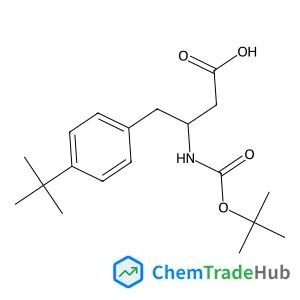
(S)-3-((tert-Butoxycarbonyl)amino)-4-(4-(tert-butyl)phenyl)butanoic acid
CAS Number:
403661-85-8
Molecular Formula:
C19H29NO4
Recommended Suppliers






Disclaimer
This page provides academic journal information for reference and research purposes only. We are not affiliated with any journal publishers and do not handle publication submissions. For publication-related inquiries, please contact the respective journal publishers directly.
If you notice any inaccuracies in the information displayed, please contact us at support@chemtradehub.com. We will promptly review and address your concerns.