












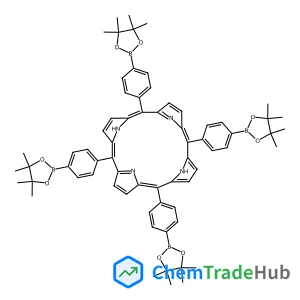
5,10,15,20-tetrakis(4-boronic acid pinacol ester phenyl) porphyrin
CAS Number:
1332748-00-1
Molecular Formula:
C68H74B4N4O8
Lei Xu, Wei Zhu, Rui Sun
A circular hydrophobic–hydrophilic-Ti4+ immobilized phosphate polymer is patterned on a silicon wafer. Such a wafer is used as a novel sample support to allow fast selective enrichment, wash-free self-desalting and mass spectroscopy (MS) analysis of phosphopeptides, thanks to the high Ti4+ loading amount, pure phosphate polymer–Ti4+ interface, and strong hydrophobic–hydrophilic attraction pattern. The detection sensitivity was enhanced 300 folds compared with what was obtained using the common MALDI plate. Remarkable selectivity for phosphopeptides can be achieved at a molar ratio as low as 1 : 500 of phosphopeptides (casein digest)/nonphosphopeptides (BSA). High-quality mass spectra can be obtained even in the presence of NaCl (1 M), NH4HCO3 (100 mM), or urea (1 M). These microspots were also used to selectively capture phosphopeptides from milk and human serum, which further demonstrated that they were capable of identifying low-abundance phosphopeptides from real complex samples. They provide a low detection limit (3 fmol μL−1), small sample size, and excellent enrichment and desalting efficiency. Such a method significantly simplifies the analytical procedures, reduces possible sample loss, and is relatively low cost. Therefore, this on-plate patterned technique is very promising in the high-throughput phosphoproteomic research, especially for the detection of tiny amounts of samples.
Yoichi Otsuka, Koji Makara, Shuya Satoh, Hiroyuki Hashimoto, Yasuyuki Ozeki
DOI: 10.1039/C5AN00335K
Hongyan Wang, Jinmei Fang, Jifei Xu, Fan Wang, Bai Sun, Shengnan He, Guoping Sun, Honglin Liu
DOI: 10.1039/C5AN00232J
W. B. Struwe, J. L. Benesch, D. J. Harvey
DOI: 10.1039/C5AN01092F
Gregory Q. Wallace, Mariachiara S. Zuin, Mohammadali Tabatabaei, Pierangelo Gobbo, François Lagugné-Labarthet, Mark S. Workentin
DOI: 10.1039/C5AN01127B
Mohammad Ali Al-Ameen, Ji Li, David G. Beer, Gargi Ghosh
DOI: 10.1039/C5AN00358J
Mark Burgess, Bobby Reddy, Jr., Eric Salm, Yi-Shao Liu, Joaquin Rodriguez-Lopez
DOI: 10.1039/C5AN00085H
Cris Lapthorn, Frank S. Pullen, Babur Z. Chowdhry, Patricia Wright, George L. Perkins, Yanira Heredia
DOI: 10.1039/C5AN00411J
Ping Liu, Xiaotong Jing, Changjun Lv
DOI: 10.1039/C5AN00759C
When handling 4-Methyl-6-(trifluoromethyl)quinoline (CAS: 40716-16-3), safety go...
4-(3,5-Difluorophenyl)aniline is an aromatic organic compound with the CAS numbe...
5-{[4-(Trifluoromethyl)phenyl]sulfanyl}-1,2,3-thiadiazole-4-carboxylic acid can ...
The market for 4-Benzylaniline hydrochloride (CAS: 6317-57-3) is steadily growin...
[3-(Diethylsulfamoyl)phenyl]boronic acid is generally considered safe when handl...
3-Bromo-2,5-dimethoxyaniline is mainly used in the pharmaceutical and chemical i...
N-Methyl-1-(5-methyl-1H-indol-3-yl)methanamine (CAS: 915922-67-7) is subject to ...
This compound is primarily used in the pharmaceutical industry for the synthesis...
2-Methyl-2-propanyl [(1S,3R)-3-aminocyclohexyl]carbamate (CAS: 1298101-47-9) sho...
Ethyl 2-bromo-4,4,4-trifluorobutanoate (CAS: 367-33-9) is utilized in the pharma...

Analyst publishes analytical and bioanalytical research that reports premier fundamental discoveries and inventions, and the applications of those discoveries, unconfined by traditional discipline barriers.
![6,7-Dihydro-5H-pyrrolo[1,2-a]imidazole-6-carboxylic acid structure](https://static.chemtradehub.com/structs/136/1369160-12-2-6524.webp "6,7-Dihydro-5H-pyrrolo[1,2-a]imidazole-6-carboxylic acid structure")
![N-{3-[Benzyl(methyl)amino]propyl}-9-chloro-5,6,7,8-tetrahydro-2-acridinecarboxamide structure](https://static.chemtradehub.com/structs/142/1426944-49-1-1e4c.webp "N-{3-[Benzyl(methyl)amino]propyl}-9-chloro-5,6,7,8-tetrahydro-2-acridinecarboxamide structure")




