












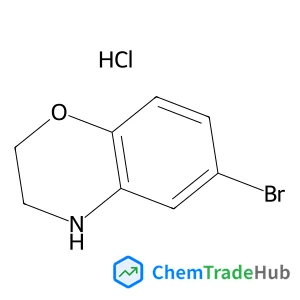
6-Bromo-3,4-dihydro-2H-1,4-benzoxazine hydrochloride (1:1)
CAS Number:
1260803-10-8
Molecular Formula:
C8H9BrClNO
H. Mendil-Jakani, I. Zamanillo Lopez, P. M. Legrand, V. H. Mareau, L. Gonon
The structure of a commercial sulfonated poly(ether ether ketone) (sPEEK) membrane was analyzed by Small-Angle X-Ray Scattering (SAXS) for different water uptakes obtained after immersion in liquid water at various temperatures. For low membrane swelling, the SAXS profile displays only a wide-angle peak in the 0.2–0.3 Å−1 region. As the membrane swells, two supplementary correlation peaks arise and shift towards small angles, which are the signature of a structural evolution of the membrane, whereas the wide angle peak remains stable. The SAXS spectra of sPEEK membranes can thus display three correlation peaks simultaneously. Therefore we propose a new interpretation of these SAXS spectra which conclude that the two small angle peaks are attributed to the so-called matrix and ionomer peaks and the wide-angle peak is ascribed to the mean separation distance between sulfonic acid groups grafted onto the polymer backbone. This peak attribution implies that the sPEEK nano-phase separation is triggered by an immersion in hot water (ionomer peak apparition). Our new peak attribution was confirmed by studying the impact of temperature, electron density contrast and ionic exchange capacity.
Abbasriyaludeen Abdul Raheem, Santhosh Kamaraj, Veeman Sannasi, Chandrasekar Praveen
DOI: 10.1039/C7QO00920H
Qi Yang, Liang Liu, Yue Chi, Wei Hao, Wen-Xiong Zhang
DOI: 10.1039/C7QO00927E
Xiaozhong Cheng, Tao Zhu, Haofei Hong, Zhifang Zhou, Zhimeng Wu
DOI: 10.1039/C7QO00481H
Rita Mocci, Sergio Murgia, Lidia De Luca, Francesco Delogu, Andrea Porcheddu
DOI: 10.1039/C7QO01006K
Jing Zeng, Guangfei Sun, Ruobin Wang, Shuxin Zhang, Shuang Teng, Zhiwen Liao, Lingkui Meng
DOI: 10.1039/C7QO00648A
Jing Liu, Weipeng Li, Jin Xie
DOI: 10.1039/C7QO00808B
Wannaporn Disadee
DOI: 10.1039/C7QO00406K
Jundong Li, Yilin Ye, Yandong Zhang
DOI: 10.1039/C7QO01077J
Wenpeng Dai, Yingyin Lin, Yan Wan, Song Cao
DOI: 10.1039/C7QO00716G
Tanzeel Arif, Cyril Borie, Marion Jean, Nicolas Vanthuyne, Michèle P. Bertrand, Didier Siri, Malek Nechab
DOI: 10.1039/C7QO00288B
When handling 4-Methyl-6-(trifluoromethyl)quinoline (CAS: 40716-16-3), safety go...
4-(3,5-Difluorophenyl)aniline is an aromatic organic compound with the CAS numbe...
5-{[4-(Trifluoromethyl)phenyl]sulfanyl}-1,2,3-thiadiazole-4-carboxylic acid can ...
The market for 4-Benzylaniline hydrochloride (CAS: 6317-57-3) is steadily growin...
[3-(Diethylsulfamoyl)phenyl]boronic acid is generally considered safe when handl...
3-Bromo-2,5-dimethoxyaniline is mainly used in the pharmaceutical and chemical i...
N-Methyl-1-(5-methyl-1H-indol-3-yl)methanamine (CAS: 915922-67-7) is subject to ...
This compound is primarily used in the pharmaceutical industry for the synthesis...
2-Methyl-2-propanyl [(1S,3R)-3-aminocyclohexyl]carbamate (CAS: 1298101-47-9) sho...
Ethyl 2-bromo-4,4,4-trifluorobutanoate (CAS: 367-33-9) is utilized in the pharma...

Physical Chemistry Chemical Physics (PCCP) is an international journal co-owned by 19 physical chemistry and physics societies from around the world. This journal publishes original, cutting-edge research in physical chemistry, chemical physics and biophysical chemistry. To be suitable for publication in PCCP, articles must include significant innovation and/or insight into physical chemistry; this is the most important criterion that reviewers and Editors will judge against when evaluating submissions. The journal has a broad scope and welcomes contributions spanning experiment, theory, computation and data science. Topical coverage includes spectroscopy, dynamics, kinetics, statistical mechanics, thermodynamics, electrochemistry, catalysis, surface science, quantum mechanics, quantum computing and machine learning. Interdisciplinary research areas such as polymers and soft matter, materials, nanoscience, energy, surfaces/interfaces, and biophysical chemistry are welcomed if they demonstrate significant innovation and/or insight into physical chemistry. Joined experimental/theoretical studies are particularly appreciated when complementary and based on up-to-date approaches.

![(2E)-3-(3-Chlorophenyl)-N-{2-[4-(methylsulfonyl)-1-piperazinyl]-2-oxoethyl}acrylamide structure](https://static.chemtradehub.com/structs/250/2505001-54-5-c1e9.webp "(2E)-3-(3-Chlorophenyl)-N-{2-[4-(methylsulfonyl)-1-piperazinyl]-2-oxoethyl}acrylamide structure")






