


Simple preparation of positively charged silver nanoparticles for detection of anions by surface-enhanced Raman spectroscopy
Literature Information
Publication Date
2015-02-25
DOI
10.1039/C4AN02305F
Impact Factor
4.616
Authors
A. Stewart, S. Murray, S. E. J. Bell
View Original
Abstract
Modification of citrate and hydroxylamine reduced Ag colloids with thiocholine bromide, a thiol functionalized quaternary ammonium salt, creates particles where the zeta potential is switched from the normal values of ca. −50 mV to ca. +50 mV. These colloids are stable but can be aggregated with metal salts in much the same way as the parent colloids. They are excellent SERS substrates for detection of anionic targets since their positive zeta potentials promote adsorption of negatively charged ions. This is important because the vast majority of published SERS studies involve cationic or neutral targets. Moreover, the fact that the modifier is a quaternary ammonium ion means that the negative surface charge is maintained even at alkaline pH. The modified colloids can be used to detect compounds which cannot be detected using conventional negatively-charged citrate or hydroxylamine reduced metal nanoparticles, for example the detection limit was 5.0 × 10⁻⁵ M for perchlorate and <8.7 × 10⁻⁷ M for tetraphenylporphine tetrasulfonic acid (TPPS). More importantly, picric acid (an explosive) and diclofenac (a non-steroidal anti-inflammatory) could also be analysed quantitatively at low concentrations, 2.5 × 10⁻⁵ M and 1.9 × 10⁻⁵ M, respectively. Interestingly, the correct choice of aggregating agent is important for achieving high sensitivity since the anion in the aggregating salt may compete with anionic targets for surface binding sites. Finally, since the modification procedure simply involves reaction of nanoparticles with a small alkyl thiol derivative, it can easily be adapted to other particle morphologies or metals.
Recommended Journals

Russian Journal of Bioorganic Chemistry

Current Opinion in Solid State & Materials Science

Russian Chemical Bulletin

Russian Journal of Applied Chemistry

Chemical Communications

Organic Process Research & Development

Chemistry Education Research and Practice

Acta Materialia

Journal of Natural Medicines

Nature Medicine
Related Literature
Mechanistic insights into the formation of oxenium ions and radical intermediates through the photolysis of phenylhydroxylamine and its derivatives
Yumei Yang, Weihai Fang, Xuebo Chen
2017-12-18
Paper
DOI: 10.1039/C7CP07071C
Fragment motion in motor molecules: basic concepts and application to intra-molecular rotations
Klaus E. Hermann, Fei Qi, Rundong Zhao, Michel A. Van Hove
2018-08-02
Paper
DOI: 10.1039/C8CP03076F
Cluster-model DFT simulations of the infrared spectra of triazine-based molecular crystals
Xiaohong Yuan, Nan Liu, Xueqiang Ji, Chao Liu, Julong He, Guangjun Tian, Yuanchun Zhao, Dongli Yu
2018-05-24
Paper
DOI: 10.1039/C8CP01550C
Hexagonal Ti2B2 monolayer: a promising anode material offering high rate capability for Li-ion and Na-ion batteries
Olle Eriksson
2018-08-03
Paper
DOI: 10.1039/C8CP03362E
Improved multivariate analysis for fast and selective monitoring of structural dynamics by in situ X-ray powder diffraction‡
Pietro Guccione, Marco Milanesio, Benny Danilo Belviso, Rocco Caliandro
2017-10-26
Paper
DOI: 10.1039/C7CP06326A
Hot kinetic model as a guide to improve organic photovoltaic materials
Andrey Yu. Sosorev, Dmitry Yu. Godovsky
2018-01-04
Paper
DOI: 10.1039/C7CP06158G
Towards a coarse-grained model of the peptoid backbone: the case of N,N-dimethylacetamide
Pu Du, Steven W. Rick, Revati Kumar
2018-08-27
Paper
DOI: 10.1039/C8CP03283A
Local structural changes in graphene oxide layers induced by silver nanoparticles‡
Sanpon Vantasin, Oraporn Wong-u-ra, Yasutaka Kitahama, Sanong Ekgasit, Yukihiro Ozaki
2018-07-24
Paper
DOI: 10.1039/C8CP02108B
You might also like
Compound Q&A
What precautions should be taken when handling 4-Methyl-6-(trifluoromethyl)quinoline (CAS: 40716-16-3)?
When handling 4-Methyl-6-(trifluoromethyl)quinoline (CAS: 40716-16-3), safety go...
40716-16-34-Methyl-6-(trifluor...
Compound Q&A
What is 4-(3,5-Difluorophenyl)aniline (CAS: 405058-00-6)?
4-(3,5-Difluorophenyl)aniline is an aromatic organic compound with the CAS numbe...
405058-00-64-(3,5-Difluoropheny...
Compound Q&A
How is 5-{[4-(Trifluoromethyl)phenyl]sulfanyl}-1,2,3-thiadiazole-4-carboxylic acid (CAS: 338982-07-3) typically synthesized?
5-{[4-(Trifluoromethyl)phenyl]sulfanyl}-1,2,3-thiadiazole-4-carboxylic acid can ...
338982-07-35-{[4-(Trifluorometh...
Compound Q&A
What is the market or research trend for 4-Benzylaniline hydrochloride (CAS: 6317-57-3)?
The market for 4-Benzylaniline hydrochloride (CAS: 6317-57-3) is steadily growin...
6317-57-34-Benzylaniline hydr...
Compound Q&A
Is [3-(Diethylsulfamoyl)phenyl]boronic acid (CAS: 871329-58-7) safe?
[3-(Diethylsulfamoyl)phenyl]boronic acid is generally considered safe when handl...
871329-58-7[3-(Diethylsulfamoyl...
Compound Q&A
What are the main uses of 3-Bromo-2,5-dimethoxyaniline (CAS: 115929-62-9)?
3-Bromo-2,5-dimethoxyaniline is mainly used in the pharmaceutical and chemical i...
115929-62-93-Bromo-2,5-dimethox...
Compound Q&A
What regulatory guidelines apply to N-Methyl-1-(5-methyl-1H-indol-3-yl)methanamine (CAS: 915922-67-7)?
N-Methyl-1-(5-methyl-1H-indol-3-yl)methanamine (CAS: 915922-67-7) is subject to ...
915922-67-7N-Methyl-1-(5-methyl...
Compound Q&A
What industries use Carbamic acid, N-[(5S)-5,6-diamino-6-oxohexyl]-, 1,1-dimethylethyl ester (CAS: 24828-96-4)?
This compound is primarily used in the pharmaceutical industry for the synthesis...
24828-96-4Carbamic acid, N-[(5...
Compound Q&A
How should 2-Methyl-2-propanyl [(1S,3R)-3-aminocyclohexyl]carbamate (CAS: 1298101-47-9) be stored?
2-Methyl-2-propanyl [(1S,3R)-3-aminocyclohexyl]carbamate (CAS: 1298101-47-9) sho...
1298101-47-92-Methyl-2-propanyl ...
Compound Q&A
What industries use Ethyl 2-bromo-4,4,4-trifluorobutanoate (CAS: 367-33-9)?
Ethyl 2-bromo-4,4,4-trifluorobutanoate (CAS: 367-33-9) is utilized in the pharma...
367-33-9Ethyl 2-bromo-4,4,4-...
Source Journal
Analyst

CiteScore:
7.8
Self-citation Rate:
5.6%
Articles per Year:
653
Analyst publishes analytical and bioanalytical research that reports premier fundamental discoveries and inventions, and the applications of those discoveries, unconfined by traditional discipline barriers.
Recommended Compounds
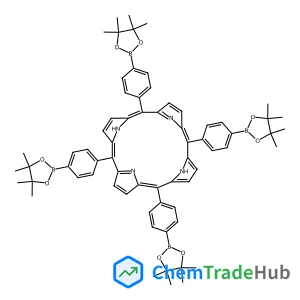
5,10,15,20-tetrakis(4-boronic acid pinacol ester phenyl) porphyrin
CAS Number:
1332748-00-1
Molecular Formula:
C68H74B4N4O8
![[3-(2,6-Dichlorophenyl)-5-isopropyl-1,2-oxazol-4-yl]methanol structure](https://static.chemtradehub.com/structs/278/278597-30-1-5c79.webp "[3-(2,6-Dichlorophenyl)-5-isopropyl-1,2-oxazol-4-yl]methanol structure")
[3-(2,6-Dichlorophenyl)-5-isopropyl-1,2-oxazol-4-yl]methanol
CAS Number:
278597-30-1
Molecular Formula:
C13H13Cl2NO2
![Imidazo[1,2-c]pyrimidine structure](https://static.chemtradehub.com/structs/274/274-78-2-8b4c.webp "Imidazo[1,2-c]pyrimidine structure")
![N-{3-[Benzyl(methyl)amino]propyl}-9-chloro-5,6,7,8-tetrahydro-2-acridinecarboxamide structure](https://static.chemtradehub.com/structs/142/1426944-49-1-1e4c.webp "N-{3-[Benzyl(methyl)amino]propyl}-9-chloro-5,6,7,8-tetrahydro-2-acridinecarboxamide structure")
N-{3-[Benzyl(methyl)amino]propyl}-9-chloro-5,6,7,8-tetrahydro-2-acridinecarboxamide
CAS Number:
1426944-49-1
Molecular Formula:
C25H28ClN3O
Recommended Suppliers




Disclaimer
This page provides academic journal information for reference and research purposes only. We are not affiliated with any journal publishers and do not handle publication submissions. For publication-related inquiries, please contact the respective journal publishers directly.
If you notice any inaccuracies in the information displayed, please contact us at support@chemtradehub.com. We will promptly review and address your concerns.