











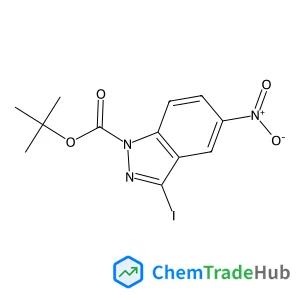
Tert-butyl 3-iodo-5-nitro-1H-indazole-1-carboxylate
CAS Number:
459133-69-8
Molecular Formula:
C12H12IN3O4
Eunjoo Lee, Jungwoo Sung, Taechang An, Heungjoo Shin, Hong Gil Nam, Geunbae Lim
The application of nanomaterials for biosensors and fuel cells is becoming more common, but it requires an understanding of the relationship between the structure and electrochemical characteristics of the materials at the nanoscale. Herein, we report the development of scanning electrochemical microscopy–atomic force microscopy (SECM–AFM) nanoprobes for collecting spatially resolved data regarding the electrochemical activity of nanomaterials such as carbon nanotube (CNT) networks. The fabrication of the nanoprobe begins with the integration of a CNT-bundle wire into a conventional AFM probe followed by the deposition of an insulating layer and cutting of the probe end. In addition, a protrusive insulating tip is integrated at the end of the insulated CNT-bundle wire to maintain a constant distance between the nanoelectrode and the substrate; this yields an L-shaped nanoprobe. The resulting nanoprobes produced well-fitted maps of faradaic current data with less than 300 nm spatial resolution and topographical images of CNT networks owing to the small effective distance (of the order of tens of nanometers) between the electrode and the substrate. Electrochemical imaging using the L-shaped nanoprobe revealed that the electrochemical activity of the CNT network is not homogeneous and provided further understanding of the relationship between the topography and electrochemical characteristics of CNT networks.
Leo Yuxiu Li, Nathan A. Seifert, Fan Xie, Matthias Heger, Yunjie Xu, Wolfgang Jäger
DOI: 10.1039/C8CP03342K
Zhe Fang, Jianfeng Wang, Shijie Zhu, Xiaofan Yang, Qiang Sun, Shaokang Guan
DOI: 10.1039/C7CP07431J
Vivekanand Shukla, Rafael B. Araujo, Naresh K. Jena
DOI: 10.1039/C8CP03686A
Li Shen, Zhaofeng Tang, Xuemin Wang, Heyuan Liu, Yanli Chen, Xiyou Li
DOI: 10.1039/C8CP03216E
Hung-Cheng Chen, Andrew R. Cook, Sadayuki Asaoka, Jeffery S. Boschen, Theresa L. Windus, John R. Miller
DOI: 10.1039/C8CP90016G
DOI: 10.1039/C8CP02898B
A. D. Protopopova, V. B. Tsvetkov, A. M. Varizhuk, N. A. Barinov, V. V. Podgorsky, D. V. Klinov, G. E. Pozmogova
DOI: 10.1039/C7CP05380K
Aleksandra Vojvodic
DOI: 10.1039/C7CP06539F
When handling 4-Methyl-6-(trifluoromethyl)quinoline (CAS: 40716-16-3), safety go...
4-(3,5-Difluorophenyl)aniline is an aromatic organic compound with the CAS numbe...
5-{[4-(Trifluoromethyl)phenyl]sulfanyl}-1,2,3-thiadiazole-4-carboxylic acid can ...
The market for 4-Benzylaniline hydrochloride (CAS: 6317-57-3) is steadily growin...
[3-(Diethylsulfamoyl)phenyl]boronic acid is generally considered safe when handl...
3-Bromo-2,5-dimethoxyaniline is mainly used in the pharmaceutical and chemical i...
N-Methyl-1-(5-methyl-1H-indol-3-yl)methanamine (CAS: 915922-67-7) is subject to ...
This compound is primarily used in the pharmaceutical industry for the synthesis...
2-Methyl-2-propanyl [(1S,3R)-3-aminocyclohexyl]carbamate (CAS: 1298101-47-9) sho...
Ethyl 2-bromo-4,4,4-trifluorobutanoate (CAS: 367-33-9) is utilized in the pharma...

Analyst publishes analytical and bioanalytical research that reports premier fundamental discoveries and inventions, and the applications of those discoveries, unconfined by traditional discipline barriers.
![(4aR,5S,6R,8aS)-5-[2-(3-Furyl)ethyl]-8a-(hydroxymethyl)-5,6-dimethyl-3,4,4a,5,6,7,8,8a-octahydro-1-naphthalenecarboxylic acid structure](https://static.chemtradehub.com/structs/184/18411-75-1-d4cd.webp "(4aR,5S,6R,8aS)-5-[2-(3-Furyl)ethyl]-8a-(hydroxymethyl)-5,6-dimethyl-3,4,4a,5,6,7,8,8a-octahydro-1-naphthalenecarboxylic acid structure")
![N-{3-[Benzyl(methyl)amino]propyl}-9-chloro-5,6,7,8-tetrahydro-2-acridinecarboxamide structure](https://static.chemtradehub.com/structs/142/1426944-49-1-1e4c.webp "N-{3-[Benzyl(methyl)amino]propyl}-9-chloro-5,6,7,8-tetrahydro-2-acridinecarboxamide structure")




