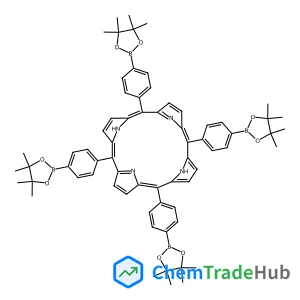
5,10,15,20-tetrakis(4-boronic acid pinacol ester phenyl) porphyrin
CAS Number:
1332748-00-1
Molecular Formula:
C68H74B4N4O8
Huimin Deng, Xinjian Yang, Zhiqiang Gao
As one of the inorganic graphene analogues, two dimensional MoS2 nanosheets have been drawing extensive attention in the past few years due to their remarkable structural and electronic properties. Herein, a simple signal-on fluorescence DNA methyltransferase (MTase) activity assay using a MoS2 nanosheet mediated fluorescence quenching strategy is described. Briefly, substrate DNA is designed to possess a double-stranded DNA (ds-DNA) segment containing the recognition sequence of DNA adenosine methyltransferase (Dam) and a single-stranded DNA (ss-DNA) segment for anchoring the substrate DNA to MoS2 nanosheets via van der Waals interactions. Once the substrate DNA is absorbed onto MoS2 nanosheets, the fluorescence of the fluorophores labeled to the end of the ds-DNA region is quenched. When the substrate DNA is methylated by Dam, fluorescence is recovered resulting from the release of the fluorophore labeled segment cleaved by the methylation sensitive restriction endonuclease DpnI. Since the fluorescence recovery directly reflects the methylation level, the Dam MTase activity can be quantified accordingly. Based on this assay, a linear range of 0.2–20 U mL−1 is achieved with high sensitivity and selectivity. Furthermore, the inhibitor screening ability is well demonstrated.

Chemistry Education Research and Practice

Journal of Natural Medicines

Current Opinion in Colloid & Interface Science

Russian Journal of Applied Chemistry

Acta Materialia

Saudi Pharmaceutical Journal

Russian Journal of General Chemistry

Russian Journal of Organic Chemistry

Organic Process Research & Development

Current Opinion in Solid State & Materials Science
Bin Liu, Meihua Gao, Haiping Li, Jianqiang Liu, Shiling Yuan, Na Du
DOI: 10.1039/C8CP90011F
Andrey G. Cherstvy, Oliver Nagel, Carsten Beta, Ralf Metzler
DOI: 10.1039/C8CP04254C
Hung-Cheng Chen, Andrew R. Cook, Sadayuki Asaoka, Jeffery S. Boschen, Theresa L. Windus, John R. Miller
DOI: 10.1039/C8CP90016G
Gehong Su, Liyang Jia, Xueqian Zhang, Yulin Zhang, Pengchi Deng, Tao Zhou
DOI: 10.1039/C8CP02429D
Montserrat Manadé, Francesc Viñes, Francesc Illas
DOI: 10.1039/C7CP07995H
Shilpa R. Nath, Kaustubh A. Joshi
DOI: 10.1039/C8CP01045E
Renlu Han, Weiping Li, Laihui Luo, Weidong Fei
DOI: 10.1039/C8CP04072A
Olle Eriksson
DOI: 10.1039/C8CP03362E
When handling 4-Methyl-6-(trifluoromethyl)quinoline (CAS: 40716-16-3), safety go...
4-(3,5-Difluorophenyl)aniline is an aromatic organic compound with the CAS numbe...
5-{[4-(Trifluoromethyl)phenyl]sulfanyl}-1,2,3-thiadiazole-4-carboxylic acid can ...
The market for 4-Benzylaniline hydrochloride (CAS: 6317-57-3) is steadily growin...
[3-(Diethylsulfamoyl)phenyl]boronic acid is generally considered safe when handl...
3-Bromo-2,5-dimethoxyaniline is mainly used in the pharmaceutical and chemical i...
N-Methyl-1-(5-methyl-1H-indol-3-yl)methanamine (CAS: 915922-67-7) is subject to ...
This compound is primarily used in the pharmaceutical industry for the synthesis...
2-Methyl-2-propanyl [(1S,3R)-3-aminocyclohexyl]carbamate (CAS: 1298101-47-9) sho...
Ethyl 2-bromo-4,4,4-trifluorobutanoate (CAS: 367-33-9) is utilized in the pharma...

Analyst publishes analytical and bioanalytical research that reports premier fundamental discoveries and inventions, and the applications of those discoveries, unconfined by traditional discipline barriers.