












Salt-induced reentrant hydrogel of poly(ethylene glycol)–poly(lactide-co-glycolide) block copolymers
Literature Information
Publication Date
2013-09-26
DOI
10.1039/C3PY01107K
Impact Factor
5.582
Authors
Ting Li, Tianyuan Ci, Liang Chen, Lin Yu, Jiandong Ding
View Original
Abstract
A diblock copolymer of methoxy poly(ethylene glycol) and poly(DL-lactide-co-glycolide) (MPEG–PLGA) was synthesized via ring-opening polymerization. Its aqueous system over the critical gelation concentration underwent a gel-to-sol transition with increasing the temperature. More interestingly, gel-to-sol-to-(reentrant gel) transitions upon heating were found in the presence of salts. The reentrant gel and virgin gel exhibited different viscoelasticities, as revealed by dynamic rheological measurements, and different microstructures displayed in cryo-SEM images. Based on the observations of micelle formation at low copolymer concentrations and NMR detections at high concentrations etc., we anticipated that the virgin gel was formed by the jamming of close-packed micelles and the reentrant gel had, as a thermogel, an internal structure of a percolated micelle network. The phase transition temperatures varied with the salt concentration, and depended also on the type of ion, with the trend obeying the Hofmeister series.
Recommended Journals
Related Literature
Analysis of reduced paramagnetic shifts as an effective tool in NMR spectroscopy
Igor A. Nikovskiy, Dmitry Y. Aleshin
2021-12-06
Paper
DOI: 10.1039/D1CP04648A
Directed gas-phase preparation of the elusive phosphinosilylidyne (SiPH2, X2A′′) and cis/trans phosphinidenesilyl (HSiPH; X2A′) radicals under single-collision conditions
Chao He, Shane J. Goettl, Zhenghai Yang, Srinivas Doddipatla, Ralf I. Kaiser, Mateus Xavier Silva, Breno R. L. Galvão
2021-08-12
Paper
DOI: 10.1039/D1CP02812J
One order of magnitude increase of triplet state lifetime observed in deprotonated form selenium substituted uracil
Peipei Jin, Xueli Wang, Haifeng Pan
2021-12-01
Paper
DOI: 10.1039/D1CP04811B
Effects of strain and electric fields on the electronic transport properties of single-layer β12-borophene nanoribbons
M. Davoudiniya, K. Mirabbaszadeh
2021-08-06
Paper
DOI: 10.1039/D1CP00340B
Impact of fluorination and chlorination on the electronic structure, topology and in-plane ring normal modes of pyridines
Enrico Benassi, Tamara Vaganova, Evgenij Malykhin, Haiyan Fan
2021-07-29
Paper
DOI: 10.1039/D1CP02342J
Crucial impact of exchange between layers on temperature programmed desorption
Tobias Dickbreder, Ralf Bechstein, Angelika Kühnle
2021-08-06
Paper
DOI: 10.1039/D1CP01924D
Improving the theoretical description of Ln(iii)/An(iii) separation with phosphinic acid ligands: a benchmarking study of structure and selectivity‡
Robert C. Chapleski, Jr., Alexander S. Ivanov, Kirk A. Peterson, Vyacheslav S. Bryantsev
2021-08-17
Paper
DOI: 10.1039/D1CP02466C
Vacancy-triggered and dopant-assisted NO electrocatalytic reduction over MoS2
Chao Wu
2021-08-16
Paper
DOI: 10.1039/D1CP02764F
The NV−⋯N+ charged pair in diamond: a quantum-mechanical investigation
Anna Maria Ferrari, Khaled E. El-Kelany, Francesco Silvio Gentile, Maddalena D’Amore, Roberto Dovesi
2021-08-12
Paper
DOI: 10.1039/D1CP02363B
Investigating the role of Cu-oxo species in Cu-nitrate formation over Cu-CHA catalysts
Chiara Negri, Gabriele Deplano, Kirill A. Lomachenko, Ton V. W. Janssens, Elisa Borfecchia, Gloria Berlier, Silvia Bordiga
2021-08-13
Paper
DOI: 10.1039/D1CP01754C
You might also like
Compound Q&A
What are the main uses of 4-Nitrophenyl phosphate disodium salt hexahydrate (CAS: 333338-18-4)?
4-Nitrophenyl phosphate disodium salt hexahydrate is primarily used as a substra...
333338-18-44-Nitrophenyl phosph...
Compound Q&A
What are the main uses of 2-(Trifluoromethyl)-1,3-oxazole-4-carboxylic Acid (CAS: 1060816-01-4)?
2-(Trifluoromethyl)-1,3-oxazole-4-carboxylic Acid (CAS: 1060816-01-4) is widely ...
1060816-01-42-(Trifluoromethyl)-...
Compound Q&A
How should 2-Fluoro-4-biphenylcarboxylic acid (CAS: 137045-30-8) be stored?
2-Fluoro-4-biphenylcarboxylic acid should be stored in a cool, dry place at room...
137045-30-82-Fluoro-4-biphenylc...
Compound Q&A
What industries use Prednisolone-21-Carboxylic Acid (CAS: 61549-70-0)?
Prednisolone-21-Carboxylic Acid is primarily used in the pharmaceutical industry...
61549-70-0Prednisolone-21-Carb...
Compound Q&A
How should 4-(Hydrazinomethyl)-1,2,3-benzenetriol (CAS: 3614-72-0) be stored?
4-(Hydrazinomethyl)-1,2,3-benzenetriol (CAS: 3614-72-0) should be stored in a co...
3614-72-04-(Hydrazinomethyl)-...
Compound Q&A
What industries use 4-Amino-1-methyl-1H-pyrazole-5-carboxylic acid hydrochloride (CAS: 92534-70-8)?
4-Amino-1-methyl-1H-pyrazole-5-carboxylic acid hydrochloride (CAS: 92534-70-8) i...
92534-70-84-Amino-1-methyl-1H-...
Compound Q&A
What regulatory guidelines apply to dehydropachymic acid (CAS: 77012-31-8)?
Dehydropachymic acid (CAS: 77012-31-8) is regulated by various agencies. It fall...
77012-31-8Dehydropachymic acid
Compound Q&A
What is the market or research trend for 6-[(2,2-Dimethylpropanoyl)amino]nicotinic acid (CAS: 898561-66-5)?
The market and research trends for 6-[(2,2-Dimethylpropanoyl)amino]nicotinic aci...
898561-66-56-[(2,2-Dimethylprop...
Compound Q&A
How should 1,10-Phenanthroline-2,9-dicarbaldehyde (CAS: 57709-62-3) be stored?
1,10-Phenanthroline-2,9-dicarbaldehyde should be stored in a cool, dry place awa...
57709-62-31,10-Phenanthroline-...
Compound Q&A
How is 5-Carbamoyl-11-oxo-10,11-dihydro-5H-dibenzo[b,f]azepin-10-yl acetate (CAS: 113952-21-9) typically synthesized?
5-Carbamoyl-11-oxo-10,11-dihydro-5H-dibenzo[b,f]azepin-10-yl acetate can be synt...
113952-21-95-Carbamoyl-11-oxo-1...
Source Journal
Polymer Chemistry

CiteScore:
8.6
Self-citation Rate:
7.3%
Articles per Year:
457
Polymer Chemistry welcomes submissions in all areas of polymer science that have a strong focus on macromolecular chemistry. Manuscripts may cover a broad range of fields, yet no direct application focus is required.
Recommended Compounds

6-Bromo-3,4-dihydro-2H-1,4-benzoxazine hydrochloride (1:1)
CAS Number:
1260803-10-8
Molecular Formula:
C8H9BrClNO
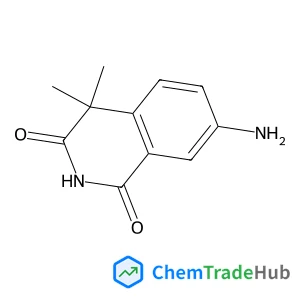
1,3(2H,4H)-Isoquinolinedione, 7-amino-4,4-dimethyl-
CAS Number:
14576-22-8
Molecular Formula:
C11H12N2O2
Recommended Suppliers






Disclaimer
This page provides academic journal information for reference and research purposes only. We are not affiliated with any journal publishers and do not handle publication submissions. For publication-related inquiries, please contact the respective journal publishers directly.
If you notice any inaccuracies in the information displayed, please contact us at support@chemtradehub.com. We will promptly review and address your concerns.