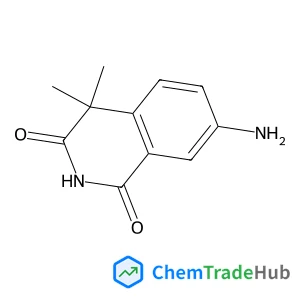
1,3(2H,4H)-Isoquinolinedione, 7-amino-4,4-dimethyl-
CAS Number:
14576-22-8
Molecular Formula:
C11H12N2O2
Dahlia N. Amato, Gregory A. Strange, John P. Swanson, Anton D. Chavez, Suzanne E. Roy, Kim L. Varney, Craig A. Machado, Douglas V. Amato, Philip J. Costanzo
A soybean based coating with thermally responsive Diels–Alder linkages has been prepared following an automotive 2-component formulation. The resulting coatings displayed the capability to be healed following physical deformation by a thermal stimulus, and such a material has significant potential for end users. Various curing agents were employed, and resulted in variation of scratch resistance and re-healablity. Different thermally responsive soybean resins were synthesized to have varying amounts reversible and nonreversible linkages when incorporated into the coating. Additionally, different isocyanates were added at differing ratios of NCO : OH in search of the optimum coating. It was found through the analysis of rehealability, hardness, gloss, and adhesion that the optimal combination was an acetylated resin (no irreversible crosslinks) with 54% reversible Diels–Alder linkages at an NCO : OH ratio of 5 : 1 using isophorone diiscocyanate. Materials were evaluated via differential scanning calorimetry (DSC), scratch resistance, Koenig hardness, gloss measurements, and topographical analysis.

Current Opinion in Colloid & Interface Science

Journal of Saudi Chemical Society

Russian Journal of Bioorganic Chemistry

Russian Journal of General Chemistry

Organic Process Research & Development

Current Opinion in Solid State & Materials Science

Crystallography Reports

Russian Journal of Organic Chemistry

Acta Materialia

Saudi Pharmaceutical Journal
Shaohua Lu, Yiyuan Cai, Xiaojun Hu
DOI: 10.1039/D1CP02286E
Anna Maria Ferrari, Khaled E. El-Kelany, Francesco Silvio Gentile, Maddalena D’Amore, Roberto Dovesi
DOI: 10.1039/D1CP02363B
Zexiong Yang, Haiqian Zhao, Delin Wang, Li Yin, Kenxiang Cai, Zehua Lin, Tao Chen, Chufen Yang
DOI: 10.1039/D1CP02750F
DOI: 10.1039/D1CP90169A
Rabindranath Paul, Sandip Paul
DOI: 10.1039/D1CP01187A
Joanne L. Woodhouse, Alice Henley, Ross Lewin, John M. Ward, Helen C. Hailes, Anastasia V. Bochenkova, Helen H. Fielding
DOI: 10.1039/D1CP01901E
DOI: 10.1039/D1CP02524D
Minjung Son, Muath Nairat, Tiejun Wei, Christopher D. P. Duffy, Gabriela S. Schlau-Cohen
DOI: 10.1039/D1CP01628H
Zachary Morrow, Hyuk-Yong Kwon, C. T. Kelley, Elena Jakubikova
DOI: 10.1039/D1CP03446D
4-Nitrophenyl phosphate disodium salt hexahydrate is primarily used as a substra...
2-(Trifluoromethyl)-1,3-oxazole-4-carboxylic Acid (CAS: 1060816-01-4) is widely ...
2-Fluoro-4-biphenylcarboxylic acid should be stored in a cool, dry place at room...
Prednisolone-21-Carboxylic Acid is primarily used in the pharmaceutical industry...
4-(Hydrazinomethyl)-1,2,3-benzenetriol (CAS: 3614-72-0) should be stored in a co...
4-Amino-1-methyl-1H-pyrazole-5-carboxylic acid hydrochloride (CAS: 92534-70-8) i...
Dehydropachymic acid (CAS: 77012-31-8) is regulated by various agencies. It fall...
The market and research trends for 6-[(2,2-Dimethylpropanoyl)amino]nicotinic aci...
1,10-Phenanthroline-2,9-dicarbaldehyde should be stored in a cool, dry place awa...
5-Carbamoyl-11-oxo-10,11-dihydro-5H-dibenzo[b,f]azepin-10-yl acetate can be synt...

Polymer Chemistry welcomes submissions in all areas of polymer science that have a strong focus on macromolecular chemistry. Manuscripts may cover a broad range of fields, yet no direct application focus is required.
![N-[2-(4-Hydroxyphenoxy)-4-nitrophenyl]methanesulfonamide structure](https://static.chemtradehub.com/structs/109/109032-22-6-7c88.webp "N-[2-(4-Hydroxyphenoxy)-4-nitrophenyl]methanesulfonamide structure")