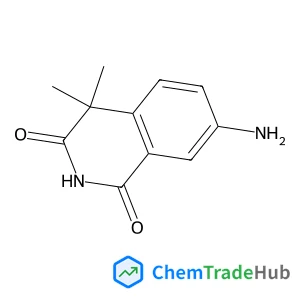
1,3(2H,4H)-Isoquinolinedione, 7-amino-4,4-dimethyl-
CAS Number:
14576-22-8
Molecular Formula:
C11H12N2O2
Jiaul Hoque, Spandhana Gonuguntla, Venkateswarlu Yarlagadda, Vinod K. Aswal, Jayanta Haldar
This study provides an insight into the micellar aggregation properties in aqueous solutions of various gemini surfactants bearing one or more amide groups at the side chains and/or in the spacer by conductivity and small angle neutron scattering (SANS) studies. The amide functionality was found to enhance the surfactant aggregation properties as compared to the surfactants having no amide bond. Furthermore, the aggregation properties of the gemini surfactants bearing amide groups were found to strongly depend on the position and number of amide bonds. With the increase in the number of amide bonds, the aggregation number (N) and the size of the micelles increased. Additionally, the size and shape of the micelles were also found to depend both on the hydrocarbon chain length and the spacer chain length. It was also found that the aggregation number and the size of the micelles increased with an increase in concentration and decreased with an increase in temperature. The critical micellar concentration (CMC) values of the gemini surfactants obtained by a conductometric method were found to vary greatly with variation in the hydrocarbon chain.

NDT & E International

Biocatalysis and Biotransformation

Journal of Asian Natural Products Research

Journal of the Indian Institute of Science

Atomization and Sprays

Colloid Journal

Journal of Chemical Sciences

Acta Metallurgica Sinica-English Letters

Bioorganic & Medicinal Chemistry Letters

Bioorganic & Medicinal Chemistry
Kikujiro Ishii, Hideyuki Nakayama
DOI: 10.1039/C4CP00458B
M. V. Peskov, U. Schwingenschlögl
DOI: 10.1039/C4CP00836G
Eric A. C. Bushnell, Thomas D. Burns, Russell J. Boyd
DOI: 10.1039/C4CP01105H
DOI: 10.1039/C3CP55397C
H. Mendil-Jakani, I. Zamanillo Lopez, P. M. Legrand, V. H. Mareau, L. Gonon
DOI: 10.1039/C4CP00710G
Andrea Grafmüller, Volker Knecht
DOI: 10.1039/C3CP54685C
Shunli Yin, Xiaomei Wang, Zhigang Mou, Yijie Wu, Hui Huang, Mingshan Zhu, Yukou Du, Ping Yang
DOI: 10.1039/C4CP00384E
Jinying Wang, Shuqing Zhang, Jingyuan Zhou, Rong Liu, Ran Du, Hua Xu, Zhongfan Liu, Jin Zhang, Zhirong Liu
DOI: 10.1039/C4CP00539B
W. Calvet, E. Murugasen, J. Klett, B. Kaiser, W. Jaegermann, F. Finger, S. Hoch, M. Blug, J. Busse
DOI: 10.1039/C3CP55198A
Hilde D. de Gier, Ria Broer
DOI: 10.1039/C4CP01070A
When handling 4-Methyl-6-(trifluoromethyl)quinoline (CAS: 40716-16-3), safety go...
4-(3,5-Difluorophenyl)aniline is an aromatic organic compound with the CAS numbe...
5-{[4-(Trifluoromethyl)phenyl]sulfanyl}-1,2,3-thiadiazole-4-carboxylic acid can ...
The market for 4-Benzylaniline hydrochloride (CAS: 6317-57-3) is steadily growin...
[3-(Diethylsulfamoyl)phenyl]boronic acid is generally considered safe when handl...
3-Bromo-2,5-dimethoxyaniline is mainly used in the pharmaceutical and chemical i...
N-Methyl-1-(5-methyl-1H-indol-3-yl)methanamine (CAS: 915922-67-7) is subject to ...
This compound is primarily used in the pharmaceutical industry for the synthesis...
2-Methyl-2-propanyl [(1S,3R)-3-aminocyclohexyl]carbamate (CAS: 1298101-47-9) sho...
Ethyl 2-bromo-4,4,4-trifluorobutanoate (CAS: 367-33-9) is utilized in the pharma...

Physical Chemistry Chemical Physics (PCCP) is an international journal co-owned by 19 physical chemistry and physics societies from around the world. This journal publishes original, cutting-edge research in physical chemistry, chemical physics and biophysical chemistry. To be suitable for publication in PCCP, articles must include significant innovation and/or insight into physical chemistry; this is the most important criterion that reviewers and Editors will judge against when evaluating submissions. The journal has a broad scope and welcomes contributions spanning experiment, theory, computation and data science. Topical coverage includes spectroscopy, dynamics, kinetics, statistical mechanics, thermodynamics, electrochemistry, catalysis, surface science, quantum mechanics, quantum computing and machine learning. Interdisciplinary research areas such as polymers and soft matter, materials, nanoscience, energy, surfaces/interfaces, and biophysical chemistry are welcomed if they demonstrate significant innovation and/or insight into physical chemistry. Joined experimental/theoretical studies are particularly appreciated when complementary and based on up-to-date approaches.
phosphoryl}methyl 4-methylbenzenesulfonate structure](https://static.chemtradehub.com/structs/864/864068-45-1-ba7c.webp "{[3-(Hexadecyloxy)propoxy](hydroxy)phosphoryl}methyl 4-methylbenzenesulfonate structure")