













Radical O–O coupling reaction in diferrate-mediated water oxidation studied using multireference wave function theory
Literature Information
Publication Date
2014-03-21
DOI
10.1039/C3CP55225J
Impact Factor
3.676
Authors
Masaaki Saitow, Jakub Chalupský
View Original
Abstract
The O–O (oxygen–oxygen) bond formation is widely recognized as a key step of the catalytic reaction of dioxygen evolution from water. Recently, the water oxidation catalyzed by potassium ferrate (K2FeO4) was investigated on the basis of experimental kinetic isotope effect analysis assisted by density functional calculations, revealing the intramolecular oxo-coupling mechanism within a di-iron(VI) intermediate, or diferrate [Sarma et al., J. Am. Chem. Soc., 2012, 134, 15371]. Here, we report a detailed examination of this diferrate-mediated O–O bond formation using scalable multireference electronic structure theory. High-dimensional correlated many-electron wave functions beyond the one-electron picture were computed using the ab initio density matrix renormalization group (DMRG) method along the O–O bond formation pathway. The necessity of using large active space arises from the description of complex electronic interactions and varying redox states both associated with two-center antiferromagnetic multivalent iron–oxo coupling. Dynamic correlation effects on top of the active space DMRG wave functions were additively accounted for by complete active space second-order perturbation (CASPT2) and multireference configuration interaction (MRCI) based methods, which were recently introduced by our group. These multireference methods were capable of handling the double shell effects in the extended active space treatment. The calculations with an active space of 36 electrons in 32 orbitals, which is far over conventional limitation, provide a quantitatively reliable prediction of potential energy profiles and confirmed the viability of the direct oxo coupling. The bonding nature of Fe–O and dual bonding character of O–O are discussed using natural orbitals.
Related Literature
Enantio- and diastereoselective synthesis of tetrahydrofuro[2,3-b]furan-2(3H)-one derivatives and related oxygen heterocycles via an asymmetric organocatalytic cascade process
Wei-Wei Zhao
2017-08-28
Research Article
DOI: 10.1039/C7QO00621G
Decarboxylative Umpolung of conjugated enals to β-carbanions for intramolecular nucleophilic addition to an aldehyde
Feng Liu, Jiaxin Tian, Yong Liu, Chuangan Tao, Hao Zhu, Aina Zhang, Dongfang Xu, Baoguo Zhao
2017-05-09
Research Article
DOI: 10.1039/C6QO00846A
Synthesis of substituted oxazoles via Pd-catalyzed tandem oxidative cyclization
Wei Zhang, Wenlong Yu, Qiangqiang Yan, Zhanxiang Liu
2017-09-04
Research Article
DOI: 10.1039/C7QO00517B
Correction: Ni(ii)-Catalyzed enantioselective Mukaiyama–Mannich reaction between silyl enol ethers and cyclic N-sulfonyl α-ketiminoesters
Lei Xie, Hongli Ma, Jiaqi Li, Xuan Yu, Zhaohai Qin, Bin Fu
2017-07-20
Correction
DOI: 10.1039/C7QO90032E
Synthesis and fluorescence properties of novel squarylium–boron complexes
Yasuhiro Kubota, Masahiro Tsukamoto, Katsuhiro Ohnishi, Jiye Jin, Kazumasa Funabiki, Masaki Matsui
2017-04-28
Research Article
DOI: 10.1039/C7QO00225D
Iodine-catalyzed cascade annulation of alkynes with sodium arylsulfinates: assembly of 3-sulfenylcoumarin and 3-sulfenylquinolinone derivatives
Yanni An, Jianxiao Li, Shaorong Yang, Zhongzhi Zhu, Huanfeng Jiang
2017-05-25
Research Article
DOI: 10.1039/C7QO00326A
Synthesis of thiophosphates through a three-component reaction by using sulfur dioxide as the sulfur source
Xinxing Gong, Jiahao Chen, Jianhe Liu
2017-08-17
Research Article
DOI: 10.1039/C7QO00634A
B2(OH)4-mediated one-pot synthesis of tetrahydroquinoxalines from 2-amino(nitro)anilines and 1,2-dicarbonyl compounds in water
Sensheng Liu, Yanmei Zhou, Yuebo Sui, Huan Liu, Haifeng Zhou
2017-08-09
Research Article
DOI: 10.1039/C7QO00604G
You might also like
Compound Q&A
What precautions should be taken when handling 4-Methyl-6-(trifluoromethyl)quinoline (CAS: 40716-16-3)?
When handling 4-Methyl-6-(trifluoromethyl)quinoline (CAS: 40716-16-3), safety go...
40716-16-34-Methyl-6-(trifluor...
Compound Q&A
What is 4-(3,5-Difluorophenyl)aniline (CAS: 405058-00-6)?
4-(3,5-Difluorophenyl)aniline is an aromatic organic compound with the CAS numbe...
405058-00-64-(3,5-Difluoropheny...
Compound Q&A
How is 5-{[4-(Trifluoromethyl)phenyl]sulfanyl}-1,2,3-thiadiazole-4-carboxylic acid (CAS: 338982-07-3) typically synthesized?
5-{[4-(Trifluoromethyl)phenyl]sulfanyl}-1,2,3-thiadiazole-4-carboxylic acid can ...
338982-07-35-{[4-(Trifluorometh...
Compound Q&A
What is the market or research trend for 4-Benzylaniline hydrochloride (CAS: 6317-57-3)?
The market for 4-Benzylaniline hydrochloride (CAS: 6317-57-3) is steadily growin...
6317-57-34-Benzylaniline hydr...
Compound Q&A
Is [3-(Diethylsulfamoyl)phenyl]boronic acid (CAS: 871329-58-7) safe?
[3-(Diethylsulfamoyl)phenyl]boronic acid is generally considered safe when handl...
871329-58-7[3-(Diethylsulfamoyl...
Compound Q&A
What are the main uses of 3-Bromo-2,5-dimethoxyaniline (CAS: 115929-62-9)?
3-Bromo-2,5-dimethoxyaniline is mainly used in the pharmaceutical and chemical i...
115929-62-93-Bromo-2,5-dimethox...
Compound Q&A
What regulatory guidelines apply to N-Methyl-1-(5-methyl-1H-indol-3-yl)methanamine (CAS: 915922-67-7)?
N-Methyl-1-(5-methyl-1H-indol-3-yl)methanamine (CAS: 915922-67-7) is subject to ...
915922-67-7N-Methyl-1-(5-methyl...
Compound Q&A
What industries use Carbamic acid, N-[(5S)-5,6-diamino-6-oxohexyl]-, 1,1-dimethylethyl ester (CAS: 24828-96-4)?
This compound is primarily used in the pharmaceutical industry for the synthesis...
24828-96-4Carbamic acid, N-[(5...
Compound Q&A
How should 2-Methyl-2-propanyl [(1S,3R)-3-aminocyclohexyl]carbamate (CAS: 1298101-47-9) be stored?
2-Methyl-2-propanyl [(1S,3R)-3-aminocyclohexyl]carbamate (CAS: 1298101-47-9) sho...
1298101-47-92-Methyl-2-propanyl ...
Compound Q&A
What industries use Ethyl 2-bromo-4,4,4-trifluorobutanoate (CAS: 367-33-9)?
Ethyl 2-bromo-4,4,4-trifluorobutanoate (CAS: 367-33-9) is utilized in the pharma...
367-33-9Ethyl 2-bromo-4,4,4-...
Source Journal
Physical Chemistry Chemical Physics

CiteScore:
5.5
Self-citation Rate:
10.3%
Articles per Year:
3036
Physical Chemistry Chemical Physics (PCCP) is an international journal co-owned by 19 physical chemistry and physics societies from around the world. This journal publishes original, cutting-edge research in physical chemistry, chemical physics and biophysical chemistry. To be suitable for publication in PCCP, articles must include significant innovation and/or insight into physical chemistry; this is the most important criterion that reviewers and Editors will judge against when evaluating submissions. The journal has a broad scope and welcomes contributions spanning experiment, theory, computation and data science. Topical coverage includes spectroscopy, dynamics, kinetics, statistical mechanics, thermodynamics, electrochemistry, catalysis, surface science, quantum mechanics, quantum computing and machine learning. Interdisciplinary research areas such as polymers and soft matter, materials, nanoscience, energy, surfaces/interfaces, and biophysical chemistry are welcomed if they demonstrate significant innovation and/or insight into physical chemistry. Joined experimental/theoretical studies are particularly appreciated when complementary and based on up-to-date approaches.
Recommended Compounds
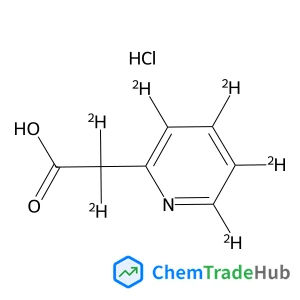
2,2-dideuterio-2-(3,4,5,6-tetradeuterio-2-pyridyl)acetic acid;hydrochloride
CAS Number:
1329799-67-8
Molecular Formula:
C7H2ClD6NO2
Recommended Suppliers







Disclaimer
This page provides academic journal information for reference and research purposes only. We are not affiliated with any journal publishers and do not handle publication submissions. For publication-related inquiries, please contact the respective journal publishers directly.
If you notice any inaccuracies in the information displayed, please contact us at support@chemtradehub.com. We will promptly review and address your concerns.