












Prospects for sub-micron solid state nuclear magnetic resonance imaging with low-temperature dynamic nuclear polarization
Literature Information
Publication Date
2010-05-11
DOI
10.1039/C0CP00157K
Impact Factor
3.676
Authors
Kent R. Thurber, Robert Tycko
View Original
Abstract
We evaluate the feasibility of 1H nuclear magnetic resonance (NMR) imaging with sub-micron voxel dimensions using a combination of low temperatures and dynamic nuclear polarization (DNP). Experiments are performed on nitroxide-doped glycerol–water at 9.4 T and temperatures below 40 K, using a 30 mW tunable microwave source for DNP. With DNP at 7 K, a 0.5 μL sample yields a 1H NMR signal-to-noise ratio of 770 in two scans with pulsed spin-lock detection and after 80 db signal attenuation. With reasonable extrapolations, we infer that 1H NMR signals from 1 μm3 voxel volumes should be readily detectable, and voxels as small as 0.03 μm3 may eventually be detectable. Through homonuclear decoupling with a frequency-switched Lee–Goldburg spin echo technique, we obtain 830 Hz 1H NMR linewidths at low temperatures, implying that pulsed field gradients equal to 0.4 G/d or less would be required during spatial encoding dimensions of an imaging sequence, where d is the resolution in each dimension.
Related Literature
Enhanced photocatalytic activity, transport properties and electronic structure of Mn doped GdFeO3 synthesized using the sol–gel process
Ritwik Maity, Alo Dutta, Saswata Halder, Santiranjan Shannigrahi, Kalyan Mandal, T. P. Sinha
2021-07-22
Paper
DOI: 10.1039/D1CP00621E
Preferred penetration of active nano-rods into narrow channels and their clustering
Zhengjia Wang, Kang-Ching Chu, Yu-Jane Sheng
2021-07-05
Paper
DOI: 10.1039/D1CP01065D
Robustness and accuracy improvement of data processing with 2D neural networks for transient absorption dynamics
Ruixuan Zhao, Daxin Wu, Jiao Wen, Qi Zhang, Guanglei Zhang, Jiebo Li
2021-07-16
Paper
DOI: 10.1039/D1CP02521J
Oscillatory dynamics during the methanol electrooxidation reaction on Pt(111)
Kaline Nascimento da Silva
2021-08-02
Paper
DOI: 10.1039/D1CP02490F
Structure and thermodynamics of empty clathrate hydrates below the freezing point of water
Fernando J. A. L. Cruz, José P. B. Mota
2021-07-13
Paper
DOI: 10.1039/D1CP00893E
Theoretical investigation of the SN2 mechanism of X− [X = SH, PH2] + CH3Y [Y = F, Cl, Br, I] reactions in water
Chen Li, Xin Xin, Dunyou Wang
2021-09-29
Paper
DOI: 10.1039/D1CP03048E
Adenine ultrafast photorelaxation via electron-driven proton transfer
Naeem Ullah, Shunwei Chen
2021-09-18
Paper
DOI: 10.1039/D1CP03162G
Intercalation/deintercalation of solvated Mg2+ into/from graphite interlayers
Masahiro Shimizu, Atsuhito Nakahigashi, Susumu Arai
2021-07-27
Paper
DOI: 10.1039/D1CP02895B
Effect of water nanoconfinement on the dynamic properties of paramagnetic colloidal complexes
Luca Bergamasco, Matteo Morciano, Matteo Fasano
2021-08-02
Paper
DOI: 10.1039/D1CP00708D
Evidence of gas-phase pyranose-to-furanose isomerization in protonated peptidoglycans
2021-10-01
Paper
DOI: 10.1039/D1CP03842G
You might also like
Compound Q&A
What precautions should be taken when handling 4-Methyl-6-(trifluoromethyl)quinoline (CAS: 40716-16-3)?
When handling 4-Methyl-6-(trifluoromethyl)quinoline (CAS: 40716-16-3), safety go...
40716-16-34-Methyl-6-(trifluor...
Compound Q&A
What is 4-(3,5-Difluorophenyl)aniline (CAS: 405058-00-6)?
4-(3,5-Difluorophenyl)aniline is an aromatic organic compound with the CAS numbe...
405058-00-64-(3,5-Difluoropheny...
Compound Q&A
How is 5-{[4-(Trifluoromethyl)phenyl]sulfanyl}-1,2,3-thiadiazole-4-carboxylic acid (CAS: 338982-07-3) typically synthesized?
5-{[4-(Trifluoromethyl)phenyl]sulfanyl}-1,2,3-thiadiazole-4-carboxylic acid can ...
338982-07-35-{[4-(Trifluorometh...
Compound Q&A
What is the market or research trend for 4-Benzylaniline hydrochloride (CAS: 6317-57-3)?
The market for 4-Benzylaniline hydrochloride (CAS: 6317-57-3) is steadily growin...
6317-57-34-Benzylaniline hydr...
Compound Q&A
Is [3-(Diethylsulfamoyl)phenyl]boronic acid (CAS: 871329-58-7) safe?
[3-(Diethylsulfamoyl)phenyl]boronic acid is generally considered safe when handl...
871329-58-7[3-(Diethylsulfamoyl...
Compound Q&A
What are the main uses of 3-Bromo-2,5-dimethoxyaniline (CAS: 115929-62-9)?
3-Bromo-2,5-dimethoxyaniline is mainly used in the pharmaceutical and chemical i...
115929-62-93-Bromo-2,5-dimethox...
Compound Q&A
What regulatory guidelines apply to N-Methyl-1-(5-methyl-1H-indol-3-yl)methanamine (CAS: 915922-67-7)?
N-Methyl-1-(5-methyl-1H-indol-3-yl)methanamine (CAS: 915922-67-7) is subject to ...
915922-67-7N-Methyl-1-(5-methyl...
Compound Q&A
What industries use Carbamic acid, N-[(5S)-5,6-diamino-6-oxohexyl]-, 1,1-dimethylethyl ester (CAS: 24828-96-4)?
This compound is primarily used in the pharmaceutical industry for the synthesis...
24828-96-4Carbamic acid, N-[(5...
Compound Q&A
How should 2-Methyl-2-propanyl [(1S,3R)-3-aminocyclohexyl]carbamate (CAS: 1298101-47-9) be stored?
2-Methyl-2-propanyl [(1S,3R)-3-aminocyclohexyl]carbamate (CAS: 1298101-47-9) sho...
1298101-47-92-Methyl-2-propanyl ...
Compound Q&A
What industries use Ethyl 2-bromo-4,4,4-trifluorobutanoate (CAS: 367-33-9)?
Ethyl 2-bromo-4,4,4-trifluorobutanoate (CAS: 367-33-9) is utilized in the pharma...
367-33-9Ethyl 2-bromo-4,4,4-...
Source Journal
Physical Chemistry Chemical Physics

CiteScore:
5.5
Self-citation Rate:
10.3%
Articles per Year:
3036
Physical Chemistry Chemical Physics (PCCP) is an international journal co-owned by 19 physical chemistry and physics societies from around the world. This journal publishes original, cutting-edge research in physical chemistry, chemical physics and biophysical chemistry. To be suitable for publication in PCCP, articles must include significant innovation and/or insight into physical chemistry; this is the most important criterion that reviewers and Editors will judge against when evaluating submissions. The journal has a broad scope and welcomes contributions spanning experiment, theory, computation and data science. Topical coverage includes spectroscopy, dynamics, kinetics, statistical mechanics, thermodynamics, electrochemistry, catalysis, surface science, quantum mechanics, quantum computing and machine learning. Interdisciplinary research areas such as polymers and soft matter, materials, nanoscience, energy, surfaces/interfaces, and biophysical chemistry are welcomed if they demonstrate significant innovation and/or insight into physical chemistry. Joined experimental/theoretical studies are particularly appreciated when complementary and based on up-to-date approaches.
Recommended Compounds
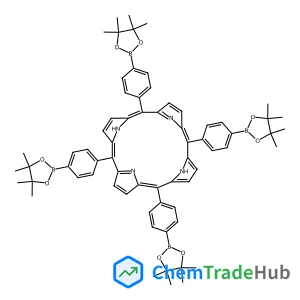
5,10,15,20-tetrakis(4-boronic acid pinacol ester phenyl) porphyrin
CAS Number:
1332748-00-1
Molecular Formula:
C68H74B4N4O8
Recommended Suppliers






Disclaimer
This page provides academic journal information for reference and research purposes only. We are not affiliated with any journal publishers and do not handle publication submissions. For publication-related inquiries, please contact the respective journal publishers directly.
If you notice any inaccuracies in the information displayed, please contact us at support@chemtradehub.com. We will promptly review and address your concerns.