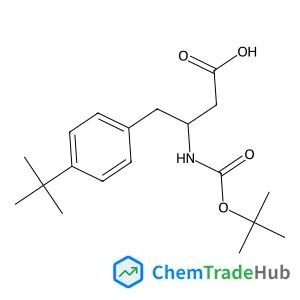
(S)-3-((tert-Butoxycarbonyl)amino)-4-(4-(tert-butyl)phenyl)butanoic acid
CAS Number:
403661-85-8
Molecular Formula:
C19H29NO4
Robert T. Zehr, Michael A. Henderson
The ultraviolet (UV) photon-induced decomposition of hexafluoroacetone ((CF3)2CO; HFA) adsorbed on the rutile TiO2(110) surface was investigated using photon stimulated desorption (PSD) and temperature programmed desorption (TPD). HFA adsorbs both molecularly and dissociatively on the reduced TiO2(110) surface. The initial ∼0.2 ML (where 1 ML equates to the cation site density of the ideal surface) coverage of HFA thermally decomposes resulting in the formation of adsorbed trifluoroacetate groups, with further HFA exposure resulting in molecular adsorption. No evidence was found for HFA photochemistry on the reduced surface. HFA adsorbed and desorbed molecularly on a pre-oxidized TiO2(110) surface with only a minor amount (∼1%) of thermal decomposition in TPD. A new adsorption state at 350 K was assigned to the reversible formation of a photoactive HFA-diolate species [(CF3)2COO]. UV irradiation depleted the 350 K state, resulting in evolution of CF3, CO, and CO2 in the gas phase and formation of surface bound trifluoroacetate groups. 18O isotope scrambling experiments showed that the ejected CO2 was from photodecomposition of the HFA-diolate species while the CO photoproduct was not. These results are in contrast to the photochemical behavior of acetone, butanone and acetaldehyde on TiO2(110), where UV irradiation resulted in the gas phase ejection of one of the carbonyl substituent groups as well as a stoichiometric amount of carboxylate left on the surface. We conclude that fluorination alters the electronic structure of adsorbed carbonyls on TiO2(110) in such a way as to promote complete fragmentation of the adsorbed carbonyl complex to form gas phase CO2 as well as to open up additional photodissociation pathways leading to CO production.

Molecular Diversity

Coloration Technology

Advanced Engineering Materials

Green Chemistry

Contact Lens & Anterior Eye

Angewandte Chemie International Edition

Journal of Enzyme inhibition and Medicinal Chemistry

Current Pharmaceutical Biotechnology

Journal of Medical Biochemistry

Mini-Reviews in Medicinal Chemistry
Andrew Schmudlach, Jeremy Felton, Robert T. Kennedy, Norman J. Dovichi
DOI: 10.1039/C6AN02268E
Kaixin Xu, Longwei He, Xueling Yang, Yunzhen Yang, Weiying Lin
DOI: 10.1039/C8AN00842F
Ashley M. Smith, Kathryn A. Johnston, Scott E. Crawford, Lauren E. Marbella, Jill E. Millstone
DOI: 10.1039/C6AN02206E
A. Peristyy, P. N. Nesterenko, A. Das, D. M. D'Alessandro
DOI: 10.1039/C6AN02344D
Gary Gorbet, Borries Demeler
DOI: 10.1039/C6AN02236G
Juntuo Zhou, Yuxin Yin
DOI: 10.1039/C6AN01753C
Kisoo Kim, Junemo Koo, SangJun Moon, Won Gu Lee
DOI: 10.1039/C6AN01506A
Blake N. Johnson, Raj Mutharasan
DOI: 10.1039/C6AN01743F
William F. Siems, Larry A. Viehland, Herbert H. Hill, Jr
DOI: 10.1039/C6AN01353H
When handling 4-Methyl-6-(trifluoromethyl)quinoline (CAS: 40716-16-3), safety go...
4-(3,5-Difluorophenyl)aniline is an aromatic organic compound with the CAS numbe...
5-{[4-(Trifluoromethyl)phenyl]sulfanyl}-1,2,3-thiadiazole-4-carboxylic acid can ...
The market for 4-Benzylaniline hydrochloride (CAS: 6317-57-3) is steadily growin...
[3-(Diethylsulfamoyl)phenyl]boronic acid is generally considered safe when handl...
3-Bromo-2,5-dimethoxyaniline is mainly used in the pharmaceutical and chemical i...
N-Methyl-1-(5-methyl-1H-indol-3-yl)methanamine (CAS: 915922-67-7) is subject to ...
This compound is primarily used in the pharmaceutical industry for the synthesis...
2-Methyl-2-propanyl [(1S,3R)-3-aminocyclohexyl]carbamate (CAS: 1298101-47-9) sho...
Ethyl 2-bromo-4,4,4-trifluorobutanoate (CAS: 367-33-9) is utilized in the pharma...

Physical Chemistry Chemical Physics (PCCP) is an international journal co-owned by 19 physical chemistry and physics societies from around the world. This journal publishes original, cutting-edge research in physical chemistry, chemical physics and biophysical chemistry. To be suitable for publication in PCCP, articles must include significant innovation and/or insight into physical chemistry; this is the most important criterion that reviewers and Editors will judge against when evaluating submissions. The journal has a broad scope and welcomes contributions spanning experiment, theory, computation and data science. Topical coverage includes spectroscopy, dynamics, kinetics, statistical mechanics, thermodynamics, electrochemistry, catalysis, surface science, quantum mechanics, quantum computing and machine learning. Interdisciplinary research areas such as polymers and soft matter, materials, nanoscience, energy, surfaces/interfaces, and biophysical chemistry are welcomed if they demonstrate significant innovation and/or insight into physical chemistry. Joined experimental/theoretical studies are particularly appreciated when complementary and based on up-to-date approaches.
![2-[(5Z,8Z,11Z,14Z)-5,8,11,14-Icosatetraen-1-yloxy]-1,3-propanediol structure](https://static.chemtradehub.com/structs/222/222723-55-9-0348.webp "2-[(5Z,8Z,11Z,14Z)-5,8,11,14-Icosatetraen-1-yloxy]-1,3-propanediol structure")
![Methyl 3-({2'-[(E)-(hydroxyhydrazono)methyl]-4-biphenylyl}methyl)-2-oxo-2,3-dihydro-1H-benzimidazole-4-carboxylate structure](https://static.chemtradehub.com/structs/149/1499167-72-4-034a.webp "Methyl 3-({2'-[(E)-(hydroxyhydrazono)methyl]-4-biphenylyl}methyl)-2-oxo-2,3-dihydro-1H-benzimidazole-4-carboxylate structure")