


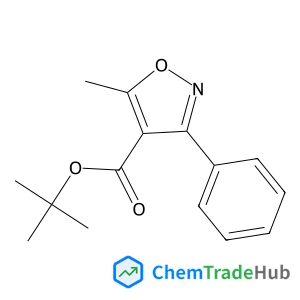
2-Methyl-2-propanyl 5-methyl-3-phenyl-1,2-oxazole-4-carboxylate
CAS Number:
211429-79-7
Molecular Formula:
C15H17NO3
Rafal Panek, Josef Granwehr, James Leggett, Walter Köckenberger
Short acquisition time and single scan capability of gradient-assisted ultrafast multidimensional spectroscopy makes it possible to record 2D spectra of highly polarised spin systems in the liquid state using dynamic nuclear polarization (DNP) in conjunction with fast dissolution. We present a slice selective experiment, suitable for back-to-back acquisition of two independent single-scan 2D experiments from different sample volumes. This scheme maximizes the amount of information obtainable from a sample that is prepolarised with a non-repeatable DNP technique. It is particularly suitable for samples with the short longitudinal relaxation times common to proton NMR spectroscopy. This technique is demonstrated by applying two filtered proton 2D COSY experiments on a DNP-polarised mixture of glutamine and glutamate to selectively amplify the correlation pattern of the protons connected to the β and γ carbons of either one of the two amino acids. Particular emphasis was put on the reproducibility of the experiments, especially the polarisation enhancement. Data for the liquid-state proton enhancement from amino acids and small proteins was assembled in a map that allowed the prediction of signal levels in liquid-state NMR experiments employing dissolution DNP.

Nature Reviews Drug Discovery

Green Chemistry

Advanced Engineering Materials

Physical Chemistry Chemical Physics

European Journal of Organic Chemistry

Environmental Toxicology and Pharmacology

Molecular Diversity

Angewandte Chemie International Edition

Photochemical & Photobiological Sciences

Journal of Enzyme inhibition and Medicinal Chemistry
Zhengru Liu, Bin Yang, Beibei Chen, Man He, Bin Hu
DOI: 10.1039/C6AN01919F
W. Chaocharoen
DOI: 10.1039/C6AN02239A
Saeed Mohammadi, Masatoshi Maeki, Akihiko Ishida, Hirofumi Tani
DOI: 10.1039/C6AN01475E
Kaixin Xu, Longwei He, Xueling Yang, Yunzhen Yang, Weiying Lin
DOI: 10.1039/C8AN00842F
John W. Patrick, Breanna Zerfas, Jianmin Gao, David H. Russell
DOI: 10.1039/C6AN02290A
Francesca Pischiutta, Elisa R. Zanier, Ari Ercole
DOI: 10.1039/C6AN02238C
Artur Dawid Surowka, Herve Boutin, Lidan Christie, Magdalena Szczerbowska-Boruchowska
DOI: 10.1039/C6AN01797E
When handling 4-Methyl-6-(trifluoromethyl)quinoline (CAS: 40716-16-3), safety go...
4-(3,5-Difluorophenyl)aniline is an aromatic organic compound with the CAS numbe...
5-{[4-(Trifluoromethyl)phenyl]sulfanyl}-1,2,3-thiadiazole-4-carboxylic acid can ...
The market for 4-Benzylaniline hydrochloride (CAS: 6317-57-3) is steadily growin...
[3-(Diethylsulfamoyl)phenyl]boronic acid is generally considered safe when handl...
3-Bromo-2,5-dimethoxyaniline is mainly used in the pharmaceutical and chemical i...
N-Methyl-1-(5-methyl-1H-indol-3-yl)methanamine (CAS: 915922-67-7) is subject to ...
This compound is primarily used in the pharmaceutical industry for the synthesis...
2-Methyl-2-propanyl [(1S,3R)-3-aminocyclohexyl]carbamate (CAS: 1298101-47-9) sho...
Ethyl 2-bromo-4,4,4-trifluorobutanoate (CAS: 367-33-9) is utilized in the pharma...
Physical Chemistry Chemical Physics (PCCP) is an international journal co-owned by 19 physical chemistry and physics societies from around the world. This journal publishes original, cutting-edge research in physical chemistry, chemical physics and biophysical chemistry. To be suitable for publication in PCCP, articles must include significant innovation and/or insight into physical chemistry; this is the most important criterion that reviewers and Editors will judge against when evaluating submissions. The journal has a broad scope and welcomes contributions spanning experiment, theory, computation and data science. Topical coverage includes spectroscopy, dynamics, kinetics, statistical mechanics, thermodynamics, electrochemistry, catalysis, surface science, quantum mechanics, quantum computing and machine learning. Interdisciplinary research areas such as polymers and soft matter, materials, nanoscience, energy, surfaces/interfaces, and biophysical chemistry are welcomed if they demonstrate significant innovation and/or insight into physical chemistry. Joined experimental/theoretical studies are particularly appreciated when complementary and based on up-to-date approaches.

![Imidazo[1,2-c]pyrimidine structure](https://static.chemtradehub.com/structs/274/274-78-2-8b4c.webp "Imidazo[1,2-c]pyrimidine structure")




