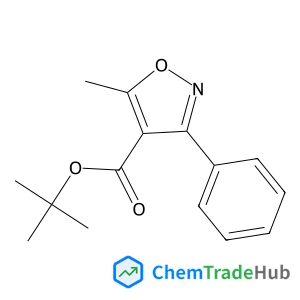
2-Methyl-2-propanyl 5-methyl-3-phenyl-1,2-oxazole-4-carboxylate
CAS Number:
211429-79-7
Molecular Formula:
C15H17NO3
Sylwia Ptasińska, Blagovest Bahnev, Agnieszka Stypczyńska, Mark Bowden, Nigel J. Mason, Nicholas St. J. Braithwaite
The DNA molecule is observed to be very susceptible to short-term exposures to an atmospheric pressure plasma jet. The DNA damage induced by plasma-generated species, i.e. excited atoms, charged particles, electrons and UV light is determined.
Charbel Eid, Juan G. Santiago
DOI: 10.1039/C6AN02119K
Adeline Huiling Loo, Chun Kiang Chua, Martin Pumera
DOI: 10.1039/C6AN02038K
Gabriela B. Almeida, Ronei J. Poppi, José A. Fracassi da Silva
DOI: 10.1039/C6AN01497F
Mahalia A. C. Serrano, Huan He, Bo Zhao, Rajasekhar R. Ramireddy, Richard W. Vachet, S. Thayumanavan
DOI: 10.1039/C6AN01591C
Jun-Kyu Park, Aaron Park, Si Kyung Yang, Sung-June Baek, Joonki Hwang, Jaebum Choo
DOI: 10.1039/C6AN02315K
Qi Xin, Jian Ru Gong
DOI: 10.1039/C6AN02006B
Kisoo Kim, Junemo Koo, SangJun Moon, Won Gu Lee
DOI: 10.1039/C6AN01506A
When handling 4-Methyl-6-(trifluoromethyl)quinoline (CAS: 40716-16-3), safety go...
4-(3,5-Difluorophenyl)aniline is an aromatic organic compound with the CAS numbe...
5-{[4-(Trifluoromethyl)phenyl]sulfanyl}-1,2,3-thiadiazole-4-carboxylic acid can ...
The market for 4-Benzylaniline hydrochloride (CAS: 6317-57-3) is steadily growin...
[3-(Diethylsulfamoyl)phenyl]boronic acid is generally considered safe when handl...
3-Bromo-2,5-dimethoxyaniline is mainly used in the pharmaceutical and chemical i...
N-Methyl-1-(5-methyl-1H-indol-3-yl)methanamine (CAS: 915922-67-7) is subject to ...
This compound is primarily used in the pharmaceutical industry for the synthesis...
2-Methyl-2-propanyl [(1S,3R)-3-aminocyclohexyl]carbamate (CAS: 1298101-47-9) sho...
Ethyl 2-bromo-4,4,4-trifluorobutanoate (CAS: 367-33-9) is utilized in the pharma...

Physical Chemistry Chemical Physics (PCCP) is an international journal co-owned by 19 physical chemistry and physics societies from around the world. This journal publishes original, cutting-edge research in physical chemistry, chemical physics and biophysical chemistry. To be suitable for publication in PCCP, articles must include significant innovation and/or insight into physical chemistry; this is the most important criterion that reviewers and Editors will judge against when evaluating submissions. The journal has a broad scope and welcomes contributions spanning experiment, theory, computation and data science. Topical coverage includes spectroscopy, dynamics, kinetics, statistical mechanics, thermodynamics, electrochemistry, catalysis, surface science, quantum mechanics, quantum computing and machine learning. Interdisciplinary research areas such as polymers and soft matter, materials, nanoscience, energy, surfaces/interfaces, and biophysical chemistry are welcomed if they demonstrate significant innovation and/or insight into physical chemistry. Joined experimental/theoretical studies are particularly appreciated when complementary and based on up-to-date approaches.
![[3-(2,6-Dichlorophenyl)-5-isopropyl-1,2-oxazol-4-yl]methanol structure](https://static.chemtradehub.com/structs/278/278597-30-1-5c79.webp "[3-(2,6-Dichlorophenyl)-5-isopropyl-1,2-oxazol-4-yl]methanol structure")