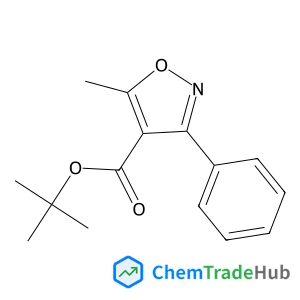
2-Methyl-2-propanyl 5-methyl-3-phenyl-1,2-oxazole-4-carboxylate
CAS Number:
211429-79-7
Molecular Formula:
C15H17NO3
Guang Feng, Jingsong Huang, Bobby G. Sumpter, Vincent Meunier, Rui Qiao
The organic electrolyte of tetraethylammonium tetrafluoroborate (TEABF4) in the aprotic solvent of acetonitrile (ACN) is widely used in electrochemical systems such as electrochemical capacitors. In this paper, we examine the solvation of TEA+ and BF4− in ACN, and the structure, capacitance, and dynamics of the electrical double layers (EDLs) in the TEABF4–ACN electrolyte using molecular dynamics simulations complemented with quantum density functional theory calculations. The solvation of TEA+ and BF4− ions is found to be much weaker than that of small inorganic ions in aqueous solutions, and the ACN molecules in the solvation shell of both types of ions show only weak packing and orientational ordering. These solvation characteristics are caused by the large size, charge delocalization, and irregular shape (in the case of TEA+ cation) of the ions. Near neutral electrodes, the double-layer structure in the organic electrolyte exhibits a rich organization: the solvent shows strong layering and orientational ordering, ions are significantly contact-adsorbed on the electrode, and alternating layers of cations/anions penetrate ca. 1.1 nm into the bulk electrolyte. The significant contact adsorption of ions and the alternating layering of cation/anion are new features found for EDLs in organic electrolytes. These features essentially originate from the fact that van der Waals interactions between organic ions and the electrode are strong and the partial desolvation of these ions occurs easily, as a result of the large size of the organic ions. Near charged electrodes, distinct counter-ion concentration peaks form, and the ion distribution cannot be described by the Helmholtz model or the Helmholtz + Poisson–Boltzmann model. This is because the number of counter-ions adsorbed on the electrode exceeds the number of electrons on the electrode, and the electrode is over-screened in parts of the EDL. The computed capacitances of the EDLs are in good agreement with that inferred from experimental measurements. Both the rotations (ACN only) and translations of interfacial ACN and ions are found to slow down as the electrode is electrified. We also observe an asymmetrical dependence of these motions on the sign of the electrode charge. The rotation/diffusion of ACN and the diffusion of ions in the region beyond the first ACN or ion layer differ only weakly from those in the bulk.
Verena Charwat, Cornelia Kasper, Stephan Hann, Gunda Koellensperger
DOI: 10.1039/C6AN01342B
Artur Dawid Surowka, Herve Boutin, Lidan Christie, Magdalena Szczerbowska-Boruchowska
DOI: 10.1039/C6AN01797E
Sui C. Phung
DOI: 10.1039/C6AN01515H
Jinsu Kim, Ryan Poling-Skutvik, João R. C. Trabuco, Katerina Kourentzi, Jacinta C. Conrad
DOI: 10.1039/C6AN00567E
Gary Gorbet, Borries Demeler
DOI: 10.1039/C6AN02236G
Michael G. Wolfe, Qiang Zhang, Christy Hui, Katherine Radford, Parameswaran Nair, John D. Brennan
DOI: 10.1039/C6AN01563H
Austen L. Davis, Wenjie Liu, William F. Siems, Brian H. Clowers
DOI: 10.1039/C6AN02249A
When handling 4-Methyl-6-(trifluoromethyl)quinoline (CAS: 40716-16-3), safety go...
4-(3,5-Difluorophenyl)aniline is an aromatic organic compound with the CAS numbe...
5-{[4-(Trifluoromethyl)phenyl]sulfanyl}-1,2,3-thiadiazole-4-carboxylic acid can ...
The market for 4-Benzylaniline hydrochloride (CAS: 6317-57-3) is steadily growin...
[3-(Diethylsulfamoyl)phenyl]boronic acid is generally considered safe when handl...
3-Bromo-2,5-dimethoxyaniline is mainly used in the pharmaceutical and chemical i...
N-Methyl-1-(5-methyl-1H-indol-3-yl)methanamine (CAS: 915922-67-7) is subject to ...
This compound is primarily used in the pharmaceutical industry for the synthesis...
2-Methyl-2-propanyl [(1S,3R)-3-aminocyclohexyl]carbamate (CAS: 1298101-47-9) sho...
Ethyl 2-bromo-4,4,4-trifluorobutanoate (CAS: 367-33-9) is utilized in the pharma...

Physical Chemistry Chemical Physics (PCCP) is an international journal co-owned by 19 physical chemistry and physics societies from around the world. This journal publishes original, cutting-edge research in physical chemistry, chemical physics and biophysical chemistry. To be suitable for publication in PCCP, articles must include significant innovation and/or insight into physical chemistry; this is the most important criterion that reviewers and Editors will judge against when evaluating submissions. The journal has a broad scope and welcomes contributions spanning experiment, theory, computation and data science. Topical coverage includes spectroscopy, dynamics, kinetics, statistical mechanics, thermodynamics, electrochemistry, catalysis, surface science, quantum mechanics, quantum computing and machine learning. Interdisciplinary research areas such as polymers and soft matter, materials, nanoscience, energy, surfaces/interfaces, and biophysical chemistry are welcomed if they demonstrate significant innovation and/or insight into physical chemistry. Joined experimental/theoretical studies are particularly appreciated when complementary and based on up-to-date approaches.
![6,7-Dihydro-5H-pyrrolo[1,2-a]imidazole-6-carboxylic acid structure](https://static.chemtradehub.com/structs/136/1369160-12-2-6524.webp "6,7-Dihydro-5H-pyrrolo[1,2-a]imidazole-6-carboxylic acid structure")