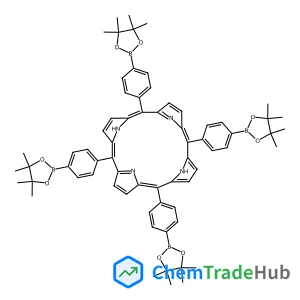
5,10,15,20-tetrakis(4-boronic acid pinacol ester phenyl) porphyrin
CAS Number:
1332748-00-1
Molecular Formula:
C68H74B4N4O8
Daniel Rhinow, Janet Vonck, Michael Schranz, Andre Beyer, Armin Gölzhäuser, Norbert Hampp
Ultrathin carbon nanomembranes (CNM) have been tested as supports for both cryogenic high-resolution transmission electron microscopy (cryo-EM) as well as atomic force microscopy (AFM) of biological specimens. Purple membrane (PM) from Halobacterium salinarum, a 2-D crystalline monolayer of bacteriorhodopsin (BR) and lipids, was used for this study. Due to their low thickness of just 1.6 nm CNM add virtually no phase contrast to the transmission pattern. This is an important advantage over commonly used amorphous carbon support films which become instable below a thickness of ∼20 nm. Moreover, the electrical conductivity of CNM can be tuned leading to conductive carbon nanomembranes (cCNM). cCNM support films were analyzed for the first time and were found to ideally meet all requirements of cryo-EM of insulating biological samples. A projection map of PM on cCNM at 4 Å resolution has been calculated which proves that the structural integrity of biological samples is preserved up to the high-resolution range. CNM have also proven to be suitable supports for AFM analysis of biological samples. PM on CNM was imaged at molecular resolution and single molecule force spectra were recorded which show no differences compared to force spectra of PM obtained with other substrates. This is the first demonstration of a support film material which meets the requirements of both, cryo-EM and AFM, thus enabling comparative structural studies of biomolecular samples with unchanged sample–substrate interactions. Beyond high-resolution cryo-EM of biological samples, cCNM are attractive new substrates for other biophysical techniques which require conductive supports, i.e. scanning tunneling microscopy (STM) and electrostatic force microscopy (EFM).
John W. Patrick, Breanna Zerfas, Jianmin Gao, David H. Russell
DOI: 10.1039/C6AN02290A
Lars B. Laurentius, Timothy S. Mulvihill, Jennifer H. Granger, John S. Spencer, Delphi Chatterjee
DOI: 10.1039/C6AN02109C
Ryan Stables, Holly J. Butler, Katherine M. Ashton, Andrew Brodbelt, Timothy P. Dawson, Leanne M. Fullwood, Michael D. Jenkinson, Matthew J. Baker
DOI: 10.1039/C6AN01583B
A. Peristyy, P. N. Nesterenko, A. Das, D. M. D'Alessandro
DOI: 10.1039/C6AN02344D
Erin A. Henslee, Ruth M. Torcal Serrano, Fatima H. Labeed, Rita I. Jabr, Christopher H. Fry, Michael P. Hughes, Kai F. Hoettges
DOI: 10.1039/C6AN01596D
Mahalia A. C. Serrano, Huan He, Bo Zhao, Rajasekhar R. Ramireddy, Richard W. Vachet, S. Thayumanavan
DOI: 10.1039/C6AN01591C
A. Taschin, P. Bartolini, J. Striova, R. Fontana
DOI: 10.1039/C6AN02113A
Ashley M. Smith, Kathryn A. Johnston, Scott E. Crawford, Lauren E. Marbella, Jill E. Millstone
DOI: 10.1039/C6AN02206E
When handling 4-Methyl-6-(trifluoromethyl)quinoline (CAS: 40716-16-3), safety go...
4-(3,5-Difluorophenyl)aniline is an aromatic organic compound with the CAS numbe...
5-{[4-(Trifluoromethyl)phenyl]sulfanyl}-1,2,3-thiadiazole-4-carboxylic acid can ...
The market for 4-Benzylaniline hydrochloride (CAS: 6317-57-3) is steadily growin...
[3-(Diethylsulfamoyl)phenyl]boronic acid is generally considered safe when handl...
3-Bromo-2,5-dimethoxyaniline is mainly used in the pharmaceutical and chemical i...
N-Methyl-1-(5-methyl-1H-indol-3-yl)methanamine (CAS: 915922-67-7) is subject to ...
This compound is primarily used in the pharmaceutical industry for the synthesis...
2-Methyl-2-propanyl [(1S,3R)-3-aminocyclohexyl]carbamate (CAS: 1298101-47-9) sho...
Ethyl 2-bromo-4,4,4-trifluorobutanoate (CAS: 367-33-9) is utilized in the pharma...

Physical Chemistry Chemical Physics (PCCP) is an international journal co-owned by 19 physical chemistry and physics societies from around the world. This journal publishes original, cutting-edge research in physical chemistry, chemical physics and biophysical chemistry. To be suitable for publication in PCCP, articles must include significant innovation and/or insight into physical chemistry; this is the most important criterion that reviewers and Editors will judge against when evaluating submissions. The journal has a broad scope and welcomes contributions spanning experiment, theory, computation and data science. Topical coverage includes spectroscopy, dynamics, kinetics, statistical mechanics, thermodynamics, electrochemistry, catalysis, surface science, quantum mechanics, quantum computing and machine learning. Interdisciplinary research areas such as polymers and soft matter, materials, nanoscience, energy, surfaces/interfaces, and biophysical chemistry are welcomed if they demonstrate significant innovation and/or insight into physical chemistry. Joined experimental/theoretical studies are particularly appreciated when complementary and based on up-to-date approaches.