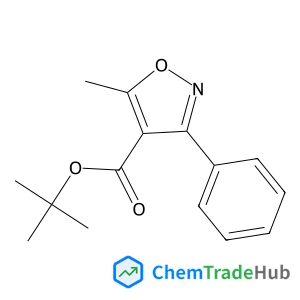
2-Methyl-2-propanyl 5-methyl-3-phenyl-1,2-oxazole-4-carboxylate
CAS Number:
211429-79-7
Molecular Formula:
C15H17NO3
Iván Bravo, Yolanda Díaz-de-Mera, Alfonso Aranda, Kevin Smith, Keith P. Shine, George Marston
The atmospheric chemistry of several gases used in industrial applications, C4F9OC2H5 (HFE-7200), C4F9OCH3 (HFE-7100), C3F7OCH3 (HFE-7000) and C3F7CH2OH, has been studied. The discharge flow technique coupled with mass-spectrometric detection has been used to study the kinetics of their reactions with OH radicals as a function of temperature. The infrared spectra of the compounds have also been measured. The following Arrhenius expressions for the reactions were determined (in units of cm3 molecule−1 s−1): k(OH + HFE-7200) = (6.9+2.3−1.7) × 10−11 exp(−(2030 ± 190)/T); k(OH + HFE-7100) = (2.8+3.2−1.5) × 10−11 exp(−(2200 ± 490)/T); k(OH + HFE-7000) = (2.0+1.2−0.7) × 10−11 exp(−(2130 ± 290)/T); and k(OH + C3F7CH2OH) = (1.4+0.3−0.2) × 10−11 exp(−(1460 ± 120)/T). From the infrared spectra, radiative forcing efficiencies were determined and compared with earlier estimates in the literature. These were combined with the kinetic data to estimate 100-year time horizon global warming potentials relative to CO2 of 69, 337, 499 and 36 for HFE-7200, HFE-7100, HFE-7000 and CF3CF2CF2CH2OH, respectively.

Angewandte Chemie International Edition

Green Chemistry

European Journal of Organic Chemistry

Current Pharmaceutical Biotechnology

Coloration Technology

Journal of Medical Biochemistry

Environmental Toxicology and Pharmacology

Foundations of Chemistry

Journal of Enzyme inhibition and Medicinal Chemistry

Molecules
Xiaoli Qi, Hui Hu, Yunxian Piao
DOI: 10.1039/C8AN00591E
Lars B. Laurentius, Timothy S. Mulvihill, Jennifer H. Granger, John S. Spencer, Delphi Chatterjee
DOI: 10.1039/C6AN02109C
S. Kanje, S. Hober, L. Mueller
DOI: 10.1039/C6AN01878E
Syed Samim Ali, Ankita Gangopadhyay, Ajoy Kumar Pramanik, Sandip Kumar Samanta, Uday Narayan Guria, Srimanta Manna, Ajit Kumar Mahapatra
DOI: 10.1039/C8AN01012A
DOI: 10.1039/C6AN90102F
Francesca Pischiutta, Elisa R. Zanier, Ari Ercole
DOI: 10.1039/C6AN02238C
When handling 4-Methyl-6-(trifluoromethyl)quinoline (CAS: 40716-16-3), safety go...
4-(3,5-Difluorophenyl)aniline is an aromatic organic compound with the CAS numbe...
5-{[4-(Trifluoromethyl)phenyl]sulfanyl}-1,2,3-thiadiazole-4-carboxylic acid can ...
The market for 4-Benzylaniline hydrochloride (CAS: 6317-57-3) is steadily growin...
[3-(Diethylsulfamoyl)phenyl]boronic acid is generally considered safe when handl...
3-Bromo-2,5-dimethoxyaniline is mainly used in the pharmaceutical and chemical i...
N-Methyl-1-(5-methyl-1H-indol-3-yl)methanamine (CAS: 915922-67-7) is subject to ...
This compound is primarily used in the pharmaceutical industry for the synthesis...
2-Methyl-2-propanyl [(1S,3R)-3-aminocyclohexyl]carbamate (CAS: 1298101-47-9) sho...
Ethyl 2-bromo-4,4,4-trifluorobutanoate (CAS: 367-33-9) is utilized in the pharma...

Physical Chemistry Chemical Physics (PCCP) is an international journal co-owned by 19 physical chemistry and physics societies from around the world. This journal publishes original, cutting-edge research in physical chemistry, chemical physics and biophysical chemistry. To be suitable for publication in PCCP, articles must include significant innovation and/or insight into physical chemistry; this is the most important criterion that reviewers and Editors will judge against when evaluating submissions. The journal has a broad scope and welcomes contributions spanning experiment, theory, computation and data science. Topical coverage includes spectroscopy, dynamics, kinetics, statistical mechanics, thermodynamics, electrochemistry, catalysis, surface science, quantum mechanics, quantum computing and machine learning. Interdisciplinary research areas such as polymers and soft matter, materials, nanoscience, energy, surfaces/interfaces, and biophysical chemistry are welcomed if they demonstrate significant innovation and/or insight into physical chemistry. Joined experimental/theoretical studies are particularly appreciated when complementary and based on up-to-date approaches.