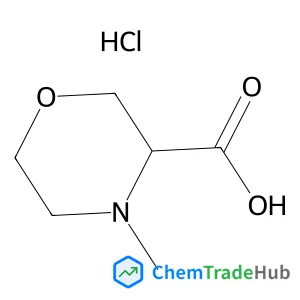
4-Methyl-3-morpholinecarboxylic acid hydrochloride (1:1)
CAS Number:
1240518-90-4
Molecular Formula:
C6H12ClNO3
László Hegedüs, Horst-Dieter Försterling, Enikö Kókai, Krisztina Pelle, Gabriella Taba, Mária Wittmann, Zoltán Noszticzius
High-pressure liquid chromatography (HPLC) and measurements of the CO2 produced were performed in the induction period of the classical Belousov–Zhabotinsky (BZ) reaction (malonic acid–bromate–cerium catalyst in sulfuric acid medium). It was found that oxalic acid is a flow-through intermediate of the reaction. This was confirmed with an independent qualitative test with thiobarbituric acid. The concentration of oxalic acid grows in the induction period together with that of bromomalonic acid and dibromomalonic acid intermediates. It is known that there are two negative feedback loops in the BZ reaction: one is ia bromide and the other ia organic free radicals. Oxalic acid and also CO2 are products of this second loop where organic radicals react with BrO2 radicals. The induction period was chosen for the present experimental studies because the above radical–radical reactions are most intense during that time. Based on the experimental results mechanistic proposals are made for the radical feedback loop. A method to accumulate multivalent organic acids present in very low concentrations in the BZ reaction was also developed. Applying this and a thermal decomposition method ethenetetracarboxylic acid (EETA) was identified as an oxidation product of ethanetetracarboxylic acid (ETA).
Hisham M. Dokainish, Bogdan F. Ion, James W. Gauld
DOI: 10.1039/C4CP01342E
Yasaman Ghadar, Aurora E. Clark
DOI: 10.1039/C4CP00602J
Ying Ma, Stephen H. Garofalini
DOI: 10.1039/C4CP00481G
Cheng Li, Dan Credgington, Doo-Hyun Ko, Zhuxia Rong, Jianpu Wang, Neil C. Greenham
DOI: 10.1039/C4CP01251H
Bryan T. Spann, S. Venkataprasad Bhat, Qiong Nian, Kelly M. Rickey, Gary J. Cheng, Xiulin Ruan, Xianfan Xu
DOI: 10.1039/C4CP01298D
X. F. Yang, Y. S. Liu, X. Zhang, L. P. Zhou, X. F. Wang, F. Chi, J. F. Feng
DOI: 10.1039/C4CP00390J
Michael Nolan
DOI: 10.1039/C4CP01309C
Bogdan I. Costescu
DOI: 10.1039/C3CP55341H
Yan Gao, Linlin Zhang, Xin Ding
DOI: 10.1039/C3CP55204G
Eric A. C. Bushnell, Thomas D. Burns, Russell J. Boyd
DOI: 10.1039/C4CP01105H
When handling 4-Methyl-6-(trifluoromethyl)quinoline (CAS: 40716-16-3), safety go...
4-(3,5-Difluorophenyl)aniline is an aromatic organic compound with the CAS numbe...
5-{[4-(Trifluoromethyl)phenyl]sulfanyl}-1,2,3-thiadiazole-4-carboxylic acid can ...
The market for 4-Benzylaniline hydrochloride (CAS: 6317-57-3) is steadily growin...
[3-(Diethylsulfamoyl)phenyl]boronic acid is generally considered safe when handl...
3-Bromo-2,5-dimethoxyaniline is mainly used in the pharmaceutical and chemical i...
N-Methyl-1-(5-methyl-1H-indol-3-yl)methanamine (CAS: 915922-67-7) is subject to ...
This compound is primarily used in the pharmaceutical industry for the synthesis...
2-Methyl-2-propanyl [(1S,3R)-3-aminocyclohexyl]carbamate (CAS: 1298101-47-9) sho...
Ethyl 2-bromo-4,4,4-trifluorobutanoate (CAS: 367-33-9) is utilized in the pharma...

Physical Chemistry Chemical Physics (PCCP) is an international journal co-owned by 19 physical chemistry and physics societies from around the world. This journal publishes original, cutting-edge research in physical chemistry, chemical physics and biophysical chemistry. To be suitable for publication in PCCP, articles must include significant innovation and/or insight into physical chemistry; this is the most important criterion that reviewers and Editors will judge against when evaluating submissions. The journal has a broad scope and welcomes contributions spanning experiment, theory, computation and data science. Topical coverage includes spectroscopy, dynamics, kinetics, statistical mechanics, thermodynamics, electrochemistry, catalysis, surface science, quantum mechanics, quantum computing and machine learning. Interdisciplinary research areas such as polymers and soft matter, materials, nanoscience, energy, surfaces/interfaces, and biophysical chemistry are welcomed if they demonstrate significant innovation and/or insight into physical chemistry. Joined experimental/theoretical studies are particularly appreciated when complementary and based on up-to-date approaches.