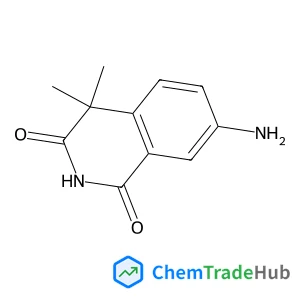
1,3(2H,4H)-Isoquinolinedione, 7-amino-4,4-dimethyl-
CAS Number:
14576-22-8
Molecular Formula:
C11H12N2O2
Heinz-Jürgen Benkelberg, Olaf Böge, Ralph Seuwen, Peter Warneck
Product distributions resulting from the OH-induced oxidation of but-1-ene, 2-methylbut-1-ene, 3-methylbut-1-ene and isoprene in air were measured in the absence of nitrogen oxides and compared with predictions based on currently accepted oxidation mechanisms. In the case of butenes, the observed distributions of carbonyl compounds, hydroxyketones, hydroxyalkanals and diols were evaluated to obtain probabilities for the initial attack of OH radical on the outer position of the double bond (γ = 0.90 ± 0.03 for 2-Me-but-1-ene and γ = 0.76 ± 0.05 for both but-1-ene and 3-Me-but-1-ene), for the probability of formation of stable products in the self-reaction of secondary β-hydroxyperoxyl radicals (kssb/kss = 0.29 ± 0.07 for but-1-ene and kssb/kss = 0.19 ± 0.06 for 3-Me-but-1-ene), and for the ratio of the reaction with oxygen s. decomposition of β-hydroxyalkoxyl radicals, k3[O2]/(k4 + k3[O2]) = 0.25 ± 0.04 for but-1-ene and = 0.38 ± 0.04 for 3-Me-but-1-ene. The last two values disagree with other published data, which suggest a smaller effect of oxygen. The oxidation of isoprene produced methacrolein and methyl vinyl ketone with a ratio 0.93 ± 0.10, the ratio of methyl vinyl ketone and 3-methylfuran was 7.3 ± 1.0. Other products were 1-hydroxy-3-methylbut-3-en-2-one (identified by mass spectrometry) and 3-methyl-3-oxo-butane (tentatively identified). The overall product distribution was complex and could not be fully elucidated. Computer simulations based on several mechanisms applied the relative probabilities for OH addition found for the but-1-enes. Comparison with the experimental data suggests probabilities for OH addition to the methylated double bond of 0.504 ± 0.027 (outer position) and 0.056 ± 0.003 (inner position), and to the non-methylated double bond of 0.335 ± 0.023 (outer position) and 0.105 ± 0.008 (inner position).
James R. Salvador, Jung Y. Cho, Zuxin Ye, Joshua E. Moczygemba, Alan J. Thompson, Jeffrey W. Sharp, Jan D. Koenig, Ryan Maloney, Travis Thompson, Jeffrey Sakamoto, Hsin Wang, Andrew A. Wereszczak
DOI: 10.1039/C4CP01582G
Isao Kagomiya, Keigo Jimbo, Ken-ichi Kakimoto, Masanobu Nakayama, Olivier Masson
DOI: 10.1039/C4CP00736K
Stefania Perticaroli, Marco Paolantoni, Paola Sassi, Silvia Corezzi, Assunta Morresi
DOI: 10.1039/C4CP00840E
Ron Simkovitch, Shay Shomer, Rinat Gepshtein, Dan Huppert, Mari Saif, Karen Kallio, S. James Remington
DOI: 10.1039/C4CP00311J
Frederico Alabarse, Claire Levelut, Aude Isambert, Philippe Hébert, Shinji Kohara, David Maurin, Jean-Louis Bantignies, Olivier Cambon, Gaëlle Creff, Pascale Roy, Jean-Blaise Brubach, Tahar Hammouda, Denis Andrault, Julien Haines
DOI: 10.1039/C4CP00186A
Ahmed E. Elwardany, Aamir Farooq
DOI: 10.1039/C4CP01253D
Michael Nolan
DOI: 10.1039/C4CP01309C
Seyed Hadi Zandavi, Charles A. Ward
DOI: 10.1039/C4CP00843J
Zhansheng Lu, Dongwei Ma, Lin Yang, Xiaobing Wang, Guoliang Xu, Zongxian Yang
DOI: 10.1039/C4CP00540F
Bryan T. Spann, S. Venkataprasad Bhat, Qiong Nian, Kelly M. Rickey, Gary J. Cheng, Xiulin Ruan, Xianfan Xu
DOI: 10.1039/C4CP01298D
When handling 4-Methyl-6-(trifluoromethyl)quinoline (CAS: 40716-16-3), safety go...
4-(3,5-Difluorophenyl)aniline is an aromatic organic compound with the CAS numbe...
5-{[4-(Trifluoromethyl)phenyl]sulfanyl}-1,2,3-thiadiazole-4-carboxylic acid can ...
The market for 4-Benzylaniline hydrochloride (CAS: 6317-57-3) is steadily growin...
[3-(Diethylsulfamoyl)phenyl]boronic acid is generally considered safe when handl...
3-Bromo-2,5-dimethoxyaniline is mainly used in the pharmaceutical and chemical i...
N-Methyl-1-(5-methyl-1H-indol-3-yl)methanamine (CAS: 915922-67-7) is subject to ...
This compound is primarily used in the pharmaceutical industry for the synthesis...
2-Methyl-2-propanyl [(1S,3R)-3-aminocyclohexyl]carbamate (CAS: 1298101-47-9) sho...
Ethyl 2-bromo-4,4,4-trifluorobutanoate (CAS: 367-33-9) is utilized in the pharma...

Physical Chemistry Chemical Physics (PCCP) is an international journal co-owned by 19 physical chemistry and physics societies from around the world. This journal publishes original, cutting-edge research in physical chemistry, chemical physics and biophysical chemistry. To be suitable for publication in PCCP, articles must include significant innovation and/or insight into physical chemistry; this is the most important criterion that reviewers and Editors will judge against when evaluating submissions. The journal has a broad scope and welcomes contributions spanning experiment, theory, computation and data science. Topical coverage includes spectroscopy, dynamics, kinetics, statistical mechanics, thermodynamics, electrochemistry, catalysis, surface science, quantum mechanics, quantum computing and machine learning. Interdisciplinary research areas such as polymers and soft matter, materials, nanoscience, energy, surfaces/interfaces, and biophysical chemistry are welcomed if they demonstrate significant innovation and/or insight into physical chemistry. Joined experimental/theoretical studies are particularly appreciated when complementary and based on up-to-date approaches.
![[(1S,2S,3R,4S,7R,9S,10S,12R,15S)-4,12-Diacetyloxy-15-[(2R,3S)-3-benzamido-3-phenyl-2-(2,2,2-trichloroethoxycarbonyloxy)propanoyl]oxy-1,9-dihydroxy-10,14,17,17-tetramethyl-11-oxo-6-oxatetracyclo[11.3.1.03,10.04,7]heptadec-13-en-2-yl] benzoate structure](https://static.chemtradehub.com/structs/100/100431-55-8-7104.webp "[(1S,2S,3R,4S,7R,9S,10S,12R,15S)-4,12-Diacetyloxy-15-[(2R,3S)-3-benzamido-3-phenyl-2-(2,2,2-trichloroethoxycarbonyloxy)propanoyl]oxy-1,9-dihydroxy-10,14,17,17-tetramethyl-11-oxo-6-oxatetracyclo[11.3.1.03,10.04,7]heptadec-13-en-2-yl] benzoate structure")